01 · The idea
In everyday language
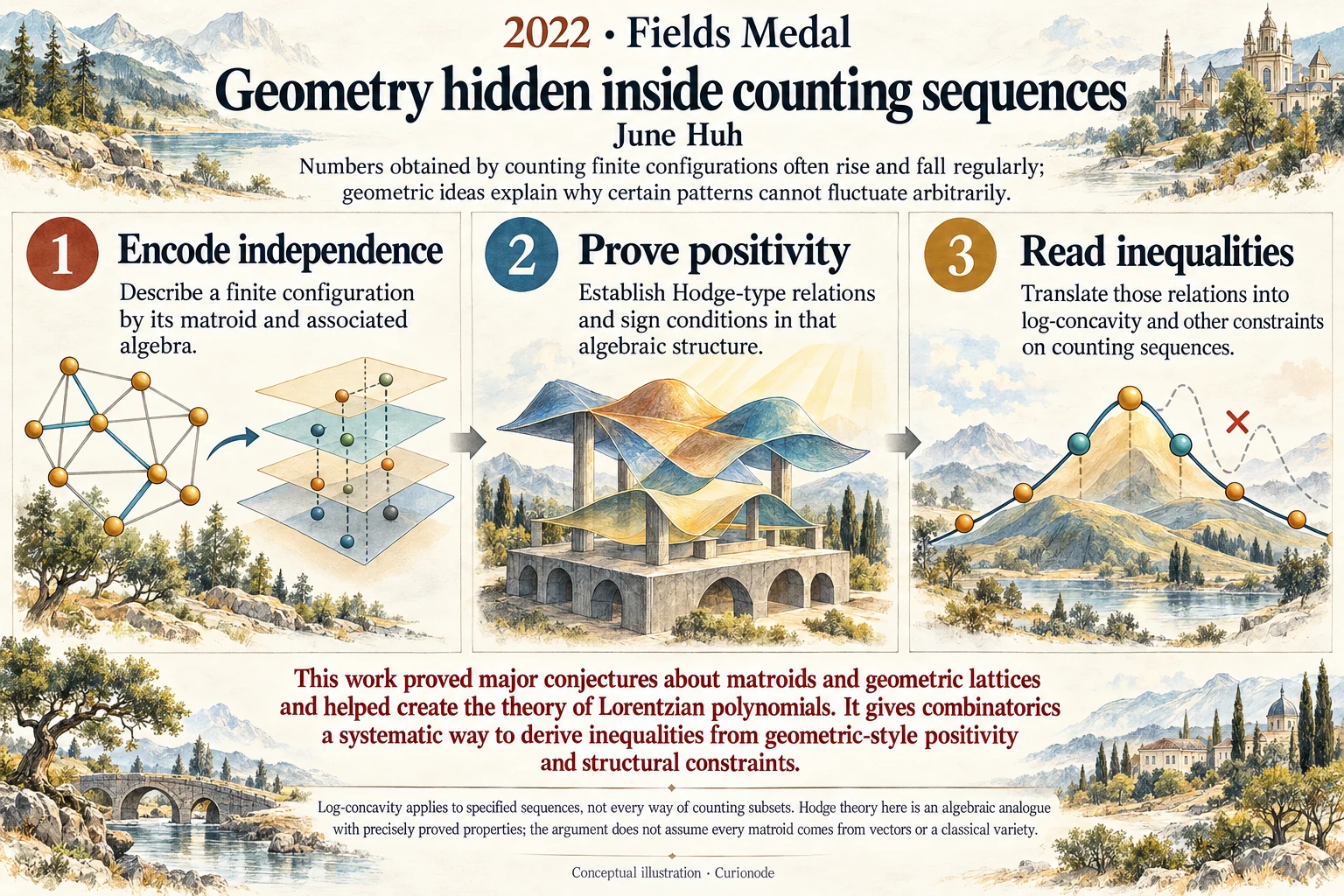
A matroid records which subsets of a finite collection are independent, generalizing both independent vectors and cycle-free edge sets of a graph. Many natural counting sequences associated with matroids were conjectured to be log-concave: each middle term squared is at least the product of its neighbors. Huh and his collaborators built an analogue of Hodge theory for these combinatorial objects, even when no ordinary algebraic variety realizes them. Positivity and duality in the resulting algebra translate into inequalities for counting coefficients. The approach explains why a finite enumeration problem can have a hidden geometric organization rather than a merely accidental numerical pattern.
Why it matters
This work proved major conjectures about matroids and geometric lattices and helped create the theory of Lorentzian polynomials. It gives combinatorics a systematic way to derive inequalities from geometric-style positivity and structural constraints.