c.curionodeThe Fields Archive

The Fields Archive

The prizes, pictured

Sixty-eight stories, drawn into focus.

Hover over a chart to read its description. Open the full-size guide to look closer.

Showing 12 of 68

Newest first · scroll to explore
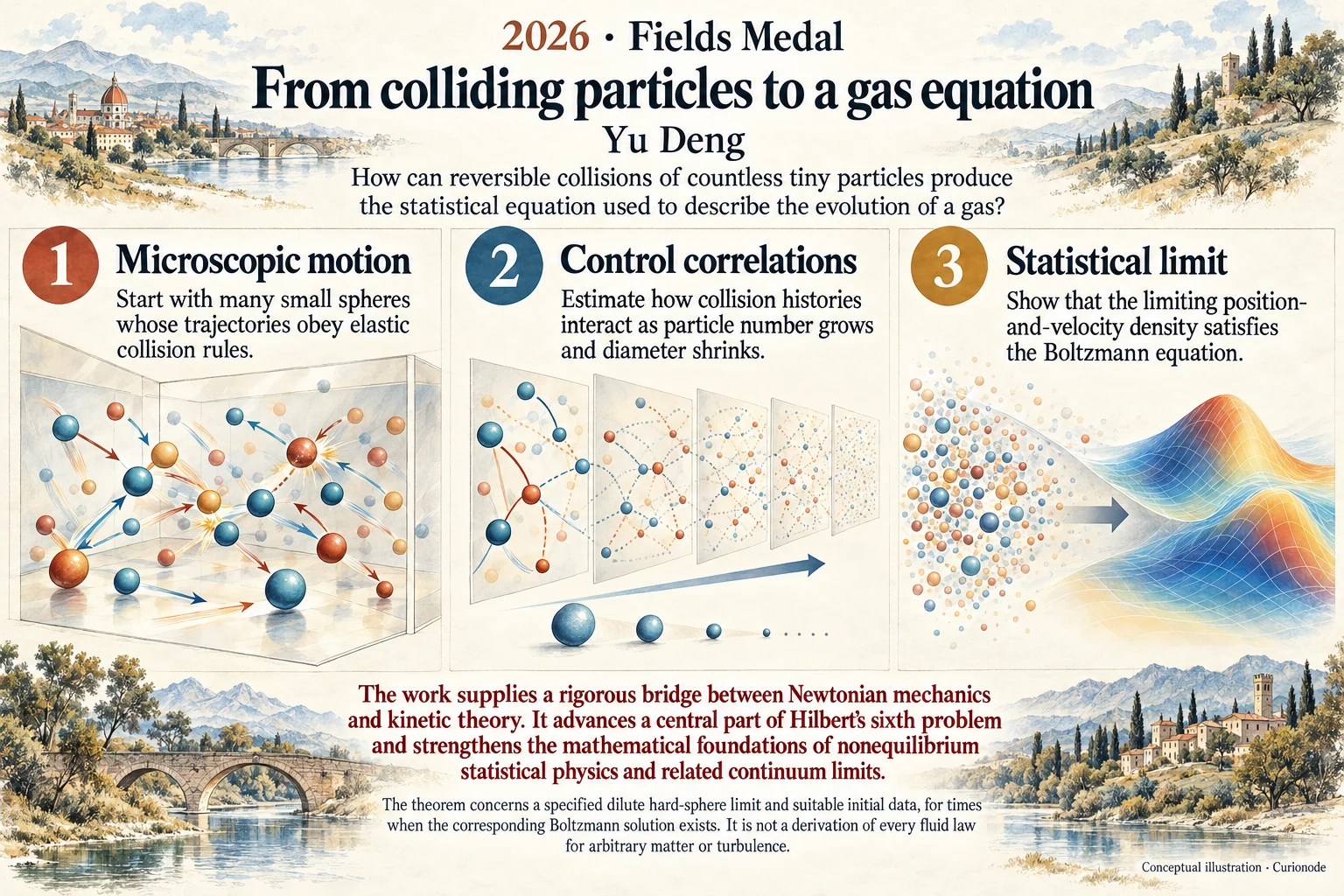
From colliding particles to a gas equation
Description

How can reversible collisions of countless tiny particles produce the statistical equation used to describe the evolution of a gas?

The work supplies a rigorous bridge between Newtonian mechanics and kinetic theory. It advances a central part of Hilbert’s sixth problem and strengthens the mathematical foundations of nonequilibrium statistical physics and related continuum limits.
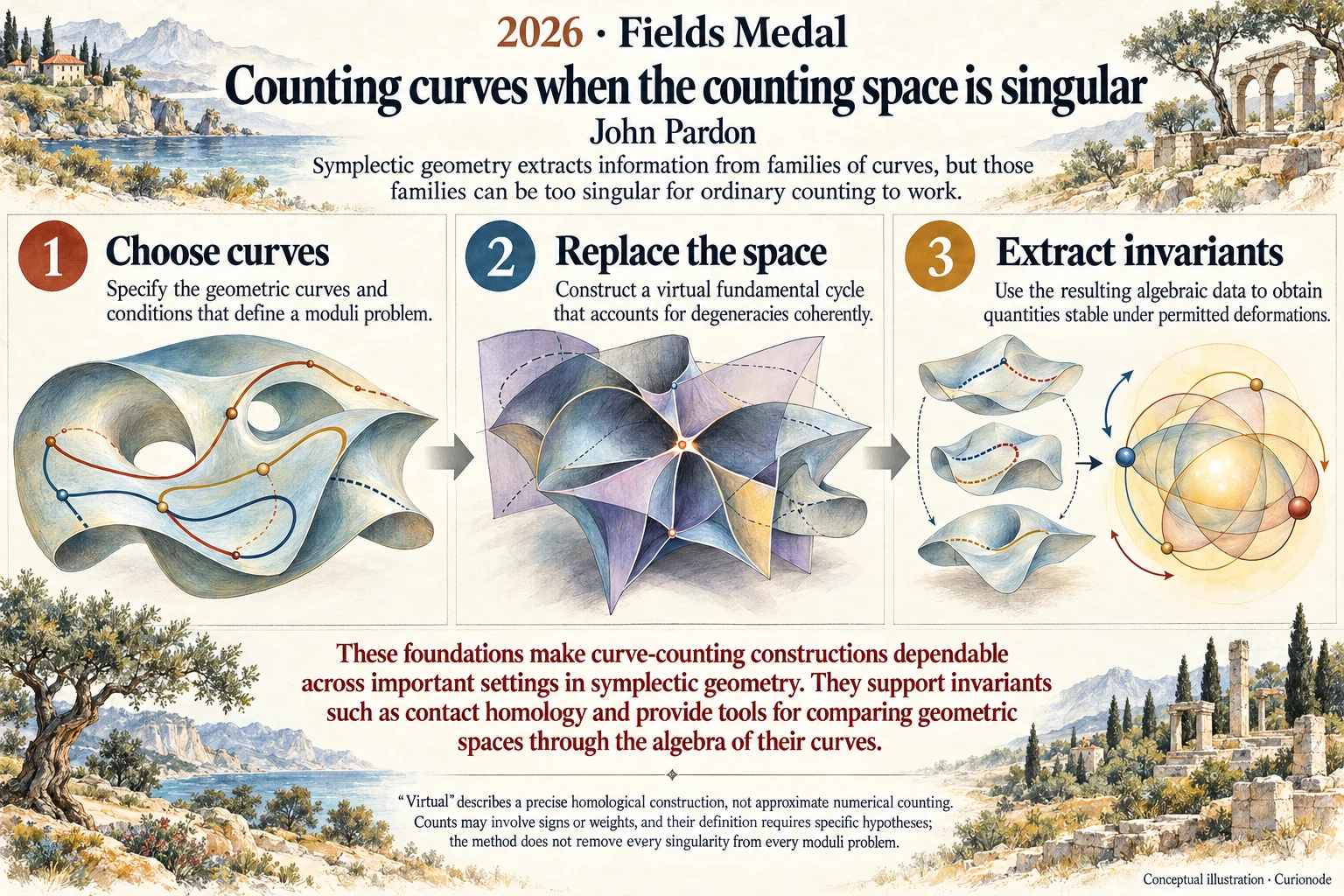
Counting curves when the counting space is singular
Description

Symplectic geometry extracts information from families of curves, but those families can be too singular for ordinary counting to work.

These foundations make curve-counting constructions dependable across important settings in symplectic geometry. They support invariants such as contact homology and provide tools for comparing geometric spaces through the algebra of their curves.

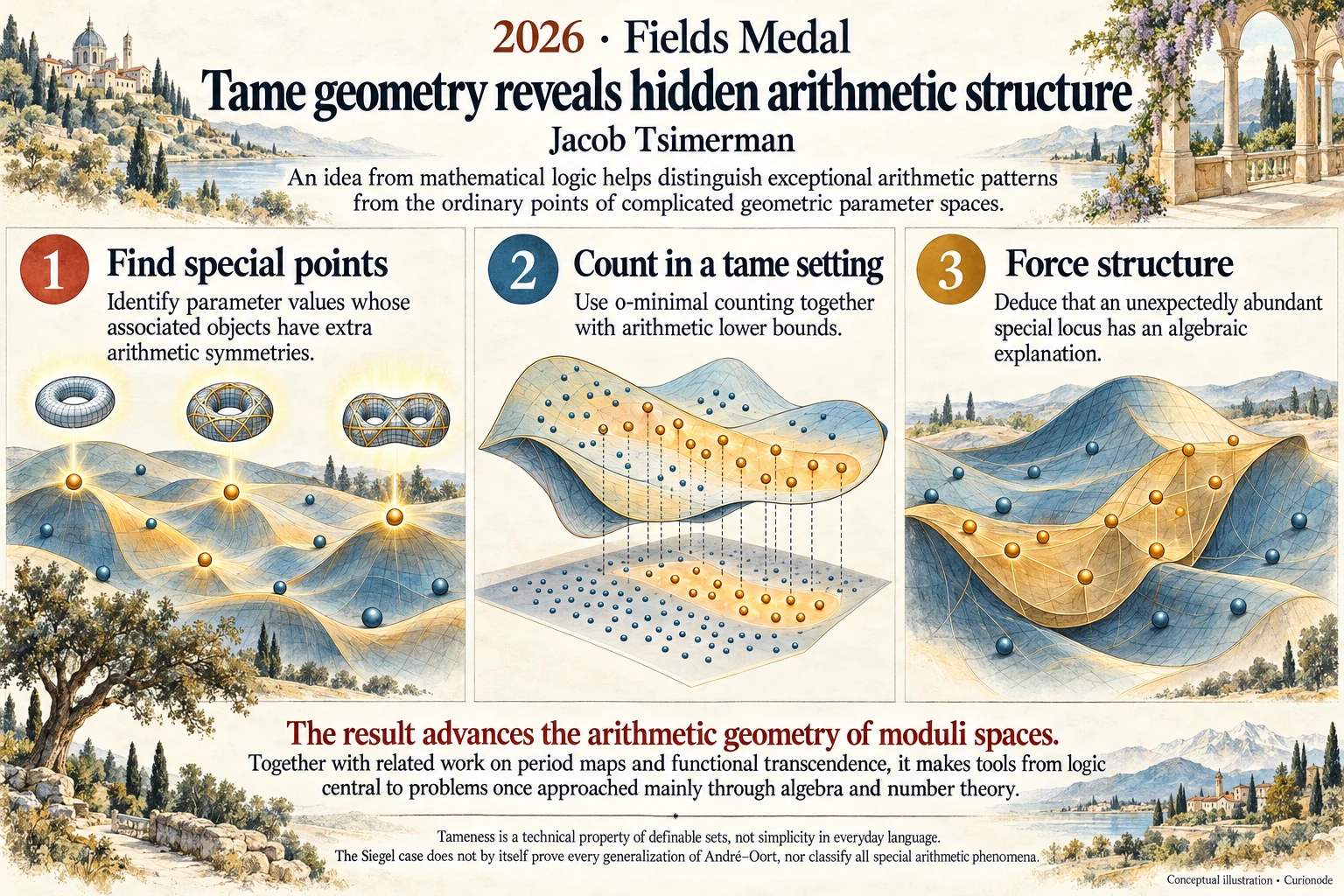
Tame geometry reveals hidden arithmetic structure
Description

An idea from mathematical logic helps distinguish exceptional arithmetic patterns from the ordinary points of complicated geometric parameter spaces.

The result advances the arithmetic geometry of moduli spaces. Together with related work on period maps and functional transcendence, it makes tools from logic central to problems once approached mainly through algebra and number theory.

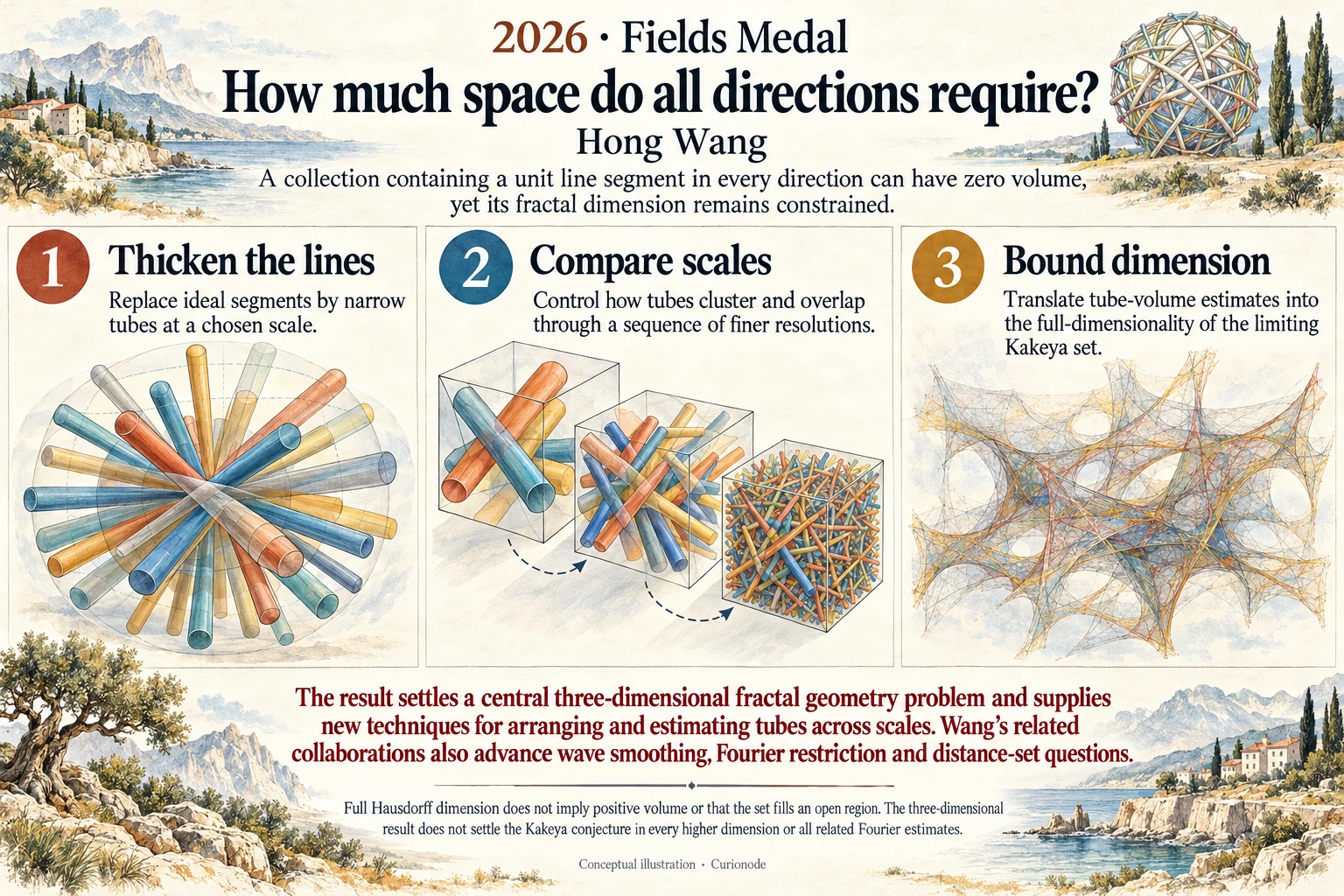
How much space do all directions require?
Description

A collection containing a unit line segment in every direction can have zero volume, yet its fractal dimension remains constrained.

The result settles a central three-dimensional fractal geometry problem and supplies new techniques for arranging and estimating tubes across scales. Wang’s related collaborations also advance wave smoothing, Fourier restriction and distance-set questions.

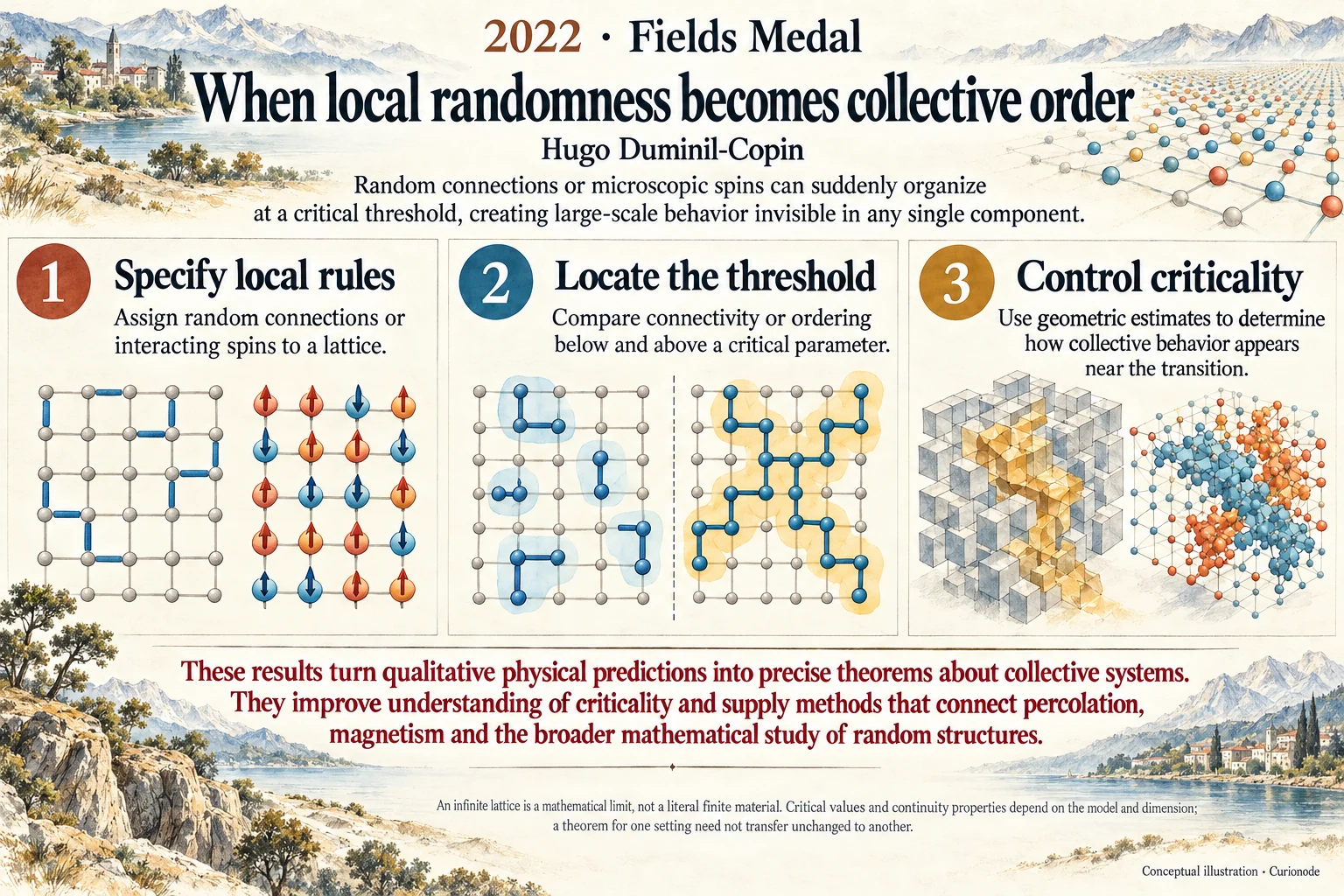
When local randomness becomes collective order
Description

Random connections or microscopic spins can suddenly organize at a critical threshold, creating large-scale behavior invisible in any single component.

These results turn qualitative physical predictions into precise theorems about collective systems. They improve understanding of criticality and supply methods that connect percolation, magnetism and the broader mathematical study of random structures.

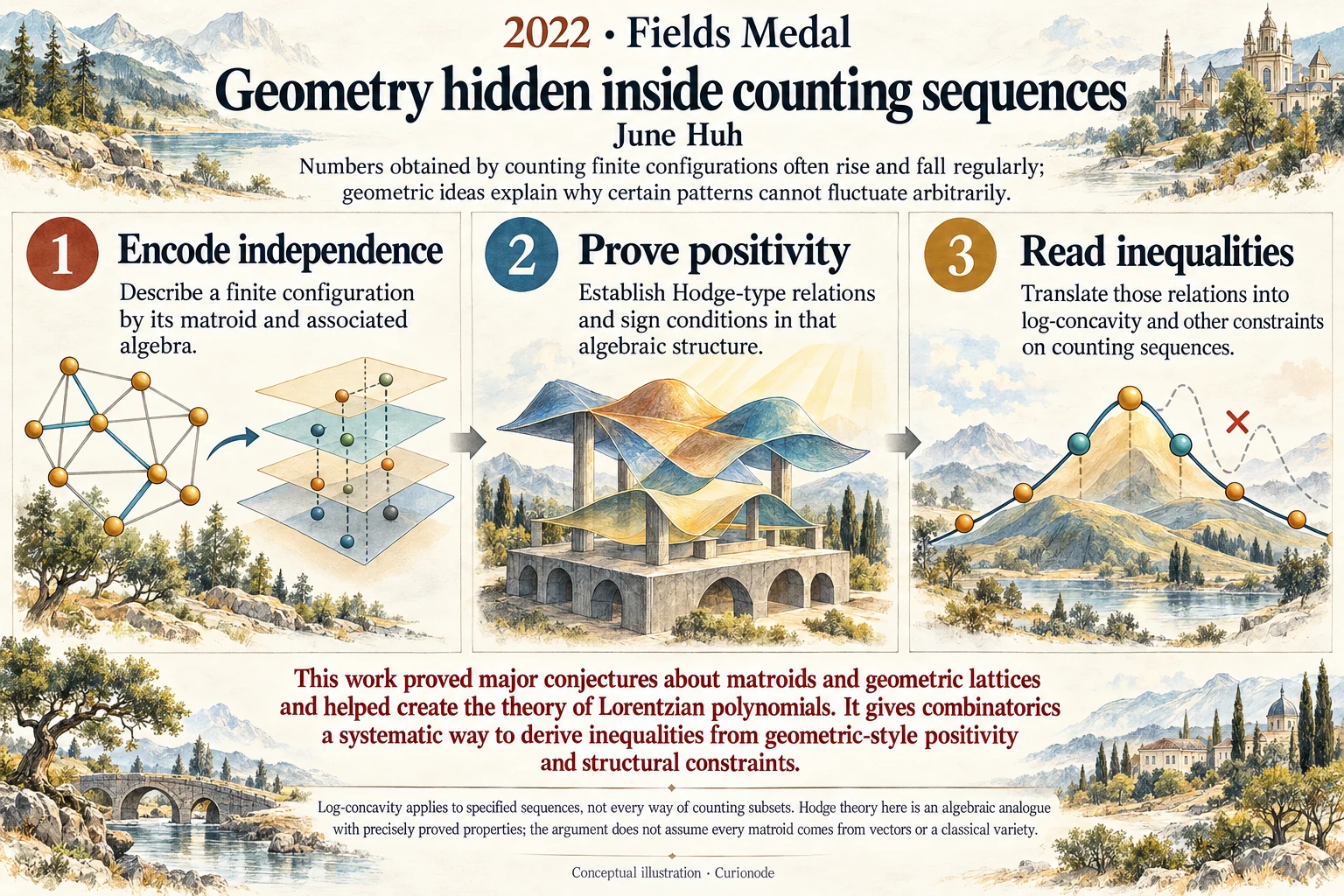
Geometry hidden inside counting sequences
Description

Numbers obtained by counting finite configurations often rise and fall regularly; geometric ideas explain why certain patterns cannot fluctuate arbitrarily.

This work proved major conjectures about matroids and geometric lattices and helped create the theory of Lorentzian polynomials. It gives combinatorics a systematic way to derive inequalities from geometric-style positivity and structural constraints.

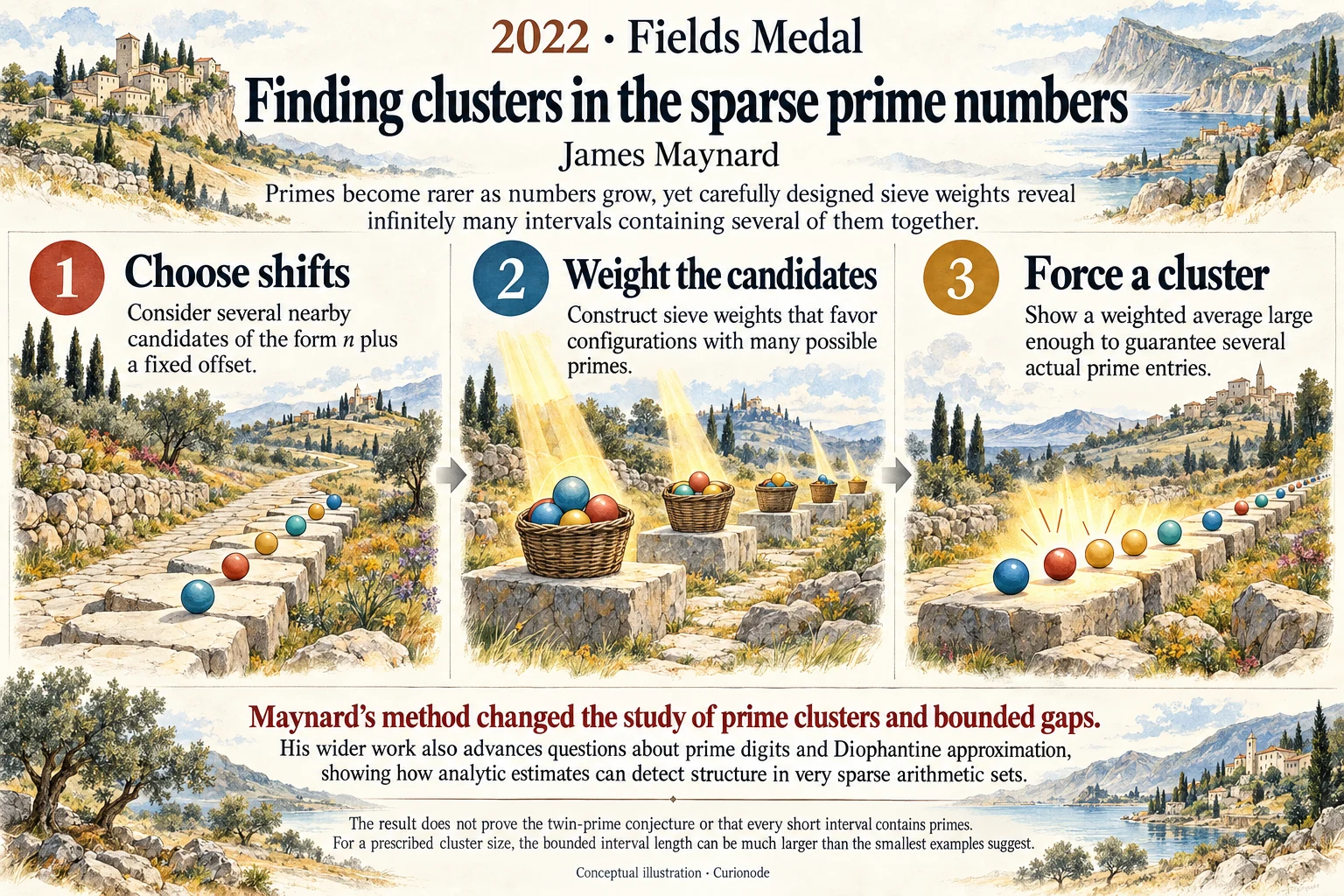
Finding clusters in the sparse prime numbers
Description

Primes become rarer as numbers grow, yet carefully designed sieve weights reveal infinitely many intervals containing several of them together.

Maynard’s method changed the study of prime clusters and bounded gaps. His wider work also advances questions about prime digits and Diophantine approximation, showing how analytic estimates can detect structure in very sparse arithmetic sets.

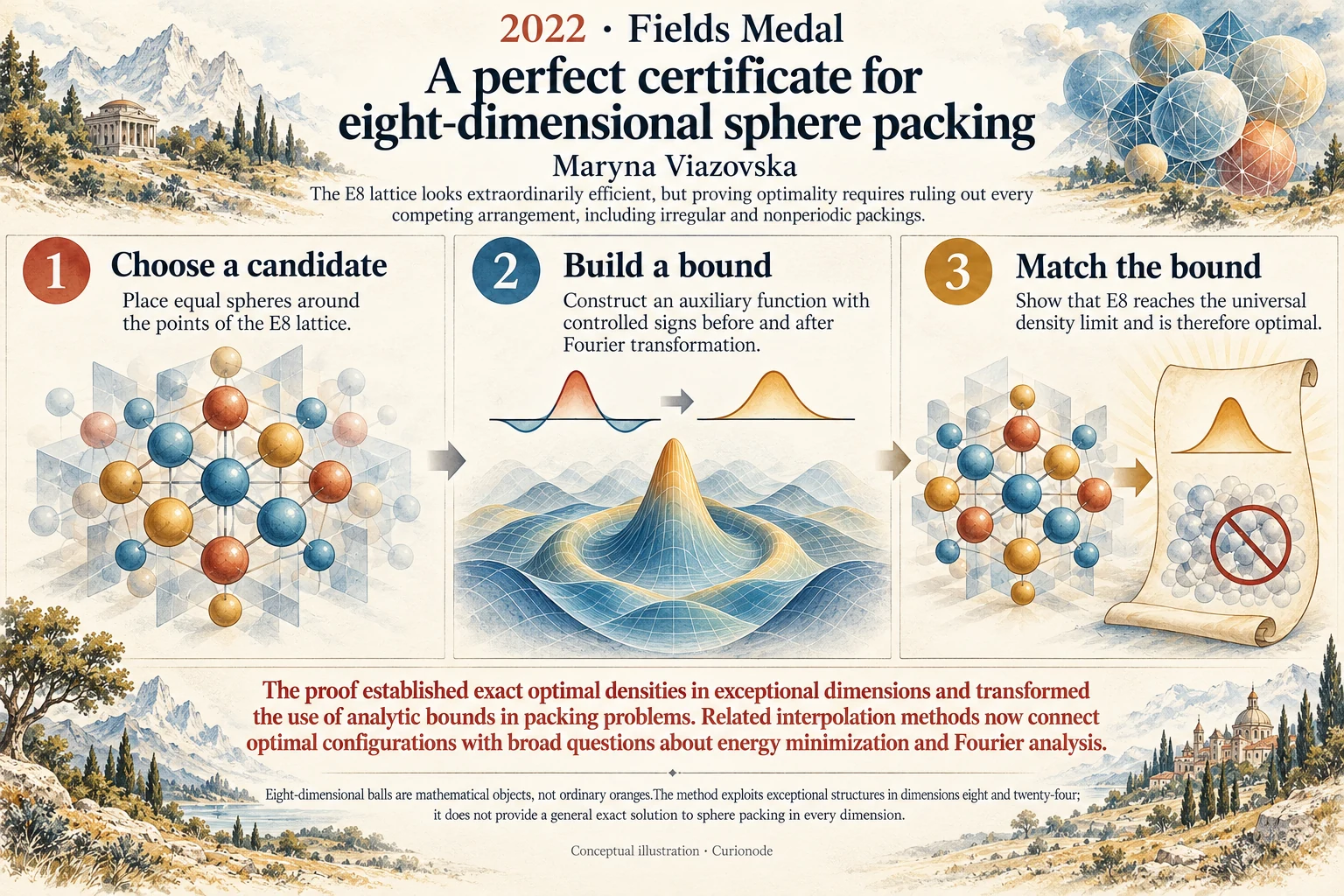
A perfect certificate for eight-dimensional sphere packing
Description

The E8 lattice looks extraordinarily efficient, but proving optimality requires ruling out every competing arrangement, including irregular and nonperiodic packings.

The proof established exact optimal densities in exceptional dimensions and transformed the use of analytic bounds in packing problems. Related interpolation methods now connect optimal configurations with broad questions about energy minimization and Fourier analysis.

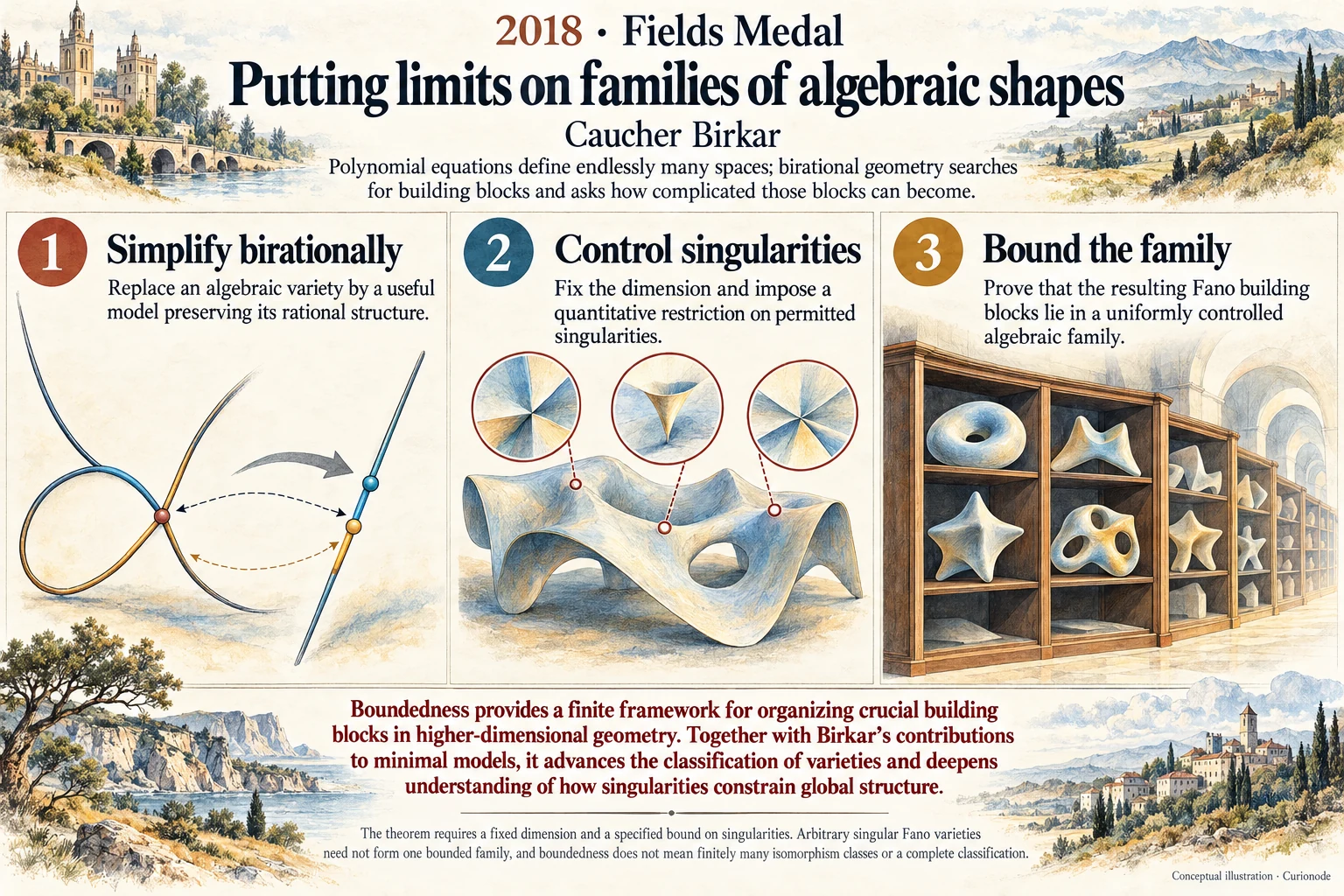
Putting limits on families of algebraic shapes
Description

Polynomial equations define endlessly many spaces; birational geometry searches for building blocks and asks how complicated those blocks can become.

Boundedness provides a finite framework for organizing crucial building blocks in higher-dimensional geometry. Together with Birkar’s contributions to minimal models, it advances the classification of varieties and deepens understanding of how singularities constrain global structure.

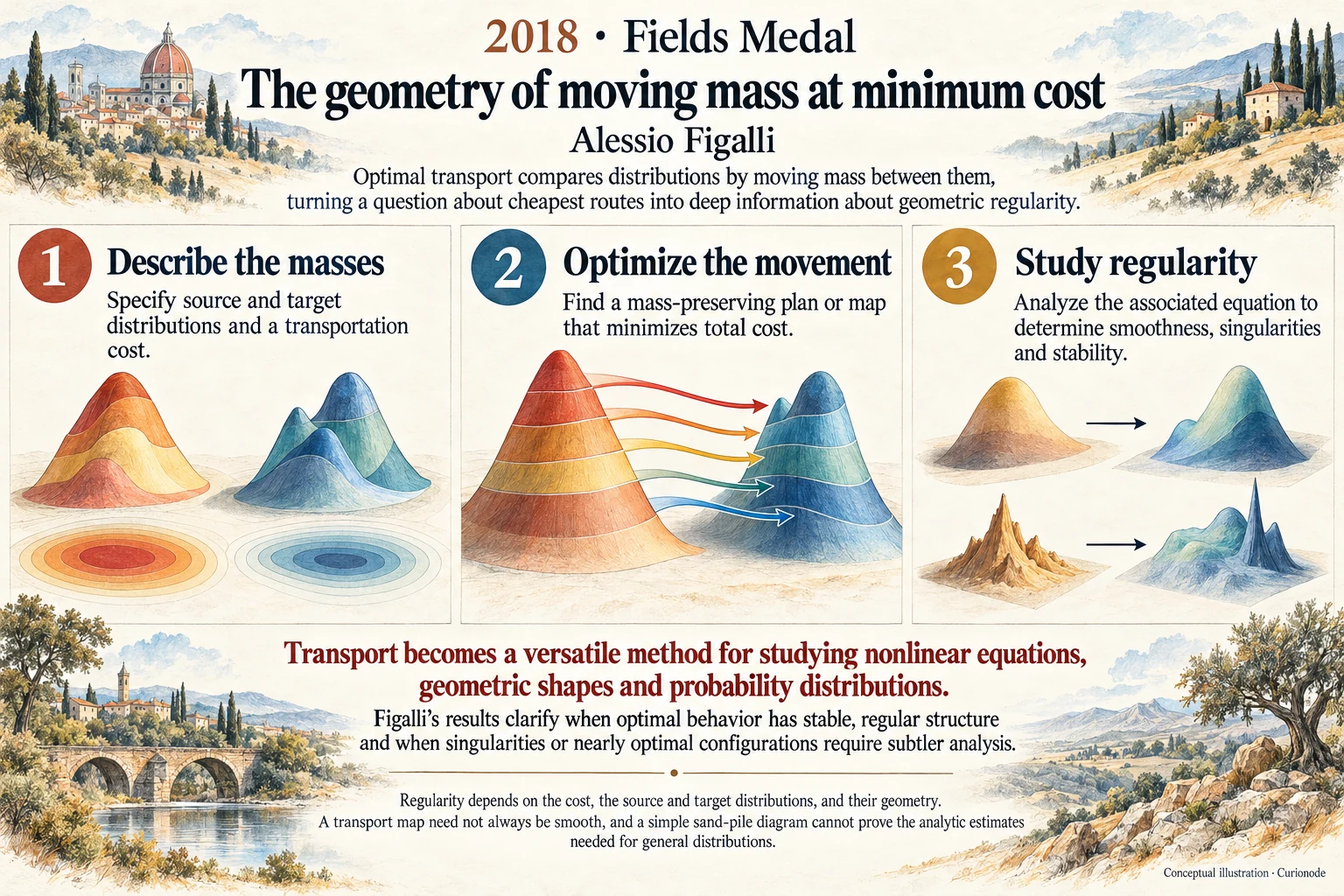
The geometry of moving mass at minimum cost
Description

Optimal transport compares distributions by moving mass between them, turning a question about cheapest routes into deep information about geometric regularity.

Transport becomes a versatile method for studying nonlinear equations, geometric shapes and probability distributions. Figalli’s results clarify when optimal behavior has stable, regular structure and when singularities or nearly optimal configurations require subtler analysis.

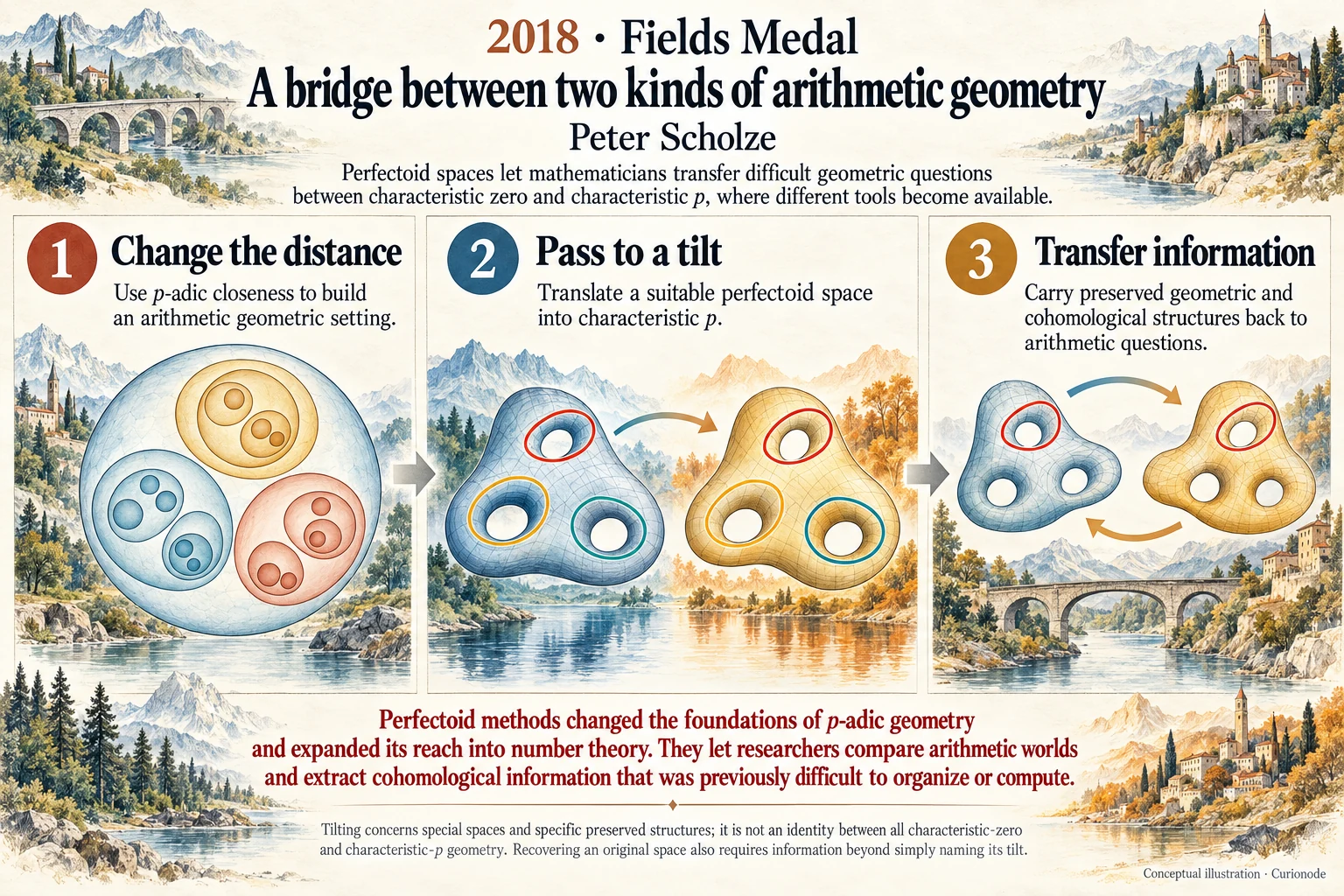
A bridge between two kinds of arithmetic geometry
Description

Perfectoid spaces let mathematicians transfer difficult geometric questions between characteristic zero and characteristic p, where different tools become available.

Perfectoid methods changed the foundations of p-adic geometry and expanded its reach into number theory. They let researchers compare arithmetic worlds and extract cohomological information that was previously difficult to organize or compute.

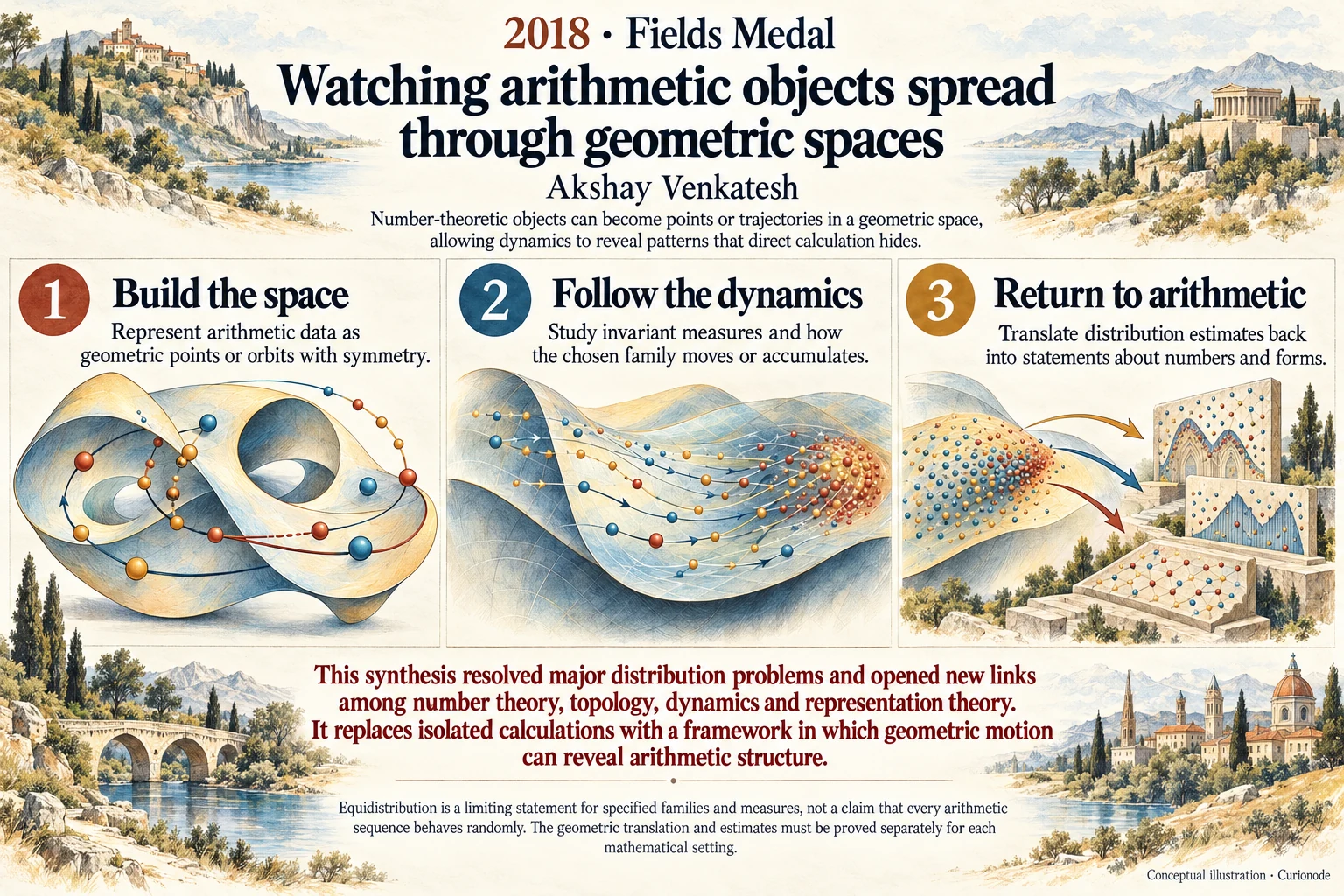
Watching arithmetic objects spread through geometric spaces
Description

Number-theoretic objects can become points or trajectories in a geometric space, allowing dynamics to reveal patterns that direct calculation hides.

This synthesis resolved major distribution problems and opened new links among number theory, topology, dynamics and representation theory. It replaces isolated calculations with a framework in which geometric motion can reveal arithmetic structure.

More entries load as you scroll.