 2026 · Analysis & PDEs
Hong Wang
A collection containing a unit line segment in every direction can have zero volume, yet its fractal dimension remains constrained.
Read the biography ↗The Fields Archive
Sixty-eight people. A world of ideas.
Discover the mathematicians behind a century of new perspectives.
Showing 18 of 68
Newest first · scroll to explore2026 · Analysis & PDEsA collection containing a unit line segment in every direction can have zero volume, yet its fractal dimension remains constrained.
Read the biography ↗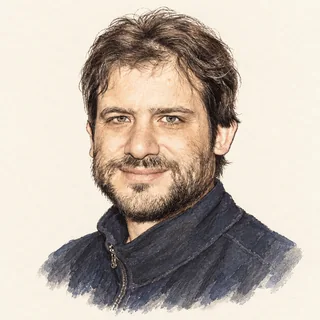 2026 · Number theory
An idea from mathematical logic helps distinguish exceptional arithmetic patterns from the ordinary points of complicated geometric parameter spaces.
Read the biography ↗ 2026 · Geometry & topology
Symplectic geometry extracts information from families of curves, but those families can be too singular for ordinary counting to work.
Read the biography ↗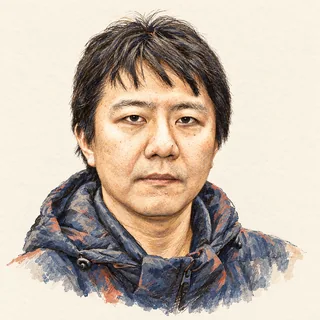 2026 · Analysis & PDEs
How can reversible collisions of countless tiny particles produce the statistical equation used to describe the evolution of a gas?
Read the biography ↗ 2022 · Probability & dynamics
Random connections or microscopic spins can suddenly organize at a critical threshold, creating large-scale behavior invisible in any single component.
Read the biography ↗ 2022 · Number theory
Primes become rarer as numbers grow, yet carefully designed sieve weights reveal infinitely many intervals containing several of them together.
Read the biography ↗ 2022 · Combinatorics
Numbers obtained by counting finite configurations often rise and fall regularly; geometric ideas explain why certain patterns cannot fluctuate arbitrarily.
Read the biography ↗ 2022 · Geometry & topology
The E8 lattice looks extraordinarily efficient, but proving optimality requires ruling out every competing arrangement, including irregular and nonperiodic packings.
Read the biography ↗ 2018 · Number theory
Number-theoretic objects can become points or trajectories in a geometric space, allowing dynamics to reveal patterns that direct calculation hides.
Read the biography ↗ 2018 · Analysis & PDEs
Optimal transport compares distributions by moving mass between them, turning a question about cheapest routes into deep information about geometric regularity.
Read the biography ↗ 2018 · Algebraic geometry
Polynomial equations define endlessly many spaces; birational geometry searches for building blocks and asks how complicated those blocks can become.
Read the biography ↗ 2018 · Algebraic geometry
Perfectoid spaces let mathematicians transfer difficult geometric questions between characteristic zero and characteristic p, where different tools become available.
Read the biography ↗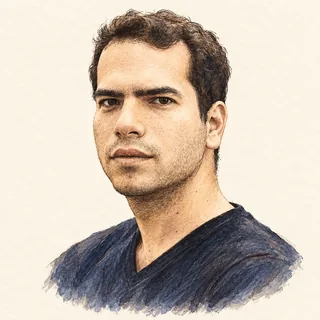 2014 · Probability & dynamics
A simple repeated rule can produce stability or chaos; renormalization compares its behavior at different scales to uncover the deeper organization.
Read the biography ↗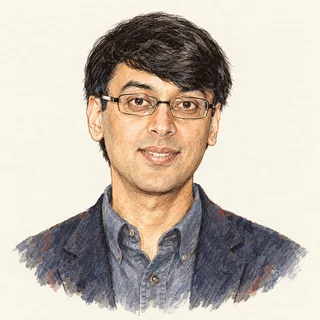 2014 · Number theory
Integer equations can look unrelated one by one; organizing them as geometric objects makes it possible to study their average behavior.
Read the biography ↗ 2014 · Analysis & PDEs
Some random-growth equations contain products too irregular for ordinary calculus; regularity structures provide a precise language for making them meaningful.
Read the biography ↗ 2014 · Geometry & topology
A curved surface contains infinitely many closed geodesics; understanding the family of all surface geometries reveals a surprising law for simple loops.
Read the biography ↗ 2010 · Analysis & PDEs
Particles need not stop moving for a collective electric field to fade; phase mixing can produce damping without ordinary friction.
Read the biography ↗ 2010 · Probability & dynamics
An orbit may look unpredictable, yet several compatible symmetries can sharply limit its possible statistical behavior and constrain arithmetic patterns.
Read the biography ↗Try a different name, year range or subject.
More entries load as you scroll.