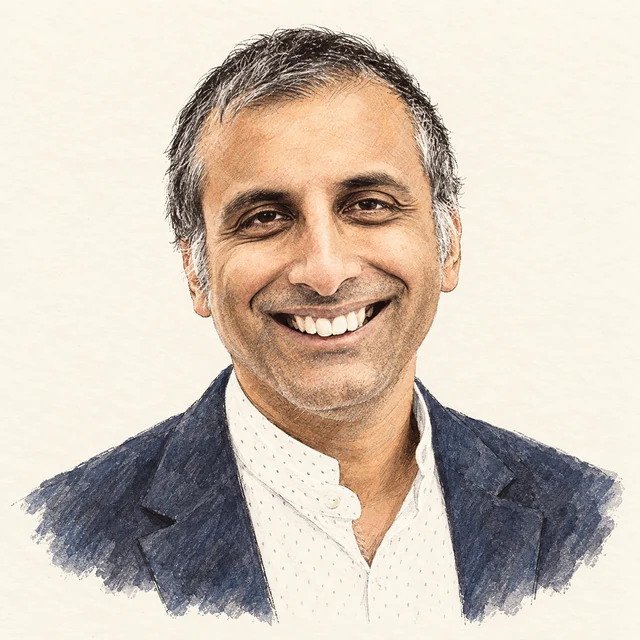
01 · A life in mathematics
The person behind the work
Akshay Venkatesh was born in New Delhi and grew up in Perth, Australia. He studied at the University of Western Australia and completed his doctorate at Princeton. He was a Stanford professor when the Fields Medal was awarded on 1 August 2018, before moving to the Institute for Advanced Study later that month. His research combines analytic number theory, homogeneous dynamics, topology and representation theory. By viewing arithmetic objects as points and trajectories in geometric spaces, he proved new distribution results and developed methods that cross traditional boundaries. His achievement illustrates how several mathematical viewpoints can illuminate the same difficult question.
The contribution, explained
Some arithmetic questions ask how special points are distributed as their defining numbers become larger. Do the points spread evenly, or concentrate in a small region? Venkatesh combined number theory with dynamics on homogeneous spaces, spaces built from groups and their symmetries. In this setting, arithmetic objects can be studied through the motion and distribution of geometric orbits. His work with collaborators developed methods to establish equidistribution and solve difficult problems involving periods and automorphic forms. The power comes from combining viewpoints: analytic bounds measure errors, dynamics controls limiting distributions, and algebra explains which symmetries and constraints must be preserved.
Why it matters
This synthesis resolved major distribution problems and opened new links among number theory, topology, dynamics and representation theory. It replaces isolated calculations with a framework in which geometric motion can reveal arithmetic structure.