01 · A life in mathematics
The person behind the work
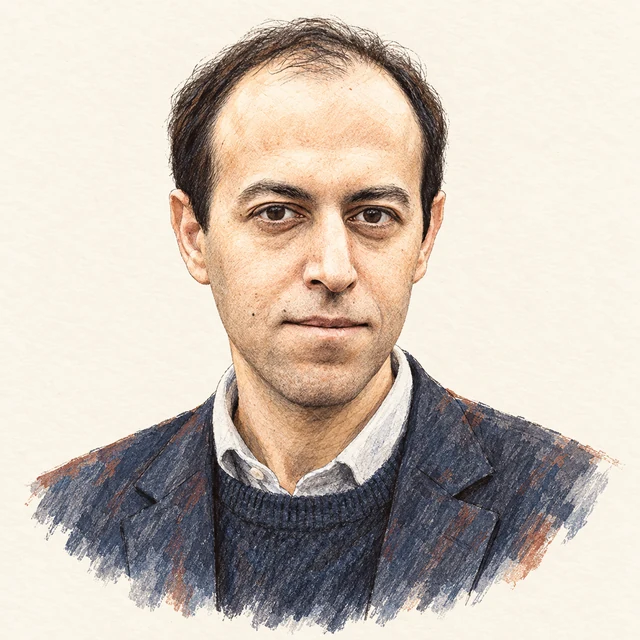
Caucher Birkar was born in the Kurdish region around Marivan, Iran. He studied in Tehran, later obtained asylum in Britain, and completed his doctorate at Nottingham. At the 2018 Fields Medal he was a professor at Cambridge. His research concerns birational geometry: classifying algebraic varieties while allowing transformations that preserve their rational structure. He contributed to the minimal model program and proved boundedness results for Fano varieties with controlled singularities. These theorems impose finite organizational limits on families of spaces that initially appear unlimited, supplying essential building blocks for the classification of higher-dimensional algebraic geometry.
The contribution, explained
A polynomial equation can describe a curve, a surface or a space of many dimensions. Birational geometry regards two such spaces as closely related if rational transformations identify large open parts of them. The minimal model program seeks useful representatives and fundamental building blocks under this relation. Birkar proved a central boundedness theorem for Fano varieties with controlled singularities: once dimension and a quantitative singularity restriction are fixed, these spaces fit into bounded algebraic families. Bounded does not mean that only finitely many individual shapes exist. It means their defining complexity can be controlled uniformly, making a vast classification problem more manageable.
Why it matters
Boundedness provides a finite framework for organizing crucial building blocks in higher-dimensional geometry. Together with Birkar’s contributions to minimal models, it advances the classification of varieties and deepens understanding of how singularities constrain global structure.