01 · A life in mathematics
The person behind the work
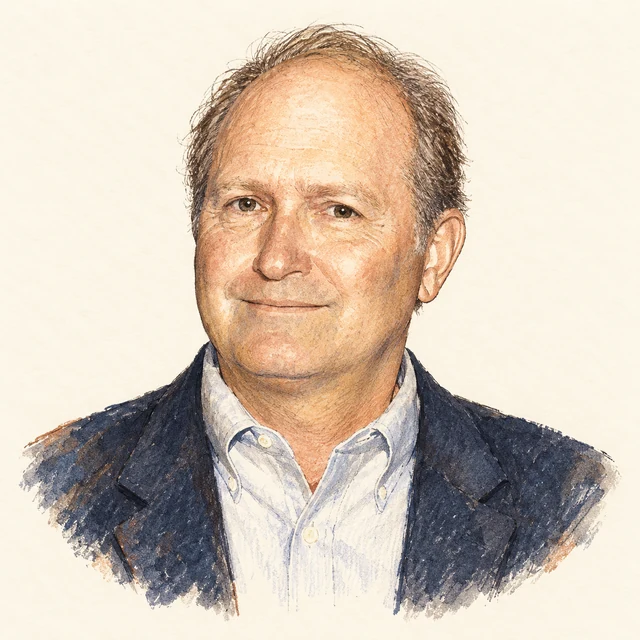
Curtis McMullen was born in Berkeley, California, and was affiliated with Harvard when he received the 1998 Fields Medal. His research joined complex dynamics with hyperbolic geometry and the study of three-dimensional manifolds. He investigated what repeated application of a complex function can reveal about stability, rigidity and self-similarity, and developed deep connections with spaces of geometric structures. His medal also recognised advances in geometrisation, including work on cusp density and theta functions. Across these subjects, he used the geometry of parameter spaces to distinguish flexible behaviour from rigid patterns. His work makes the shapes of dynamical systems part of the explanation rather than merely an illustration.
The contribution, explained
Take a complex number and repeatedly apply a function such as a polynomial. Nearby starting points may remain close, escape or develop radically different futures. The resulting dynamical picture depends on the function’s parameters. McMullen used complex analysis, geometry and renormalisation to investigate these behaviours and their rigidity. Renormalisation isolates a smaller dynamical system and compares it with the original at a new scale; geometric control makes this comparison more than a visual analogy. His broader programme connects these questions with hyperbolic three-manifolds, revealing shared structures across subjects that at first seem unrelated.
Why it matters
The work strengthened links between complex dynamics and low-dimensional geometry, giving rigorous ways to study self-similarity, parameter spaces and the rigidity of intricate dynamical patterns.