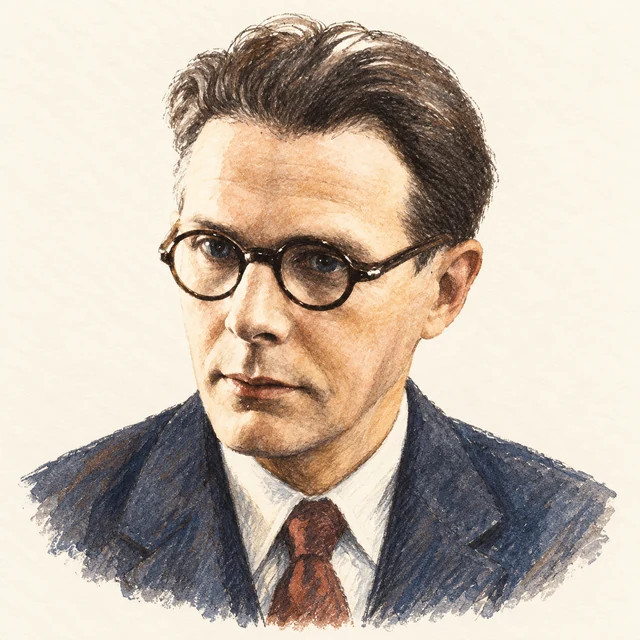
01 · A life in mathematics
The person behind the work
Born in Helsinki in 1907, Lars Ahlfors made complex analysis into a meeting place for formulas and geometry. His research examined how complex functions cover their possible values and how the resulting surfaces fit together. The inaugural Fields Medal in 1936 recognised his work on covering surfaces. He was then teaching at Harvard, having arrived in 1935 on leave from Helsinki. His later investigations of quasiconformal mappings and Riemann surfaces shaped a broad research community, while his textbooks gave generations of students a geometric way to understand complex functions.
The contribution, explained
Solving an equation backwards need not produce a single answer. The complex exponential, for example, has infinitely many inverse values related by vertical shifts. A Riemann surface organises inverse branches so that moving through one sheet can continue a value consistently. Ahlfors studied covering surfaces associated with entire and meromorphic functions, linking their geometric size and arrangement to the values those functions take. Instead of inspecting isolated formulas, one studies the surface carrying all the continuations. This made global geometric reasoning a powerful tool in complex analysis.
Why it matters
Covering-surface methods connected the growth and value distribution of complex functions with geometry, helping establish a lasting geometric approach to analysis.