01 · A life in mathematics
The person behind the work
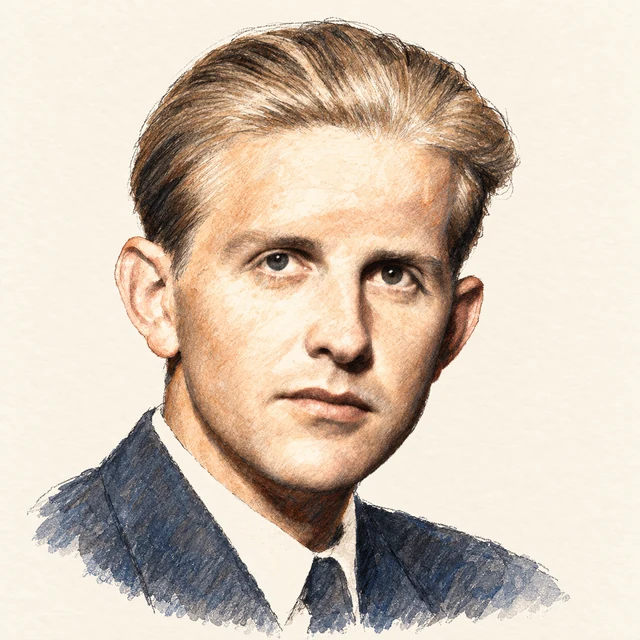
Lars Hörmander was born in Mjällby, Sweden, in 1931. He received the 1962 Fields Medal while at Stockholm University for his work on partial differential equations, especially the general theory of linear differential operators. He sought principles that explained which equations admit solutions and what regularity those solutions possess. His research and extensive treatises brought Fourier-based methods and operator analysis into a coherent framework. Later developments associated with microlocal analysis made the direction as well as the location of a singularity central to understanding how equations transmit information.
The contribution, explained
A differential equation describes an unknown function through its derivatives. Rather than attack each equation separately, Hörmander studied the operators that assemble those derivatives. Fourier analysis translates differentiation into frequency-dependent multiplication, exposing a principal symbol that reflects the operator’s leading behaviour. The symbol and suitable estimates help distinguish favourable equations from ones with obstructions to solvability or regularity. This perspective connects local algebraic information in the operator with the analytic behaviour of solutions, providing a systematic language for many different partial differential equations.
Why it matters
General operator theory and the methods it supported transformed the study of solvability, regularity and singularities, becoming standard tools across modern analysis and mathematical physics.