01 · A life in mathematics
The person behind the work
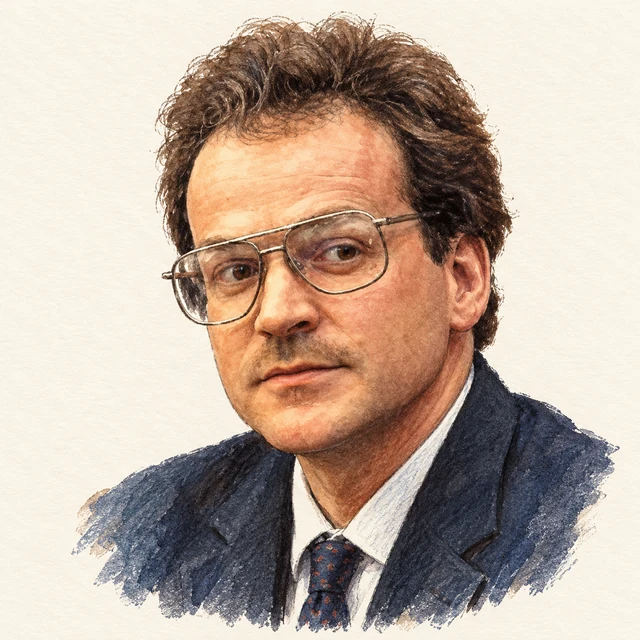
Laurent Lafforgue was born in Antony, France, and was a permanent professor at IHES when he received the 2002 Fields Medal. His central achievement established the Langlands correspondence for general linear groups over global function fields. It connected arithmetic symmetries with automorphic representations through the geometry of objects called shtukas. Building on Drinfeld’s rank-two work, Lafforgue proved the correspondence in arbitrary rank. His research shows how geometric constructions can resolve problems that initially look like questions about numbers or harmonic analysis. The award recognised this deep bridge, rather than a solution of the entire Langlands programme over every kind of field.
The contribution, explained
A global function field behaves in some ways like the rational numbers, but comes from functions on a curve over a finite field. One can study it through Galois representations, which encode arithmetic symmetries, or through automorphic representations, which encode highly constrained analytic patterns. Lafforgue established a precise matching for general linear groups in every rank. His proof uses moduli spaces of shtukas: geometric objects whose cohomology carries the information needed on both sides. The result is a dictionary preserving specific arithmetic data, not merely a suggestive resemblance between two subjects.
Why it matters
The correspondence brought a major function-field part of the Langlands programme to completion for general linear groups, giving arithmetic and analysis a common framework and new ways to transfer information.