01 · A life in mathematics
The person behind the work
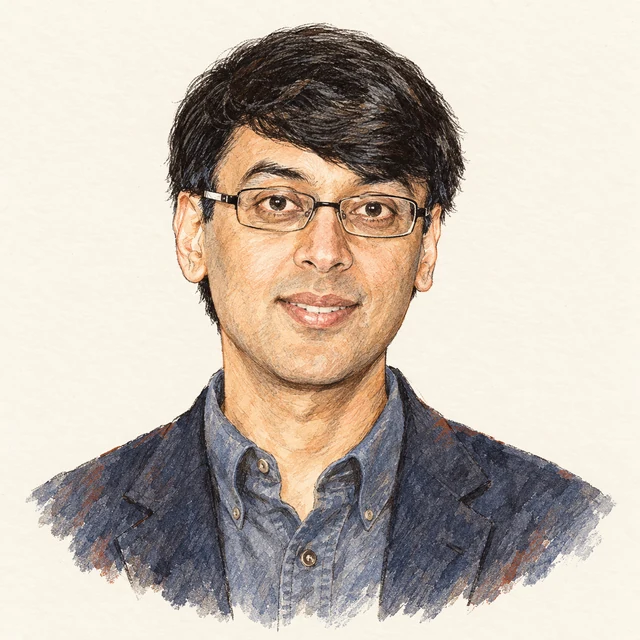
Manjul Bhargava was born in Hamilton, Canada, and grew up mainly in the United States while maintaining close connections with India. He earned his doctorate at Princeton in 2001 with Andrew Wiles and joined its faculty in 2003. His 2014 Fields Medal recognized new methods in the geometry of numbers. By representing arithmetic structures through geometric data, he counted number fields and rings and, with Arul Shankar, bounded the average rank of elliptic curves. He also developed higher composition laws and worked on universal quadratic forms. His research turns concrete counting questions into rich interactions among algebra, geometry and arithmetic.
The contribution, explained
An elliptic curve is a nonsingular cubic curve with a distinguished point. Its rational points form a group, whose rank measures the number of independent rational directions. Determining the rank of one curve can be very difficult. Bhargava developed geometric parametrizations that encode arithmetic structures as orbits of forms or other algebraic data. Counting lattice points in suitable regions then becomes a way to count number fields, rings and auxiliary objects called Selmer groups. With Arul Shankar, he used this strategy to bound average ranks of elliptic curves. The shift from individual equations to organized families reveals information inaccessible curve by curve.
Why it matters
These methods transformed arithmetic statistics, connecting the geometry of numbers with the frequency of number fields and rational solutions. They yield rigorous average results while exposing how algebraic symmetries govern the counting process.