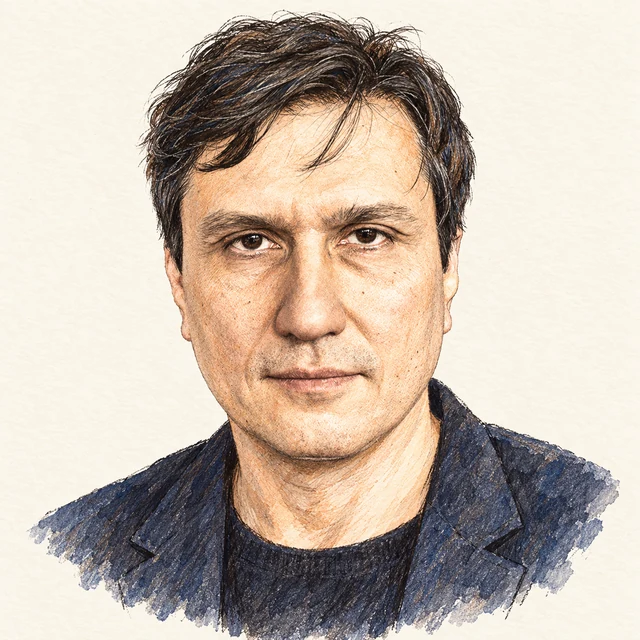
01 · A life in mathematics
The person behind the work
Maxim Kontsevich was born in Khimki in the Soviet Union. By his 1998 Fields Medal he was a permanent professor at IHES and held a visiting chair at Rutgers. His work connected algebraic geometry, topology and mathematical physics through structures that let ideas travel between these fields. He proved Witten’s conjecture on intersection numbers of moduli spaces of curves, constructed a universal finite-type knot invariant and established deformation quantisation for Poisson manifolds. These were distinct achievements united by unusually effective bridges between geometry and algebra. His work illustrates how a physical prediction can inspire a rigorous mathematical construction without making every physical formulation itself a proof.
The contribution, explained
Instead of studying one curve, a moduli space organises many curves into a single geometric object. Certain intersection numbers on the moduli spaces of stable marked curves encode how natural geometric conditions meet. Witten predicted that a generating function collecting these numbers satisfies equations from the KdV hierarchy. Kontsevich proved the prediction using a matrix integral and combinatorial descriptions by ribbon graphs. The proof translates geometric integrals into a form where the hidden recurrence becomes visible. Its subject is a precisely defined family of intersection numbers, not a claim that every possible curve-counting problem has been solved.
Why it matters
The theorem helped establish a powerful exchange between moduli-space geometry, integrable systems and mathematical physics, showing how combinatorial models can make difficult geometric invariants accessible.