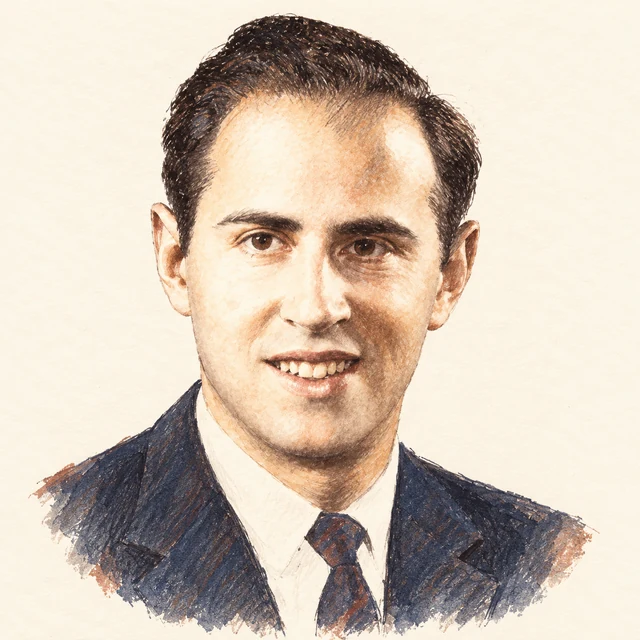
01 · A life in mathematics
The person behind the work
Paul Cohen was born in Long Branch, New Jersey, in 1934. He joined Stanford University and developed forcing, a method that transformed the foundations of mathematics. His 1966 Fields Medal recognised independence results in set theory, notably the continuum hypothesis. Combined with Gödel’s earlier work, Cohen’s proof showed that the standard ZFC axioms cannot decide this hypothesis, assuming their consistency. His achievement made the choice of axioms a concrete mathematical subject: proving a statement independent requires rigorous constructions, not simply a failure to find a proof.
The contribution, explained
The continuum hypothesis asks whether a set can have cardinality strictly between that of the integers and that of the real numbers. Gödel had shown that the hypothesis could hold in a model of the usual axioms. Cohen introduced forcing to construct extensions in which it fails while the relevant axioms remain satisfied. Together, the results establish independence from ZFC, assuming ZFC is consistent. Forcing controls which sets are added and how statements behave in the enlarged universe. It demonstrates a boundary of a particular axiom system, rather than declaring the question meaningless.
Why it matters
Forcing became a central method of set theory and changed how mathematicians investigate independence, alternative axiom systems and the possible structures of mathematical universes.