01 · A life in mathematics
The person behind the work
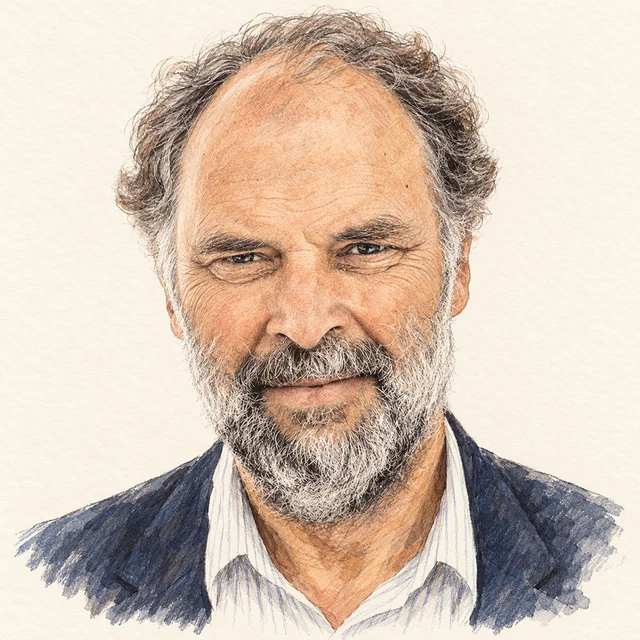
Vaughan Jones was born in Gisborne, New Zealand, and was a Berkeley professor when he received the 1990 Fields Medal. His research began in operator algebras, mathematical structures built from operators on Hilbert spaces. Studying inclusions of von Neumann algebras led him to a surprising new invariant of knots and links: the Jones polynomial. It associates algebraic data with a knotted loop in a way unchanged by permissible deformations. The discovery transformed low-dimensional topology and connected it with statistical mechanics, representation theory and mathematical physics. His work showed that an abstract question about algebras could reveal information about the shape of a knot.
The contribution, explained
A knot is a closed loop embedded in three-dimensional space. Two drawings may show the same knot even when their crossings look different. Jones discovered a polynomial invariant using ideas from operator algebras and braid representations. Local relations between diagrams let one compute the polynomial, while its invariance ensures that allowed changes of drawing do not change the answer. If two knots have different Jones polynomials, they cannot be equivalent. The reverse implication fails: the polynomial is a powerful signature, not a complete identity card. Its unexpected algebraic origin opened connections that a purely visual approach had missed.
Why it matters
The Jones polynomial supplied a major new tool in knot theory and helped connect low-dimensional topology with operator algebras, statistical mechanics, quantum groups and topological quantum field theory.