01 · A life in mathematics
The person behind the work
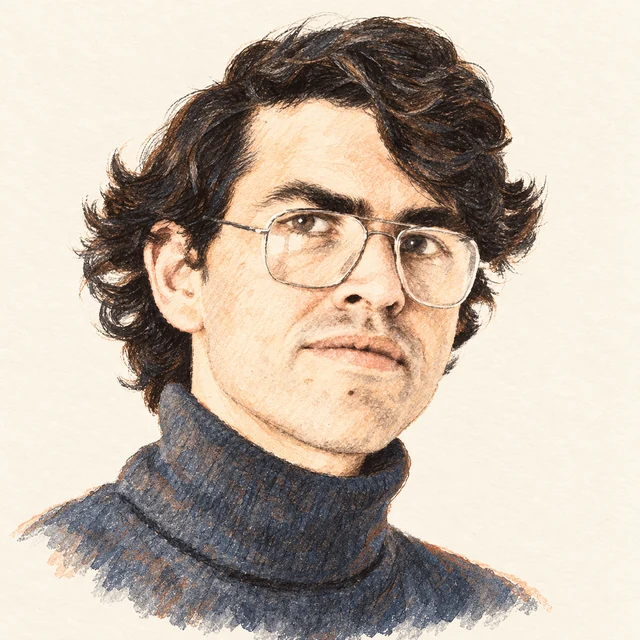
William Thurston was born in Washington, D.C., and was a Princeton professor when he received the 1982 Fields Medal. He transformed the study of three-dimensional manifolds by asking which geometric structures they can carry. His work showed that hyperbolic geometry is far more widespread in dimension three than earlier intuition suggested. Hyperbolisation results, the study of foliations and geometric models of manifolds changed both the questions and methods of topology. His geometrisation vision proposed understanding three-manifolds by decomposing them into pieces with standard geometries. The full conjecture was proved later through Perelman’s work; the award honoured Thurston’s foundational breakthroughs and new geometric viewpoint.
The contribution, explained
A three-manifold looks locally like ordinary three-dimensional space, but its global connections may be very different. Thurston proposed studying it by suitable decompositions and asking which standard geometric structures fit the pieces. Hyperbolic geometry, with constant negative curvature, plays an unexpectedly large role. His hyperbolisation results established this viewpoint for important classes of manifolds and made geometric constructions central to topology. The broader geometrisation picture involves eight model geometries, not a claim that every manifold is hyperbolic. Local geometry and global gluing must be understood together. Its later full proof built on the landscape Thurston had revealed.
Why it matters
Thurston’s viewpoint reshaped low-dimensional topology, turning the search for geometric structures and decompositions into a central organising principle for understanding three-manifolds.