c.curionodeThe Fields Archive

1954 · Geometry & topology

Reading a space one layer at a time

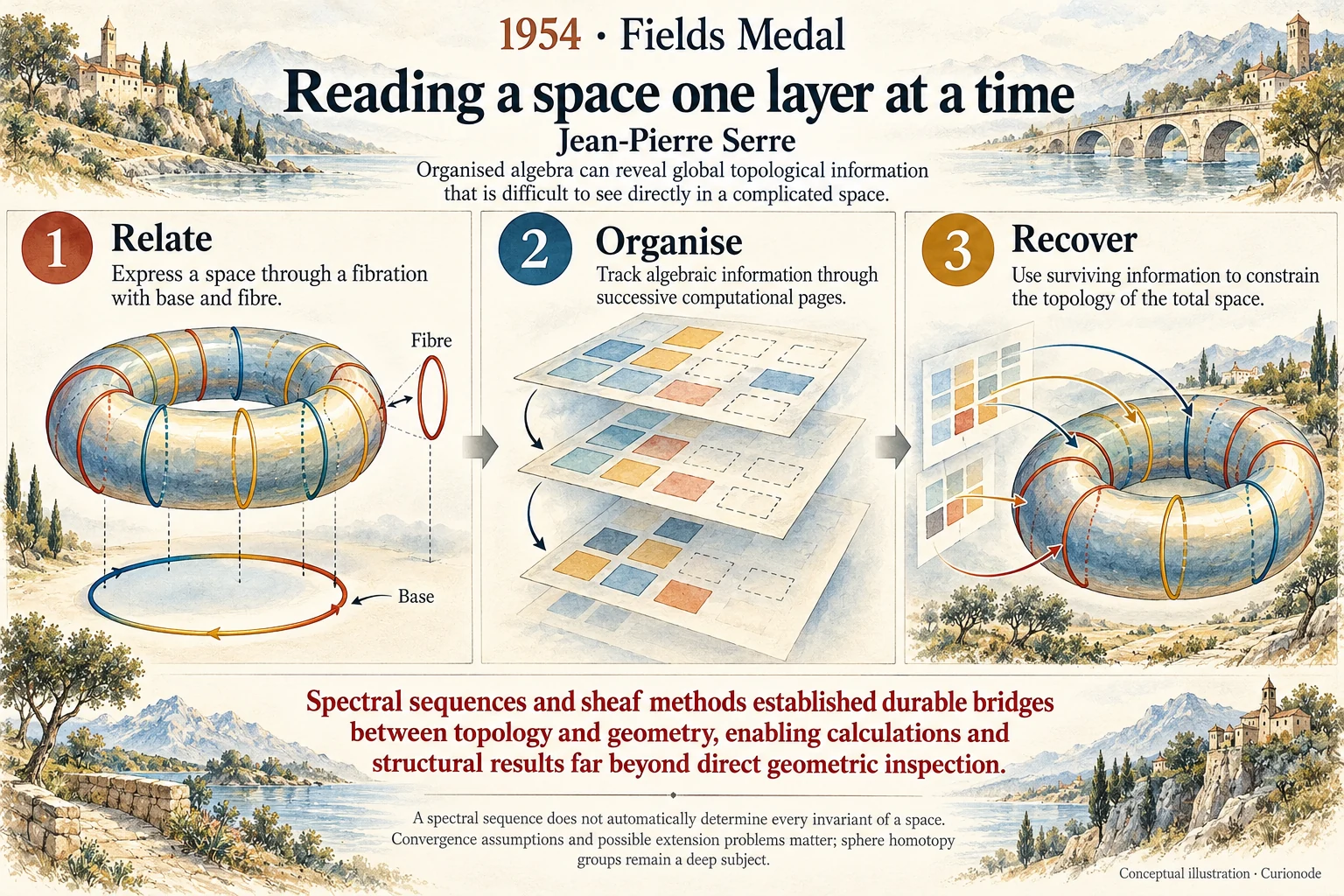
Organised algebra can reveal global topological information that is difficult to see directly in a complicated space.

1954Fields Medal
Reading a space one layer at a time: Organised algebra can reveal global topological information that is difficult to see directly in a complicated space.
Original AI-generated infographic by Curionode. Read the text version below for the full explanation.
Read the poster text
  1. Relate

    Express a space through a fibration with base and fibre.

  2. Organise

    Track algebraic information through successive computational pages.

  3. Recover

    Use surviving information to constrain the topology of the total space.

Spectral sequences and sheaf methods established durable bridges between topology and geometry, enabling calculations and structural results far beyond direct geometric inspection.

A spectral sequence does not automatically determine every invariant of a space. Convergence assumptions and possible extension problems matter; sphere homotopy groups remain a deep subject.

01 · The idea

In everyday language

A space can have structure too intricate to compute in one step. A spectral sequence organises algebraic information into successive pages: each page records what has survived the previous stage and what further relations must be considered. In Serre’s work, a fibration relates a total space to its base and fibre, allowing their homological information to interact. This provided striking new access to the topology of spheres and helped transform algebraic topology. The method is a controlled calculation with hypotheses and differentials, not merely a visual decomposition into pieces.

Why it matters

Spectral sequences and sheaf methods established durable bridges between topology and geometry, enabling calculations and structural results far beyond direct geometric inspection.

02 · The people

Who brought the idea to life?

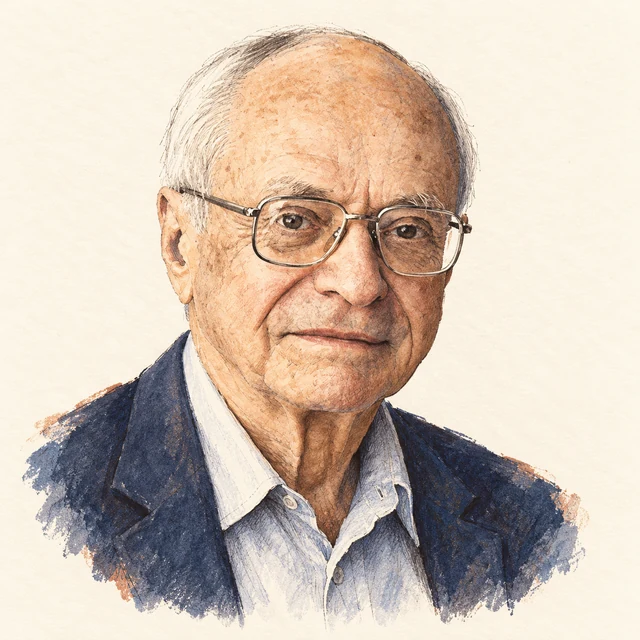
Illustrated portrait of Jean-Pierre Serre

Jean-Pierre Serre

Jean-Pierre Serre was born in Bages, France, in 1926. He received the 1954 Fields Medal for work that brought new algebraic methods into topology and complex geometry, especially spectral sequences and sheaves. His institutional chronology places him at the CNRS through 1954 and moving to Nancy that year; his Collège de France chair began in 1956. Serre’s early research showed how sophisticated spaces could be studied through carefully organised algebraic information. His subsequent work connected algebraic geometry, number theory and group theory, repeatedly turning relationships between subjects into productive mathematical tools.

Read the biography ↗

03 · Read further

From the original sources

Original explanations based on the official award record. The subject label is an editorial navigation aid.

  1. Official IMU citation: Jean-Pierre Serre ↗www.mathunion.org
  2. Heidelberg Laureate Forum: Jean-Pierre Serre ↗www.heidelberg-laureate-forum.org
  3. Collège de France: Serre professional chronology ↗www.college-de-france.fr