c.curionodeThe Fields Archive

2026 · Geometry & topology

Counting curves when the counting space is singular

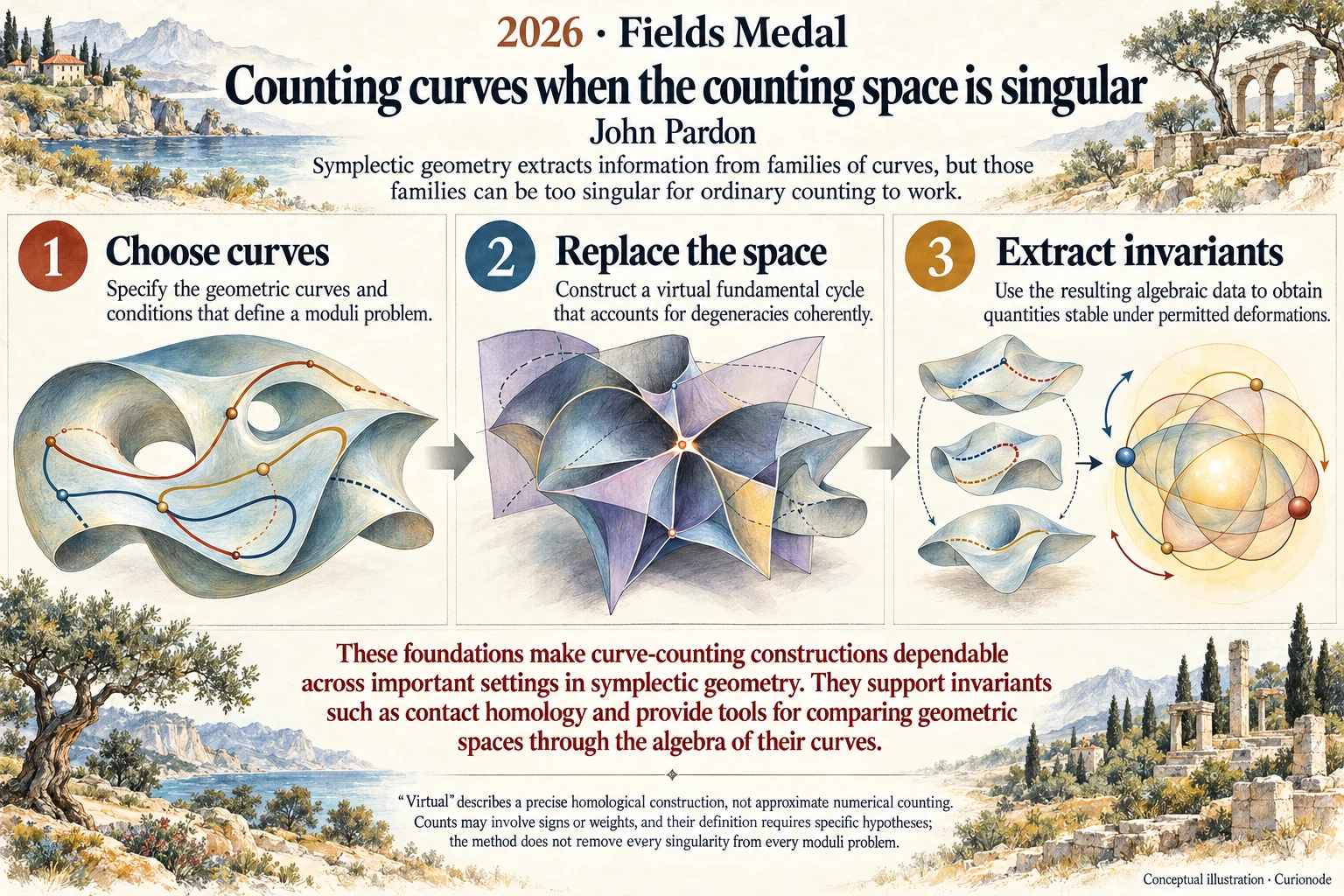
Symplectic geometry extracts information from families of curves, but those families can be too singular for ordinary counting to work.

2026Fields Medal
Counting curves when the counting space is singular: Symplectic geometry extracts information from families of curves, but those families can be too singular for ordinary counting to work.
Original AI-generated infographic by Curionode. Read the text version below for the full explanation.
Read the poster text
  1. Choose curves

    Specify the geometric curves and conditions that define a moduli problem.

  2. Replace the space

    Construct a virtual fundamental cycle that accounts for degeneracies coherently.

  3. Extract invariants

    Use the resulting algebraic data to obtain quantities stable under permitted deformations.

These foundations make curve-counting constructions dependable across important settings in symplectic geometry. They support invariants such as contact homology and provide tools for comparing geometric spaces through the algebra of their curves.


“Virtual” describes a precise homological construction, not approximate numerical counting. Counts may involve signs or weights, and their definition requires specific hypotheses; the method does not remove every singularity from every moduli problem.

01 · The idea

In everyday language

A symplectic manifold carries a geometric structure inspired by the phase spaces of mechanics. One way to explore it is to study pseudoholomorphic curves inside it. The collection of all such curves forms a moduli space, but this space may have singularities or more dimensions than a naive count expects. Pardon developed an approach to virtual fundamental cycles that uses algebraic topology to construct the appropriate substitute for a well-behaved counting space. This makes it possible to define geometric invariants consistently, even when direct counting breaks down. His wider work also illuminates group actions, knots and Fukaya categories.

Why it matters

These foundations make curve-counting constructions dependable across important settings in symplectic geometry. They support invariants such as contact homology and provide tools for comparing geometric spaces through the algebra of their curves.

02 · The people

Who brought the idea to life?

Illustrated portrait of John Pardon

John Pardon

John Pardon, born in Chapel Hill, works in topology and symplectic geometry. He studied at Princeton and earned his doctorate at Stanford before holding positions at Stanford and Princeton. By his 2026 Fields Medal he was a professor at Stony Brook University. His research established the three-dimensional Hilbert–Smith conjecture and developed foundations for counting pseudoholomorphic curves when their parameter spaces are singular. With collaborators he also advanced wrapped Fukaya categories. These achievements combine precise algebraic machinery with geometric insight, turning difficult questions about spaces, symmetries and curve counts into structures that can be studied consistently.

Read the biography ↗

03 · Read further

From the original sources

Original explanations based on the official award record. The subject label is an editorial navigation aid.

  1. Official IMU citation: John Pardon ↗www.mathunion.org
  2. Heidelberg Laureate Forum: John Pardon ↗www.heidelberg-laureate-forum.org
  3. Stony Brook University: John Pardon awarded 2026 Fields Medal ↗news.stonybrook.edu
  4. IMU: John Pardon detailed citation ↗www.mathunion.org