c.curionodeThe Fields Archive

1962 · Geometry & topology

One topological sphere, different smooth worlds

A space can have the continuous shape of a sphere while carrying a genuinely different structure for doing calculus.

1962Fields Medal
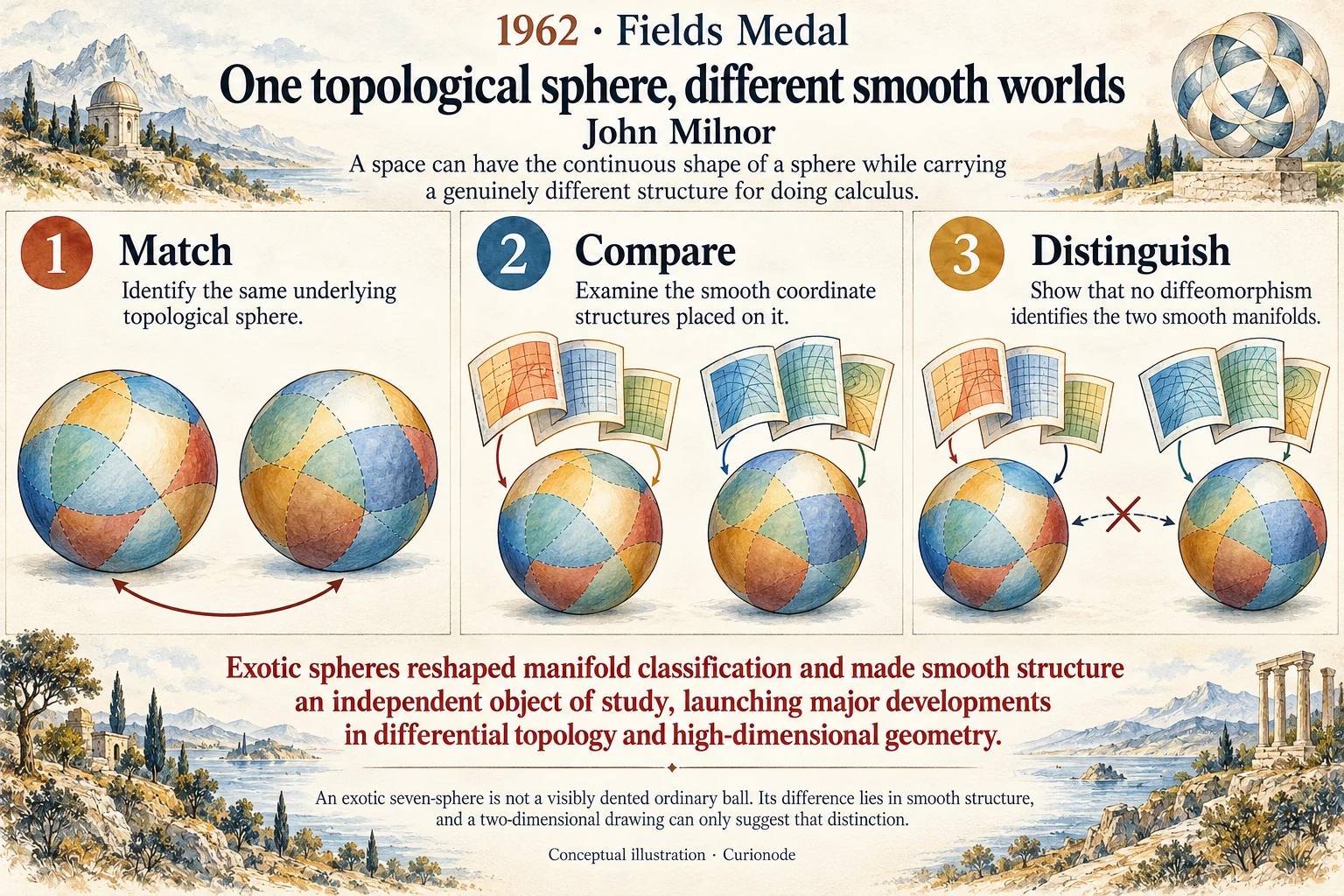
One topological sphere, different smooth worlds: A space can have the continuous shape of a sphere while carrying a genuinely different structure for doing calculus.
Original AI-generated infographic by Curionode. Read the text version below for the full explanation.
Read the poster text
  1. Match

    Identify the same underlying topological sphere.

  2. Compare

    Examine the smooth coordinate structures placed on it.

  3. Distinguish

    Show that no diffeomorphism identifies the two smooth manifolds.

Exotic spheres reshaped manifold classification and made smooth structure an independent object of study, launching major developments in differential topology and high-dimensional geometry.


An exotic seven-sphere is not a visibly dented ordinary ball. Its difference lies in smooth structure, and a two-dimensional drawing can only suggest that distinction.

01 · The idea

In everyday language

Topology treats shapes as equivalent when a continuous deformation of coordinates has a continuous inverse. Differential topology asks for more: coordinate changes must be smooth. Milnor constructed seven-dimensional manifolds homeomorphic to the ordinary seven-sphere but not diffeomorphic to it. They therefore share the same topological shape while supporting different smooth structures. The discovery showed that continuous classification does not automatically settle smooth classification. It opened a systematic search for exotic spheres and helped reveal how strongly the relationship between topology and calculus depends on dimension.

Why it matters

Exotic spheres reshaped manifold classification and made smooth structure an independent object of study, launching major developments in differential topology and high-dimensional geometry.

02 · The people

Who brought the idea to life?

Illustrated portrait of John Milnor

John Milnor

John Milnor was born in Orange, New Jersey, in 1931. His discovery of exotic seven-dimensional spheres showed that topological shape and smooth structure can differ in unexpected ways. He received the 1962 Fields Medal while at Princeton University. The result helped establish differential topology as a distinct subject, requiring mathematicians to specify not only how a space fits together continuously but also which coordinates make differentiation possible. Milnor’s wider work spans topology, geometry, algebra and dynamics, with influential writing that makes difficult structural distinctions unusually clear.

Read the biography ↗

03 · Read further

From the original sources

Original explanations based on the official award record. The subject label is an editorial navigation aid.

  1. Official IMU citation: John Milnor ↗www.mathunion.org
  2. Heidelberg Laureate Forum: John Milnor ↗www.heidelberg-laureate-forum.org
  3. John Milnor: introduction to Exotic Spheres ↗www.math.stonybrook.edu