c.curionodeThe Fields Archive

1966 · Geometry & topology

Two ways to count the same obstruction

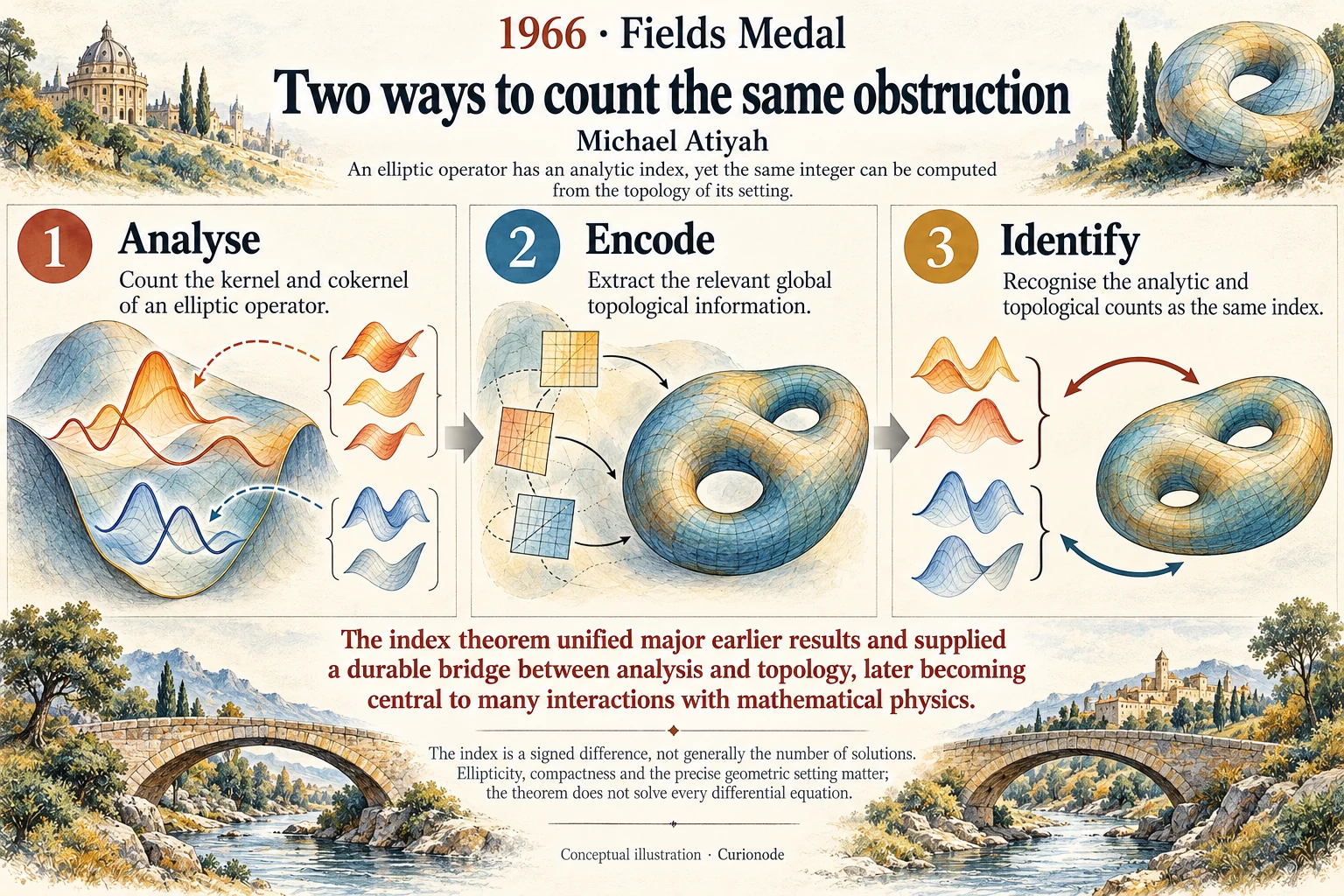
An elliptic operator has an analytic index, yet the same integer can be computed from the topology of its setting.

1966Fields Medal
Two ways to count the same obstruction: An elliptic operator has an analytic index, yet the same integer can be computed from the topology of its setting.
Original AI-generated infographic by Curionode. Read the text version below for the full explanation.
Read the poster text
  1. Analyse

    Count the kernel and cokernel of an elliptic operator.

  2. Encode

    Extract the relevant global topological information.

  3. Identify

    Recognise the analytic and topological counts as the same index.

The index theorem unified major earlier results and supplied a durable bridge between analysis and topology, later becoming central to many interactions with mathematical physics.

The index is a signed difference, not generally the number of solutions. Ellipticity, compactness and the precise geometric setting matter; the theorem does not solve every differential equation.

01 · The idea

In everyday language

Differential equations involve functions and derivatives, while topology records features unchanged by continuous deformation. The Atiyah–Singer index theorem connects these languages. For an elliptic operator on a suitable compact manifold, its analytic index is the dimension of its kernel minus that of its cokernel. The theorem identifies this integer with a topological expression built from the operator and the manifold. Individual solution spaces can change, but their signed difference is controlled by global structure. This turns topological information into a powerful constraint on differential equations, without requiring every solution to be explicitly found.

Why it matters

The index theorem unified major earlier results and supplied a durable bridge between analysis and topology, later becoming central to many interactions with mathematical physics.

02 · The people

Who brought the idea to life?

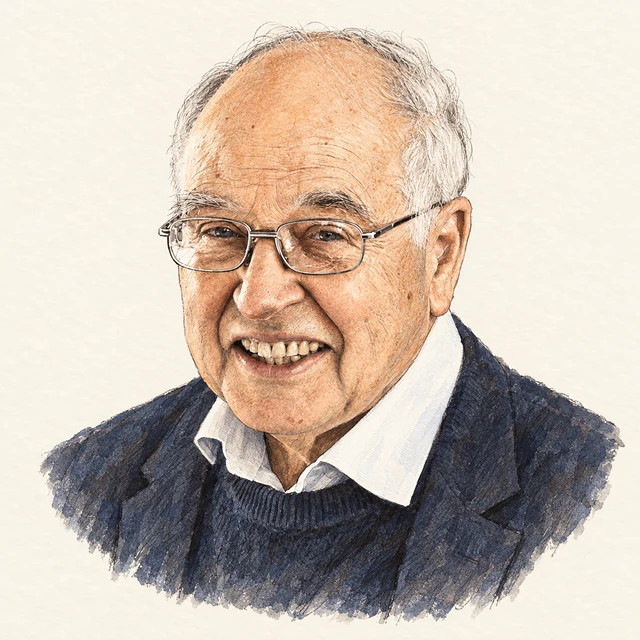
Illustrated portrait of Michael Atiyah

Michael Atiyah

Michael Atiyah was born in London in 1929 and developed a career linking geometry, topology and analysis. At Oxford, his collaborations with Friedrich Hirzebruch, Isadore Singer and Raoul Bott produced new tools for understanding vector bundles and differential operators. The 1966 Fields Medal recognised this body of work, including the index theorem proved with Singer. Atiyah’s mathematics showed how apparently different ways of counting could express the same underlying structure. The resulting bridges became influential not only within pure mathematics but also in later interactions between geometry and theoretical physics.

Read the biography ↗

03 · Read further

From the original sources

Original explanations based on the official award record. The subject label is an editorial navigation aid.

  1. Official IMU citation: Michael Atiyah ↗www.mathunion.org
  2. Heidelberg Laureate Forum: Michael Atiyah ↗www.heidelberg-laureate-forum.org
  3. Oxford: Michael Atiyah and the index theorem ↗www.maths.ox.ac.uk