c.curionodeThe Fields Archive

1966 · Geometry & topology

Taking a high-dimensional shape apart

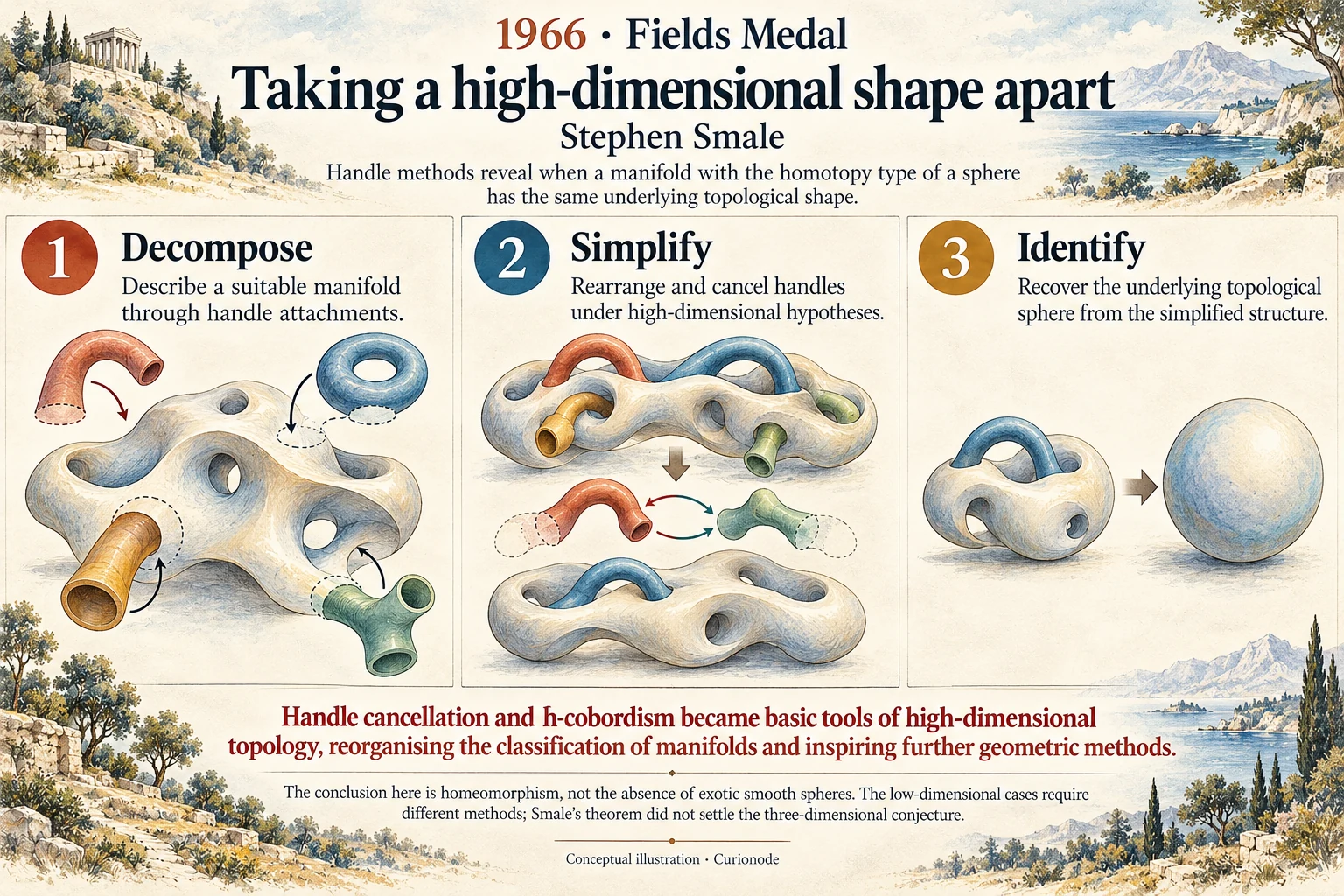
Handle methods reveal when a manifold with the homotopy type of a sphere has the same underlying topological shape.

1966Fields Medal
Taking a high-dimensional shape apart: Handle methods reveal when a manifold with the homotopy type of a sphere has the same underlying topological shape.
Original AI-generated infographic by Curionode. Read the text version below for the full explanation.
Read the poster text
  1. Decompose

    Describe a suitable manifold through handle attachments.

  2. Simplify

    Rearrange and cancel handles under high-dimensional hypotheses.

  3. Identify

    Recover the underlying topological sphere from the simplified structure.

Handle cancellation and h-cobordism became basic tools of high-dimensional topology, reorganising the classification of manifolds and inspiring further geometric methods.


The conclusion here is homeomorphism, not the absence of exotic smooth spheres. The low-dimensional cases require different methods; Smale’s theorem did not settle the three-dimensional conjecture.

01 · The idea

In everyday language

A manifold can be assembled by attaching elementary pieces called handles. Smale showed how, in sufficiently high dimensions, handles can be rearranged and cancelled under suitable hypotheses. His h-cobordism methods led to a proof that a smooth homotopy sphere of dimension at least five is homeomorphic to the ordinary sphere. The result links a global description by homotopy to an actual classification of the underlying topological space. High dimension supplies room for geometric manoeuvres that may fail in lower dimensions, making dimension an essential part of the argument rather than a cosmetic parameter.

Why it matters

Handle cancellation and h-cobordism became basic tools of high-dimensional topology, reorganising the classification of manifolds and inspiring further geometric methods.

02 · The people

Who brought the idea to life?

Illustrated portrait of Stephen Smale

Stephen Smale

Stephen Smale was born in Flint, Michigan, in 1930. He received the 1966 Fields Medal while a professor at the University of California, Berkeley. His medal-period work transformed differential topology through methods involving handles and cobordisms, including a proof of the high-dimensional generalised Poincaré conjecture in the smooth setting. He also became a major figure in dynamical systems. Smale’s career repeatedly crossed subject boundaries, from manifold classification to the study of stable and chaotic motion, illustrating how geometric constructions can reveal structures hidden by a purely formula-based approach.

Read the biography ↗

03 · Read further

From the original sources

Original explanations based on the official award record. The subject label is an editorial navigation aid.

  1. Official IMU citation: Stephen Smale ↗www.mathunion.org
  2. Heidelberg Laureate Forum: Stephen Smale ↗www.heidelberg-laureate-forum.org
  3. Stephen Smale: Berkeley biography and appointments ↗math.berkeley.edu