c.curionodeThe Fields Archive

2006 · Geometry & topology

Following curvature to classify three-dimensional spaces

Ricci flow changes a space’s geometry; controlling its singularities turned a powerful evolution equation into a solution of a century-old topological problem.

Awarded the 2006 Fields Medal; declined the medal.

2006Fields Medal
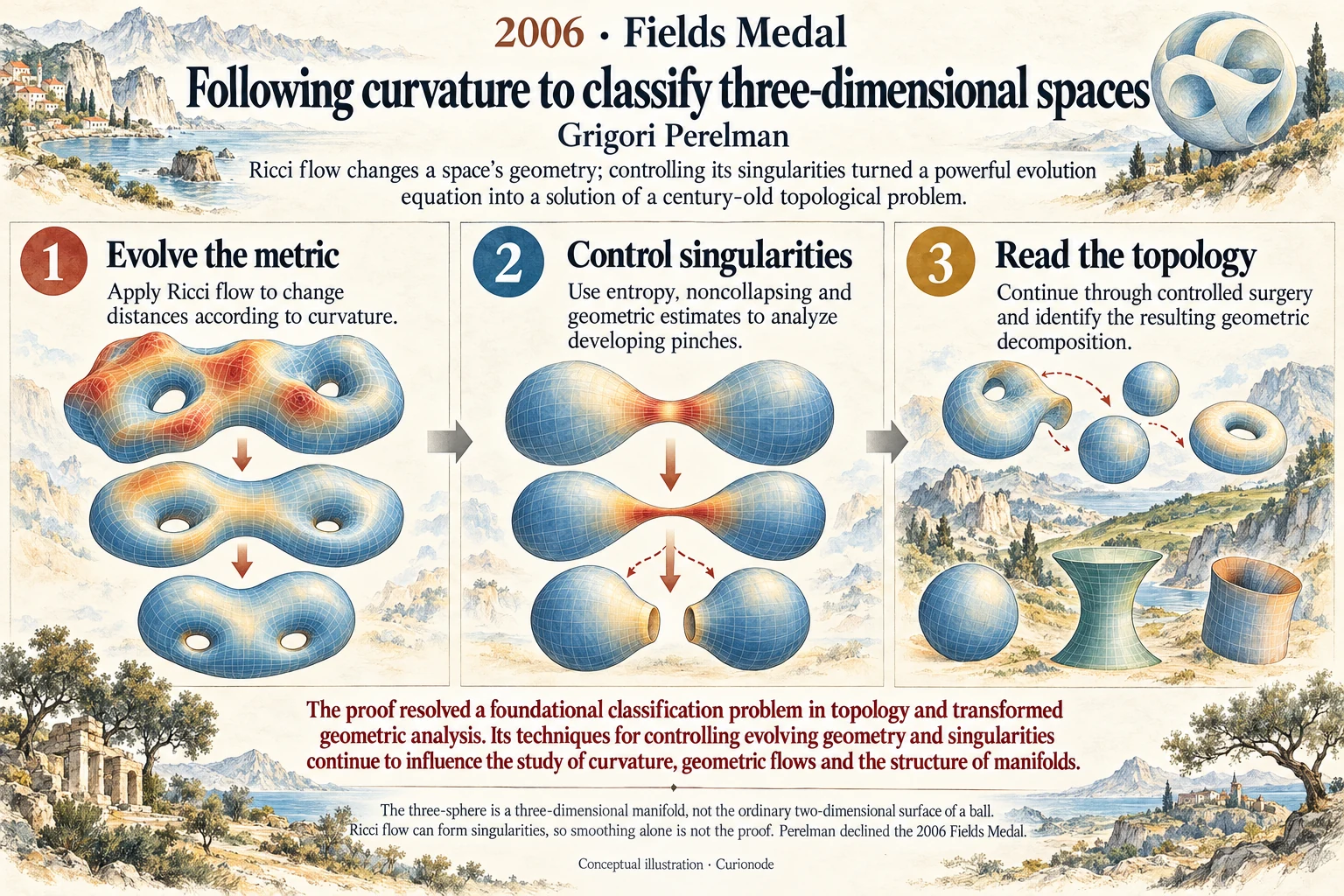
Following curvature to classify three-dimensional spaces: Ricci flow changes a space’s geometry; controlling its singularities turned a powerful evolution equation into a solution of a century-old topological problem.
Original AI-generated infographic by Curionode. Read the text version below for the full explanation.
Read the poster text
  1. Evolve the metric

    Apply Ricci flow to change distances according to curvature.

  2. Control singularities

    Use entropy, noncollapsing and geometric estimates to analyze developing pinches.

  3. Read the topology

    Continue through controlled surgery and identify the resulting geometric decomposition.

The proof resolved a foundational classification problem in topology and transformed geometric analysis. Its techniques for controlling evolving geometry and singularities continue to influence the study of curvature, geometric flows and the structure of manifolds.


The three-sphere is a three-dimensional manifold, not the ordinary two-dimensional surface of a ball. Ricci flow can form singularities, so smoothing alone is not the proof. Perelman declined the 2006 Fields Medal.

01 · The idea

In everyday language

The Poincaré conjecture asks whether every closed, simply connected three-dimensional manifold is topologically a three-sphere. Here “closed” means compact without boundary, and simply connected means every loop can contract to a point. Hamilton proposed evolving a manifold’s metric by Ricci flow, somewhat as heat spreads to smooth temperature differences. But curvature can become infinite in finite time, creating singularities. Perelman introduced entropy and noncollapsing tools that controlled these dangerous regions and justified carefully chosen surgeries. His work completed the route to geometrization, a broader decomposition of three-manifolds into standard geometric pieces, with the Poincaré conjecture as a consequence.

Why it matters

The proof resolved a foundational classification problem in topology and transformed geometric analysis. Its techniques for controlling evolving geometry and singularities continue to influence the study of curvature, geometric flows and the structure of manifolds.

02 · The people

Who brought the idea to life?

Illustrated portrait of Grigori Perelman

Grigori Perelman

Grigori Perelman was born in Leningrad and trained in the Soviet mathematical tradition. He worked in Saint Petersburg and held visiting positions in the United States before returning to the Steklov Institute. His papers of 2002–2003 introduced decisive tools for Richard Hamilton's Ricci flow program, resolving the Poincaré and geometrization conjectures. By controlling singularities and preventing local geometric collapse, he made the evolution of three-dimensional spaces usable for topology. He was selected for the 2006 Fields Medal and declined it. He had already left his institutional position, so the award-country field here records no active institutional affiliation.

Read the biography ↗

03 · Read further

From the original sources

Original explanations based on the official award record. The subject label is an editorial navigation aid.

  1. Official IMU citation: Grigori Perelman ↗www.mathunion.org
  2. Heidelberg Laureate Forum: Grigori Perelman ↗www.heidelberg-laureate-forum.org
  3. IMU: Perelman work and biography ↗www.mathunion.org
  4. IMU historical account: Perelman had already left Steklov before the medal ↗www.mathunion.org