01 · A life in mathematics
The person behind the work
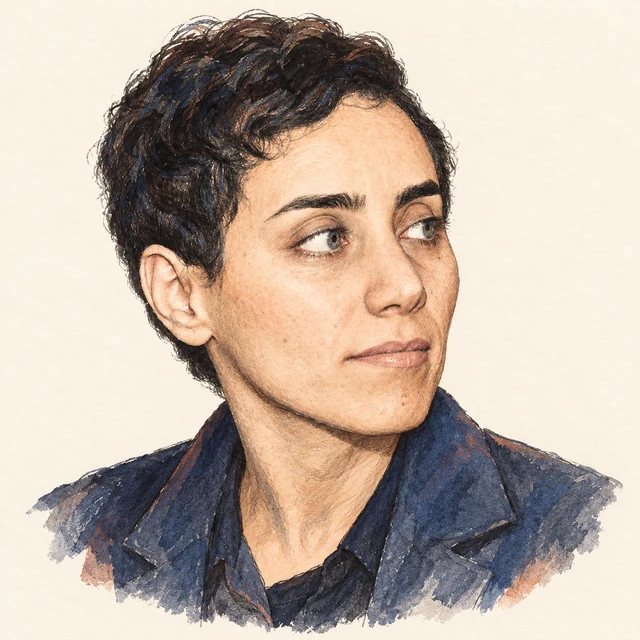
Maryam Mirzakhani was born in Tehran and earned her doctorate at Harvard in 2004 with Curtis McMullen. After a position at Princeton she joined Stanford, where she was a professor at her 2014 Fields Medal. Her research connected the geometry of curved surfaces with the dynamics of their moduli spaces, the spaces parametrizing possible surface geometries. She counted simple closed geodesics, computed volumes and proved striking rigidity results with Alex Eskin and Amir Mohammadi. The first woman awarded a Fields Medal, she died in 2017. Her work continues to shape the study of geometry, topology and dynamical systems.
The contribution, explained
On a curved surface, a geodesic is a path that is locally straight in the surface’s own geometry. Closed geodesics return to their starting point; simple ones never cross themselves. How many simple closed geodesics have length at most L on a hyperbolic surface? Mirzakhani connected this counting problem to volumes of moduli spaces, which organize different possible surface geometries. Her recursive volume formulas and geometric arguments produced precise asymptotic growth laws. She also linked these volumes to intersection theory and, in later work with collaborators, discovered remarkable rigidity in dynamics on moduli space. A question about loops thus opened onto an entire landscape of surfaces.
Why it matters
The work united hyperbolic geometry, topology, algebraic geometry and dynamics. It supplied new counting and volume tools and revealed strong structural laws in moduli spaces, influencing the study of billiards, geodesics and surface deformations.