01 · A life in mathematics
The person behind the work
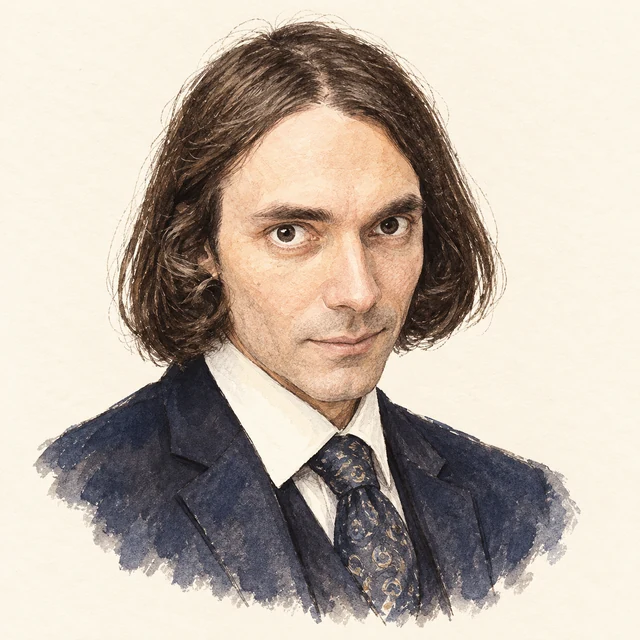
Cédric Villani was born in Brive-la-Gaillarde and earned his doctorate in Paris in 1998. At his 2010 Fields Medal he directed the Institut Henri Poincaré and was a professor at ENS Lyon; his move to Université Claude Bernard Lyon 1 took effect that September. His research studies kinetic equations, convergence to equilibrium and optimal transport. With Laurent Desvillettes he obtained quantitative results for the Boltzmann equation, and with Clément Mouhot he proved nonlinear Landau damping under suitable assumptions. His work explains how collective physical systems can approach large-scale order while their microscopic descriptions retain complicated, sometimes reversible motion.
The contribution, explained
A plasma contains charged particles whose motion creates an electric field that in turn changes their motion. In a collisionless model, the equations retain microscopic reversibility, so why should a disturbed field settle down? Landau predicted damping through phase mixing: particles moving at different velocities gradually fall out of step, making their collective field cancel more effectively. With Clément Mouhot, Villani proved nonlinear Landau damping for suitable small, sufficiently regular perturbations of stable equilibria. The challenge was to control the self-consistent feedback and repeated resonances, not merely solve a linear approximation. His broader work also quantified convergence for collisional Boltzmann equations.
Why it matters
The proof put an influential prediction of plasma physics on rigorous nonlinear foundations. Alongside work on entropy, kinetic equations and optimal transport, it clarifies how macroscopic relaxation can arise from complicated microscopic motion.