01 · A life in mathematics
The person behind the work
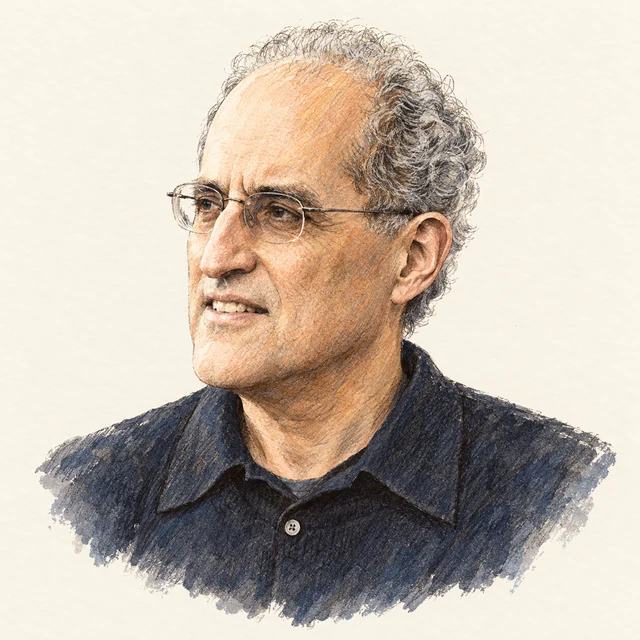
Edward Witten was born in Baltimore, Maryland, and had been a professor at the Institute for Advanced Study since 1987 when he received the 1990 Fields Medal. A theoretical physicist, he showed how quantum field theory could reveal deep mathematical structures. His interpretation of the Jones polynomial through Chern–Simons theory linked knot invariants with a three-dimensional field theory. Other work brought supersymmetry into Morse theory and influenced geometry and topology more broadly. His medal recognised an exceptional ability to turn physical insight into new mathematical directions. Formal path-integral arguments and fully rigorous constructions must still be distinguished, even when they lead to the same invariants.
The contribution, explained
A knot can be inserted into a three-dimensional gauge theory as an observable called a Wilson loop. Witten showed that in Chern–Simons theory the resulting expectation values recover knot invariants related to the Jones polynomial. The theory is topological: its key information is not an ordinary measurement of lengths or angles. This perspective explains why algebraic knot data can obey relations familiar from quantum theory and leads to a framework connecting manifolds, braids and representations. The path-integral description was a profound source of predictions, while rigorous mathematical formulations require additional constructions and care about normalisation and framing.
Why it matters
This bridge helped establish topological quantum field theory as a major meeting point of physics and mathematics, generating new ways to organise knot invariants and the topology of manifolds.