c.curionodeThe Fields Archive

1990 · Geometry & topology

A field theory can recognise a knot

Chern–Simons theory gives a physical interpretation of knot invariants that depend on topology rather than local distances.

1990Fields Medal
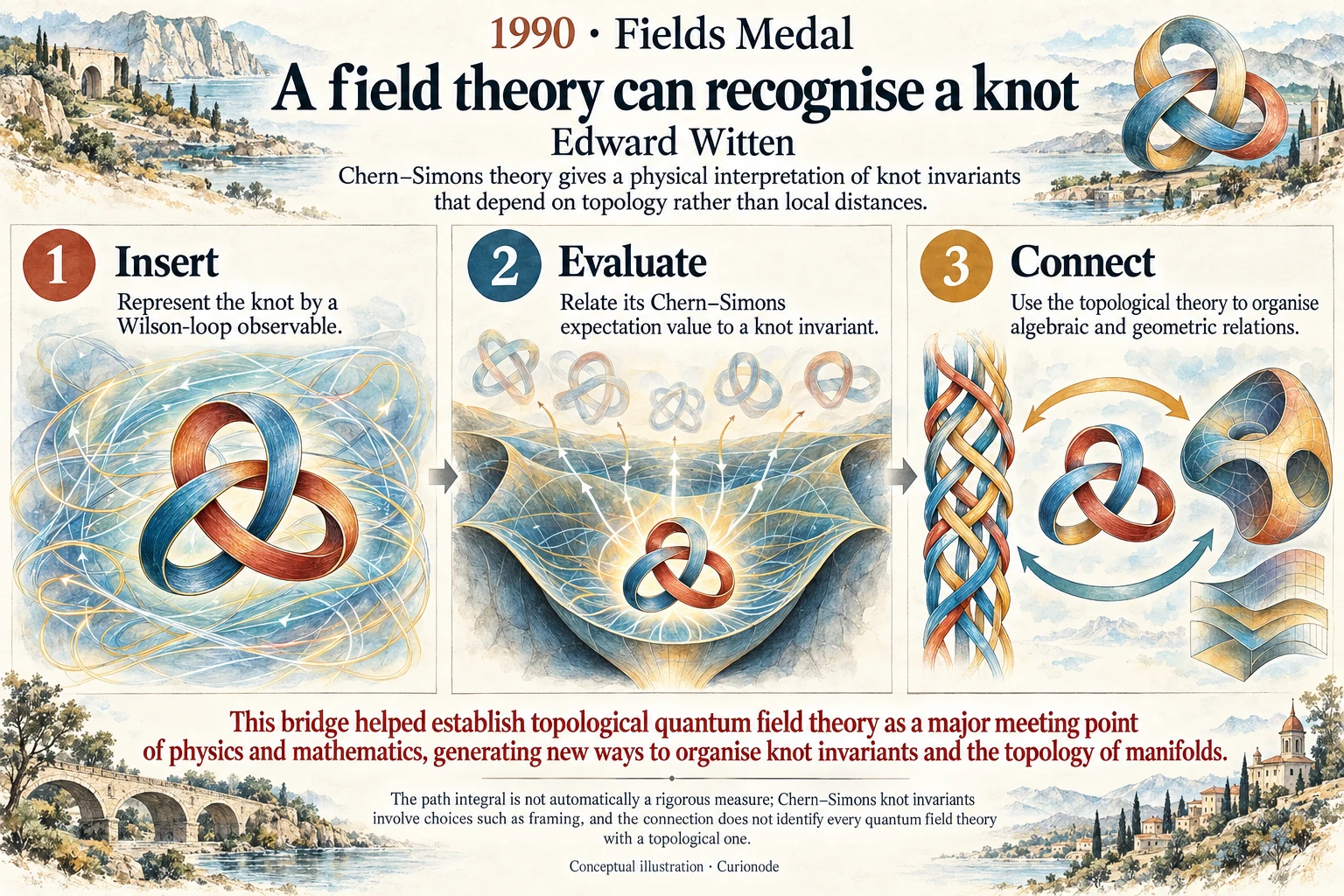
A field theory can recognise a knot: Chern–Simons theory gives a physical interpretation of knot invariants that depend on topology rather than local distances.
Original AI-generated infographic by Curionode. Read the text version below for the full explanation.
Read the poster text
  1. Insert

    Represent the knot by a Wilson-loop observable.

  2. Evaluate

    Relate its Chern–Simons expectation value to a knot invariant.

  3. Connect

    Use the topological theory to organise algebraic and geometric relations.

This bridge helped establish topological quantum field theory as a major meeting point of physics and mathematics, generating new ways to organise knot invariants and the topology of manifolds.

The path integral is not automatically a rigorous measure; Chern–Simons knot invariants involve choices such as framing, and the connection does not identify every quantum field theory with a topological one.

01 · The idea

In everyday language

A knot can be inserted into a three-dimensional gauge theory as an observable called a Wilson loop. Witten showed that in Chern–Simons theory the resulting expectation values recover knot invariants related to the Jones polynomial. The theory is topological: its key information is not an ordinary measurement of lengths or angles. This perspective explains why algebraic knot data can obey relations familiar from quantum theory and leads to a framework connecting manifolds, braids and representations. The path-integral description was a profound source of predictions, while rigorous mathematical formulations require additional constructions and care about normalisation and framing.

Why it matters

This bridge helped establish topological quantum field theory as a major meeting point of physics and mathematics, generating new ways to organise knot invariants and the topology of manifolds.

02 · The people

Who brought the idea to life?

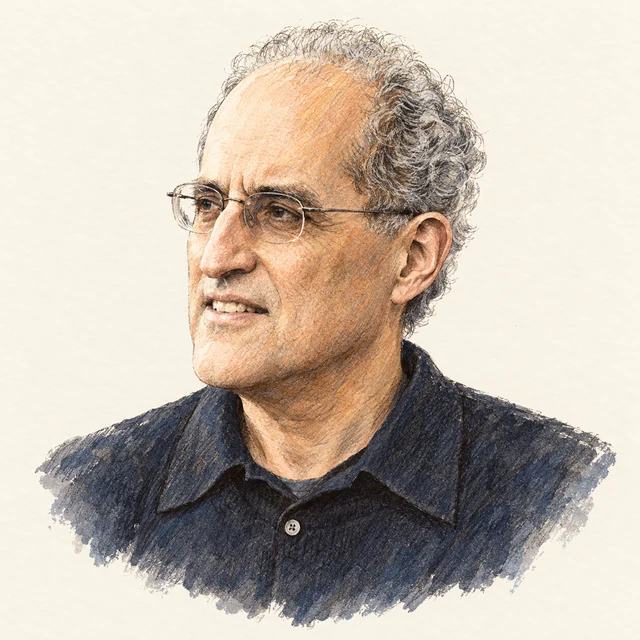
Illustrated portrait of Edward Witten

Edward Witten

Edward Witten was born in Baltimore, Maryland, and had been a professor at the Institute for Advanced Study since 1987 when he received the 1990 Fields Medal. A theoretical physicist, he showed how quantum field theory could reveal deep mathematical structures. His interpretation of the Jones polynomial through Chern–Simons theory linked knot invariants with a three-dimensional field theory. Other work brought supersymmetry into Morse theory and influenced geometry and topology more broadly. His medal recognised an exceptional ability to turn physical insight into new mathematical directions. Formal path-integral arguments and fully rigorous constructions must still be distinguished, even when they lead to the same invariants.

Read the biography ↗

03 · Read further

From the original sources

Original explanations based on the official award record. The subject label is an editorial navigation aid.

  1. Official IMU citation: Edward Witten ↗www.mathunion.org
  2. Heidelberg Laureate Forum: Edward Witten ↗www.heidelberg-laureate-forum.org
  3. IAS: Edward Witten, National Medal of Science profile ↗www.ias.edu