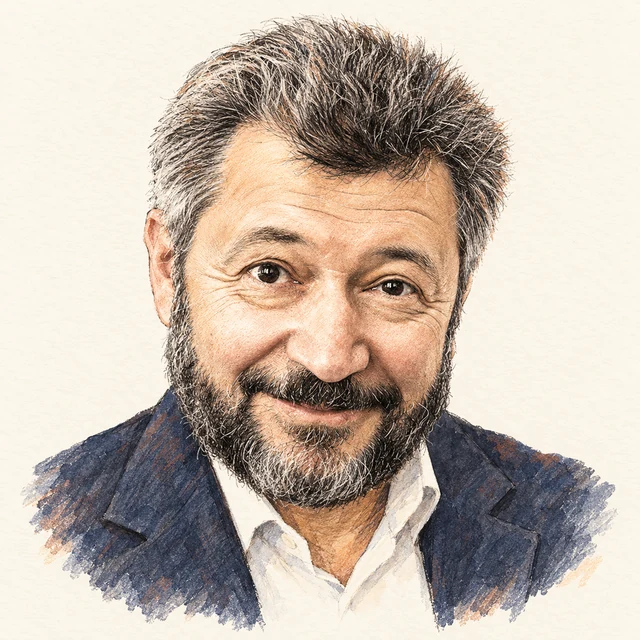
01 · A life in mathematics
The person behind the work
Efim Zelmanov was born in Khabarovsk in the Soviet Union. He joined the University of Chicago on 1 July 1994 and received the Fields Medal that August. His research in nonassociative algebra, especially Lie and Jordan algebras, supplied unexpected tools for group theory. His solution of the restricted Burnside problem showed that fixing a finite group’s number of generators and its exponent bounds the possible groups: there are only finitely many isomorphism types. The proof links finite groups to Lie-algebraic identities and structure. Its carefully restricted conclusion differs from the unrestricted Burnside problem, where finitely generated groups of bounded exponent need not be finite.
The contribution, explained
A group describes reversible operations and their compositions. Suppose it can be generated by at most d operations and every element satisfies x to the n equals the identity. The restricted Burnside problem asks whether there are only finitely many finite groups with those fixed bounds. Zelmanov proved that the answer is yes. He used deep results about Lie algebras satisfying polynomial identities, turning group-theoretic constraints into an algebraic structure where nilpotence could be controlled. The theorem gives a finiteness principle across all finite examples, not a short enumeration of them and not finiteness of every abstract group satisfying the same relations.
Why it matters
The solution resolved a longstanding problem in finite-group theory and demonstrated that the structure of Lie algebras can impose powerful global limits on groups defined by elementary-looking rules.