01 · The idea
In everyday language
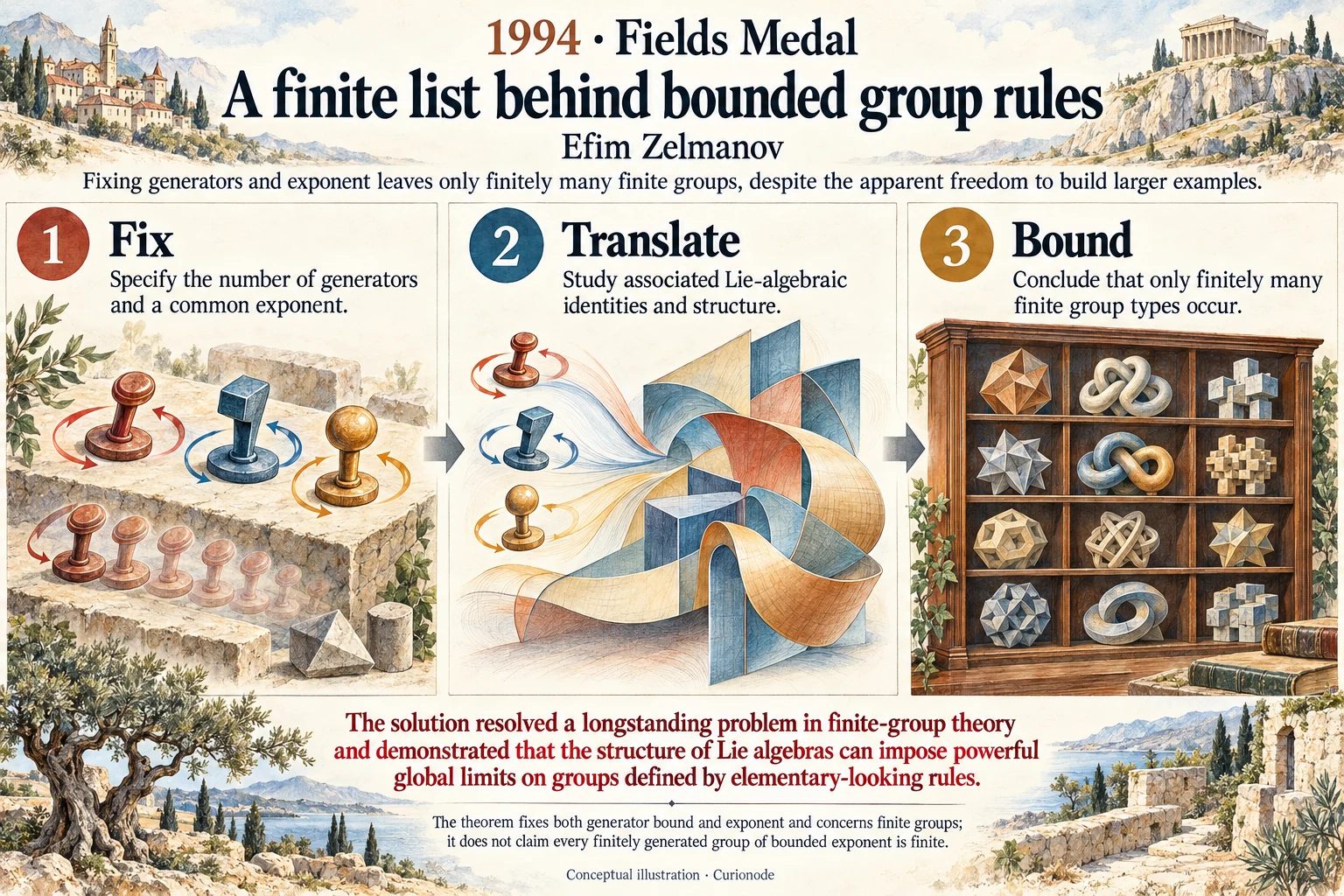
A group describes reversible operations and their compositions. Suppose it can be generated by at most d operations and every element satisfies x to the n equals the identity. The restricted Burnside problem asks whether there are only finitely many finite groups with those fixed bounds. Zelmanov proved that the answer is yes. He used deep results about Lie algebras satisfying polynomial identities, turning group-theoretic constraints into an algebraic structure where nilpotence could be controlled. The theorem gives a finiteness principle across all finite examples, not a short enumeration of them and not finiteness of every abstract group satisfying the same relations.
Why it matters
The solution resolved a longstanding problem in finite-group theory and demonstrated that the structure of Lie algebras can impose powerful global limits on groups defined by elementary-looking rules.