01 · A life in mathematics
The person behind the work
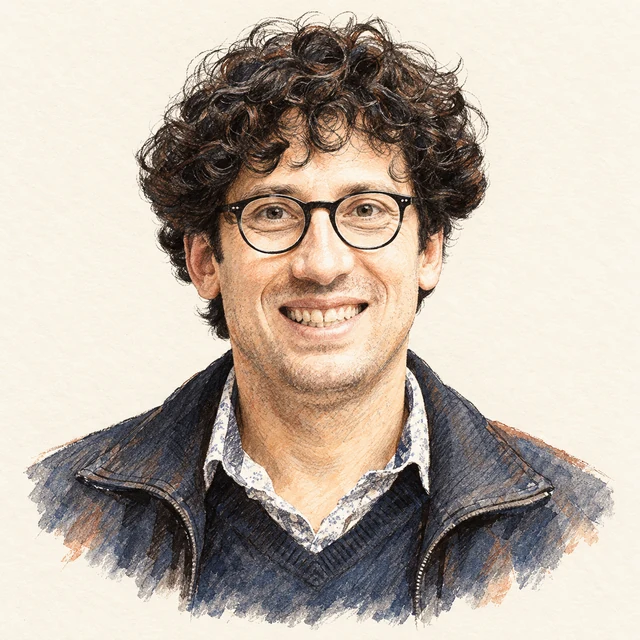
Hugo Duminil-Copin was born in Châtenay-Malabry and became a probabilist studying phase transitions. After training in Paris, he completed doctoral work with Stanislav Smirnov at the University of Geneva. At the 2022 Fields Medal he held professorships at both Geneva and IHES. His research investigates how local random interactions produce collective behavior, such as magnetization or large connected clusters. Through geometric and probabilistic techniques, often developed with collaborators, he resolved major questions about critical behavior in lattice models, including dimensions three and four. His work gives rigorous foundations to transitions first predicted through physical intuition.
The contribution, explained
In a percolation model, each connection of a lattice is open or closed at random. At low opening probability, clusters stay small; above a threshold, an infinite cluster can appear. In spin models, a similar change separates disordered behavior from spontaneous magnetization. Duminil-Copin developed geometric and probabilistic methods that make such phase transitions rigorous. His work with collaborators establishes sharp transitions and resolves difficult questions about continuity and critical behavior in important lattice models, including three and four dimensions. The central task is to deduce the behavior of an infinite interacting system from its local rules without assuming the desired large-scale picture.
Why it matters
These results turn qualitative physical predictions into precise theorems about collective systems. They improve understanding of criticality and supply methods that connect percolation, magnetism and the broader mathematical study of random structures.