c.curionodeThe Fields Archive

2022 · Probability & dynamics

When local randomness becomes collective order

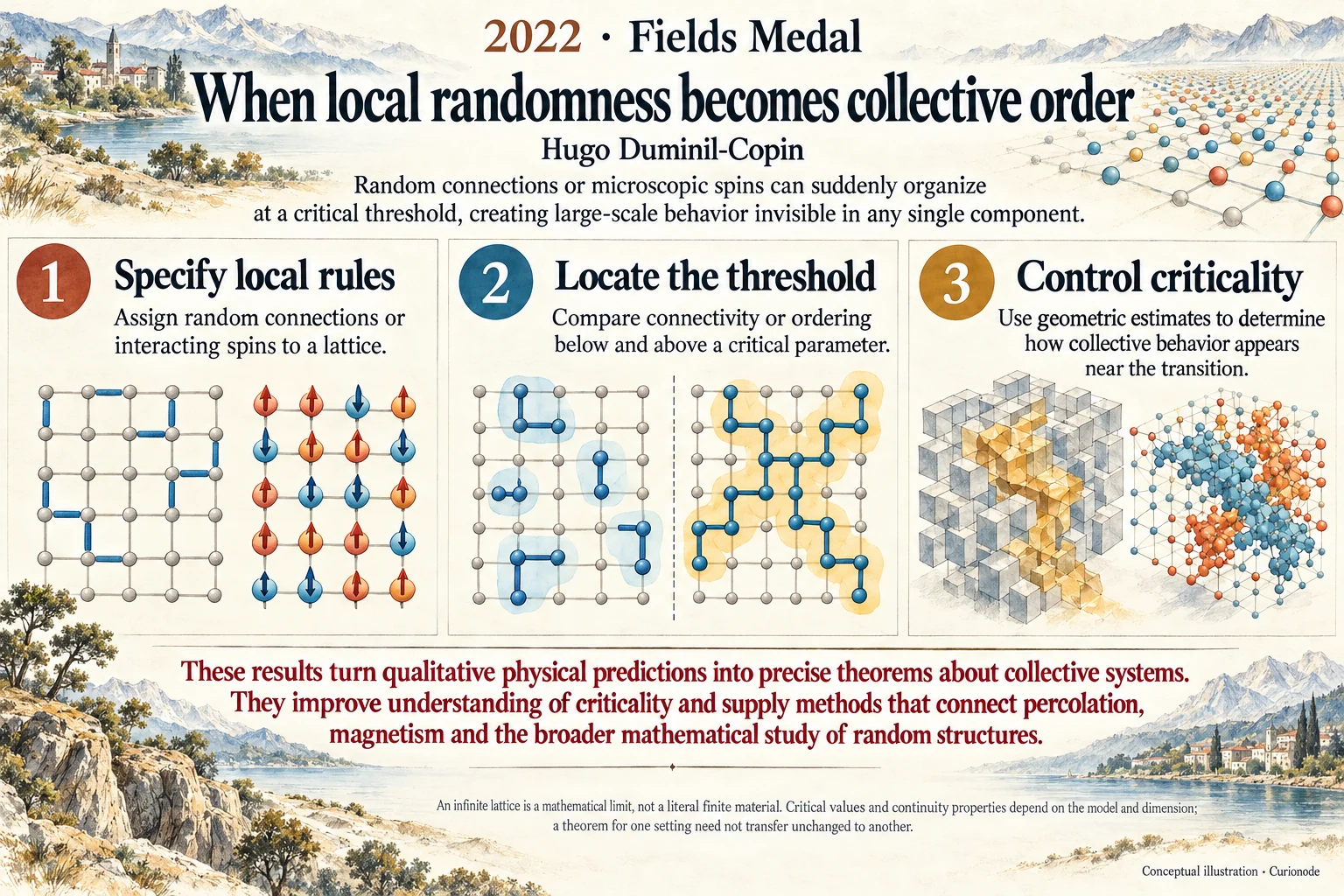
Random connections or microscopic spins can suddenly organize at a critical threshold, creating large-scale behavior invisible in any single component.

2022Fields Medal
When local randomness becomes collective order: Random connections or microscopic spins can suddenly organize at a critical threshold, creating large-scale behavior invisible in any single component.
Original AI-generated infographic by Curionode. Read the text version below for the full explanation.
Read the poster text
  1. Specify local rules

    Assign random connections or interacting spins to a lattice.

  2. Locate the threshold

    Compare connectivity or ordering below and above a critical parameter.

  3. Control criticality

    Use geometric estimates to determine how collective behavior appears near the transition.

These results turn qualitative physical predictions into precise theorems about collective systems. They improve understanding of criticality and supply methods that connect percolation, magnetism and the broader mathematical study of random structures.

An infinite lattice is a mathematical limit, not a literal finite material. Critical values and continuity properties depend on the model and dimension; a theorem for one setting need not transfer unchanged to another.

01 · The idea

In everyday language

In a percolation model, each connection of a lattice is open or closed at random. At low opening probability, clusters stay small; above a threshold, an infinite cluster can appear. In spin models, a similar change separates disordered behavior from spontaneous magnetization. Duminil-Copin developed geometric and probabilistic methods that make such phase transitions rigorous. His work with collaborators establishes sharp transitions and resolves difficult questions about continuity and critical behavior in important lattice models, including three and four dimensions. The central task is to deduce the behavior of an infinite interacting system from its local rules without assuming the desired large-scale picture.

Why it matters

These results turn qualitative physical predictions into precise theorems about collective systems. They improve understanding of criticality and supply methods that connect percolation, magnetism and the broader mathematical study of random structures.

02 · The people

Who brought the idea to life?

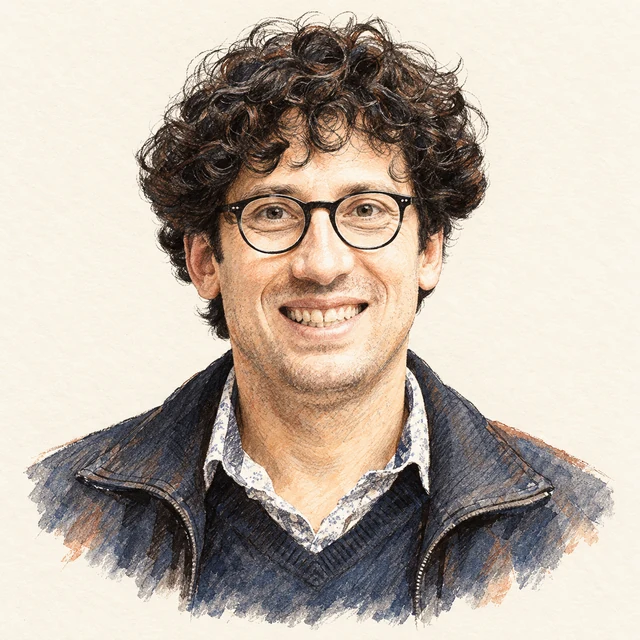
Illustrated portrait of Hugo Duminil-Copin

Hugo Duminil-Copin

Hugo Duminil-Copin was born in Châtenay-Malabry and became a probabilist studying phase transitions. After training in Paris, he completed doctoral work with Stanislav Smirnov at the University of Geneva. At the 2022 Fields Medal he held professorships at both Geneva and IHES. His research investigates how local random interactions produce collective behavior, such as magnetization or large connected clusters. Through geometric and probabilistic techniques, often developed with collaborators, he resolved major questions about critical behavior in lattice models, including dimensions three and four. His work gives rigorous foundations to transitions first predicted through physical intuition.

Read the biography ↗

03 · Read further

From the original sources

Original explanations based on the official award record. The subject label is an editorial navigation aid.

  1. Official IMU citation: Hugo Duminil-Copin ↗www.mathunion.org
  2. Heidelberg Laureate Forum: Hugo Duminil-Copin ↗www.heidelberg-laureate-forum.org
  3. IHES: Hugo Duminil-Copin awarded the Fields Medal, 5 July 2022 ↗www.ihes.fr
  4. IMU: Duminil-Copin detailed citation ↗www.mathunion.org