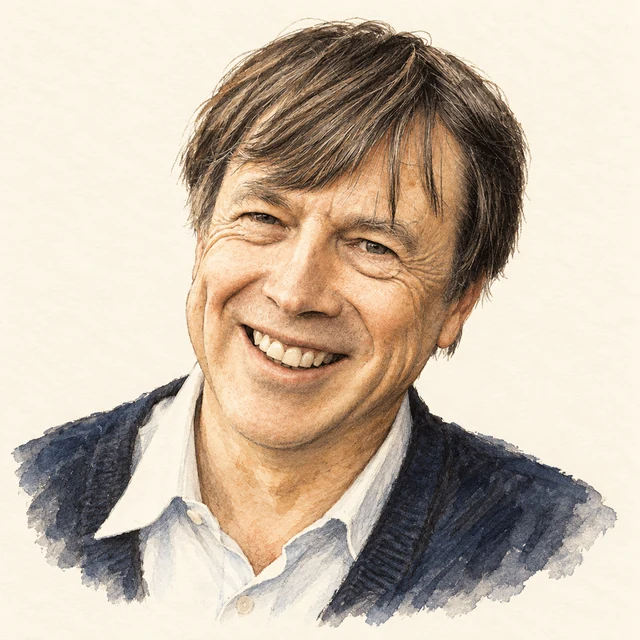
01 · A life in mathematics
The person behind the work
Jean Bourgain was born in Ostend, Belgium. He joined the Institute for Advanced Study in January 1994, the year of his Fields Medal, during a transition from his IHES professorship. His research ranged across Banach spaces, harmonic analysis, ergodic theory and nonlinear partial differential equations. Rather than treating these as isolated subjects, he combined tools from probability, combinatorics and number theory to overcome difficult analytic barriers. His estimates for dispersive equations helped control how waves evolve over time. The medal recognised this exceptional breadth and a series of breakthroughs; no single diagram or named equation can represent the whole achievement.
The contribution, explained
A complicated wave can be decomposed into oscillations of different frequencies. In a nonlinear equation these components interact, creating effects that cannot be predicted by studying each frequency alone. Bourgain developed methods that combine the geometry of frequencies with time-dependent estimates, especially for dispersive equations such as nonlinear Schrödinger equations. Suitable function spaces measure both oscillation and evolution, making it possible to prove that certain solutions exist and remain controlled. This is one strand of a much wider body of work. The goal is rigorous control of an equation’s solutions, not a claim that all waves become smooth or predictable.
Why it matters
These ideas reshaped analysis of nonlinear dispersive equations and showed how harmonic analysis, probability and arithmetic can work together to answer questions about the long-term behaviour of solutions.