01 · The idea
In everyday language
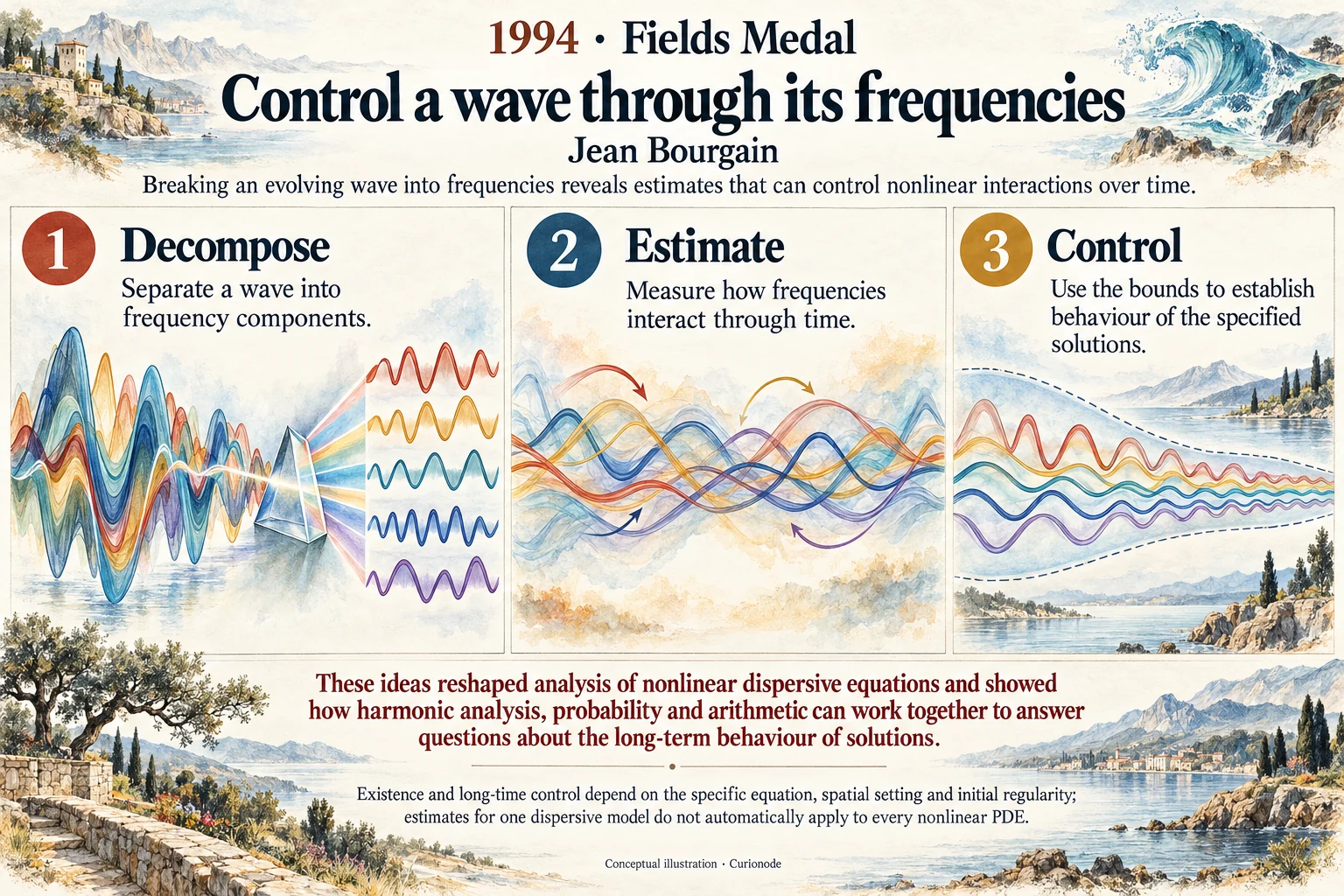
A complicated wave can be decomposed into oscillations of different frequencies. In a nonlinear equation these components interact, creating effects that cannot be predicted by studying each frequency alone. Bourgain developed methods that combine the geometry of frequencies with time-dependent estimates, especially for dispersive equations such as nonlinear Schrödinger equations. Suitable function spaces measure both oscillation and evolution, making it possible to prove that certain solutions exist and remain controlled. This is one strand of a much wider body of work. The goal is rigorous control of an equation’s solutions, not a claim that all waves become smooth or predictable.
Why it matters
These ideas reshaped analysis of nonlinear dispersive equations and showed how harmonic analysis, probability and arithmetic can work together to answer questions about the long-term behaviour of solutions.