01 · A life in mathematics
The person behind the work
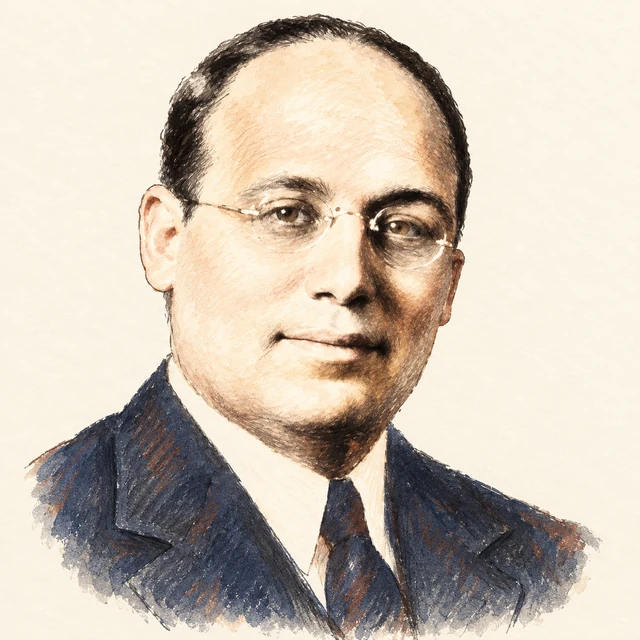
Jesse Douglas was born in New York City in 1897 and became a central figure in the mathematical study of minimal surfaces. His solution of the Plateau problem established the existence of a least-area disk spanning an appropriate closed boundary curve. He and Lars Ahlfors received the first Fields Medals in 1936. Douglas served on the MIT mathematics faculty from 1930 to 1936, a period documented in its faculty records. His achievement turned a question suggested by soap films into a rigorous existence problem, demonstrating the reach of variational methods.
The contribution, explained
Dip a wire loop into soap solution and a film may span the boundary. The mathematical question is harder than the experiment suggests: among suitable surfaces spanning a prescribed closed curve, does a least-area one exist? Douglas reformulated the disk-type Plateau problem through boundary parametrisations and an analytic minimisation problem. This approach supplied the compactness and control needed for an existence proof rather than merely a plausible picture. It connected the geometry of a surface to functions on a simpler parameter domain, helping turn a physical intuition into a theorem.
Why it matters
The solution became a landmark of the calculus of variations and minimal-surface theory, showing how analytic methods can establish the existence of geometric objects.