c.curionodeThe Fields Archive

1936 · Analysis & PDEs

The mathematics of a spanning film

Fix a boundary curve, compare spanning surfaces, and ask whether a least-area disk really exists.

1936Fields Medal
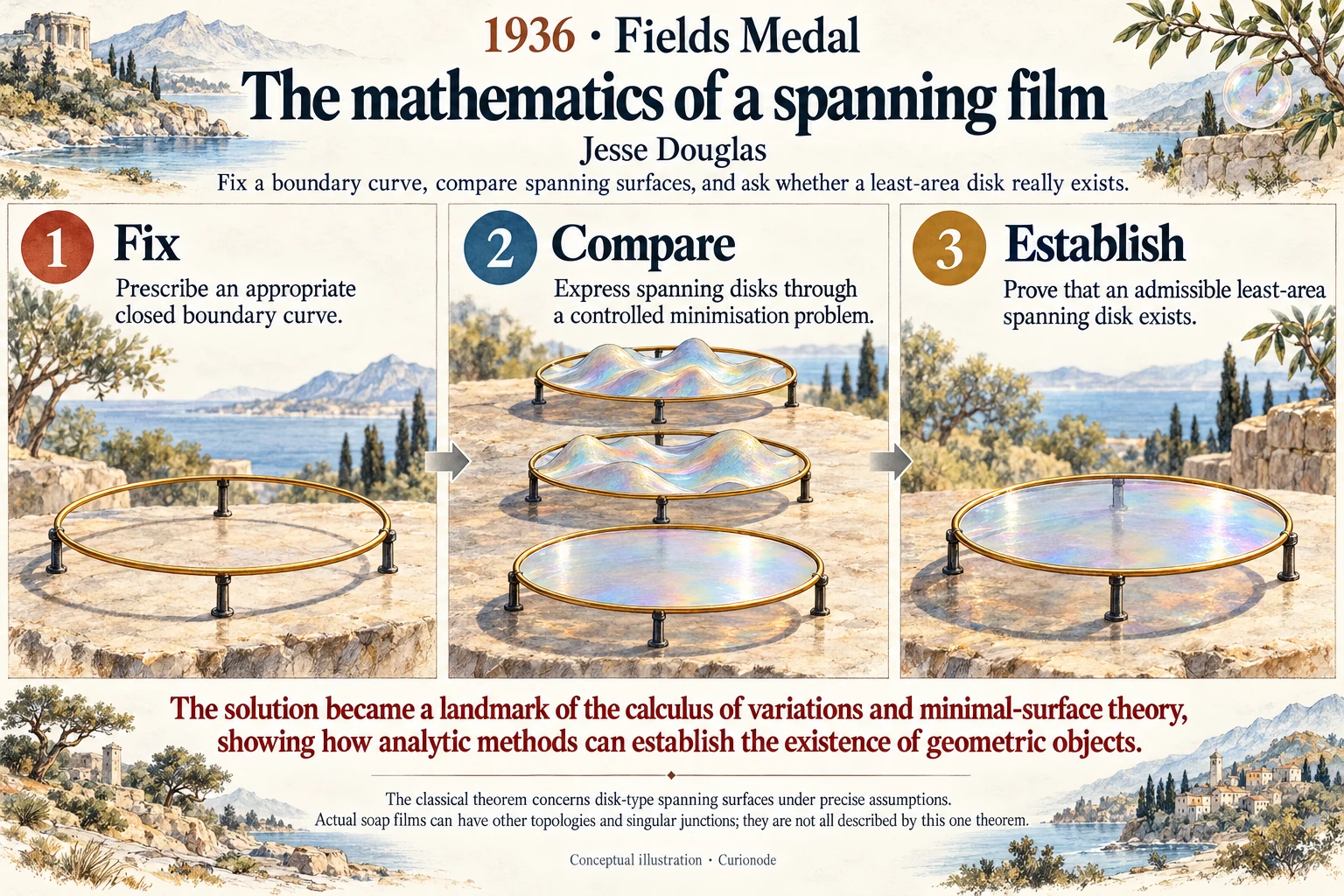
The mathematics of a spanning film: Fix a boundary curve, compare spanning surfaces, and ask whether a least-area disk really exists.
Original AI-generated infographic by Curionode. Read the text version below for the full explanation.
Read the poster text
  1. Fix

    Prescribe an appropriate closed boundary curve.

  2. Compare

    Express spanning disks through a controlled minimisation problem.

  3. Establish

    Prove that an admissible least-area spanning disk exists.

The solution became a landmark of the calculus of variations and minimal-surface theory, showing how analytic methods can establish the existence of geometric objects.

The classical theorem concerns disk-type spanning surfaces under precise assumptions. Actual soap films can have other topologies and singular junctions; they are not all described by this one theorem.

01 · The idea

In everyday language

Dip a wire loop into soap solution and a film may span the boundary. The mathematical question is harder than the experiment suggests: among suitable surfaces spanning a prescribed closed curve, does a least-area one exist? Douglas reformulated the disk-type Plateau problem through boundary parametrisations and an analytic minimisation problem. This approach supplied the compactness and control needed for an existence proof rather than merely a plausible picture. It connected the geometry of a surface to functions on a simpler parameter domain, helping turn a physical intuition into a theorem.

Why it matters

The solution became a landmark of the calculus of variations and minimal-surface theory, showing how analytic methods can establish the existence of geometric objects.

02 · The people

Who brought the idea to life?

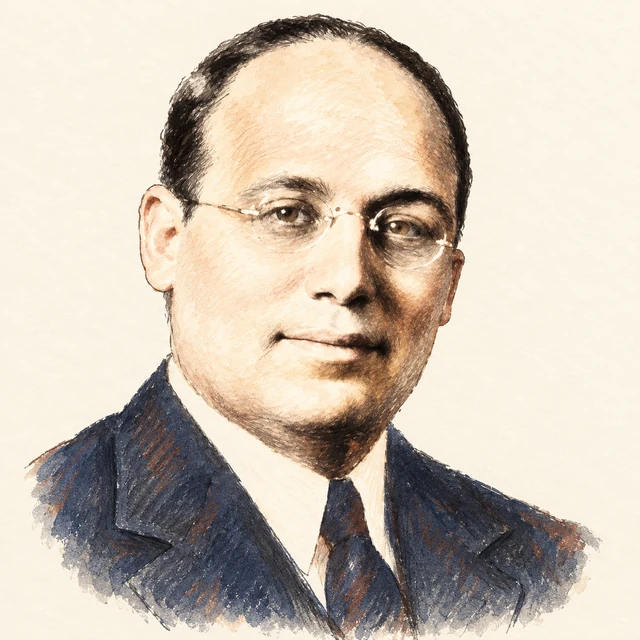
Illustrated portrait of Jesse Douglas

Jesse Douglas

Jesse Douglas was born in New York City in 1897 and became a central figure in the mathematical study of minimal surfaces. His solution of the Plateau problem established the existence of a least-area disk spanning an appropriate closed boundary curve. He and Lars Ahlfors received the first Fields Medals in 1936. Douglas served on the MIT mathematics faculty from 1930 to 1936, a period documented in its faculty records. His achievement turned a question suggested by soap films into a rigorous existence problem, demonstrating the reach of variational methods.

Read the biography ↗

03 · Read further

From the original sources

Original explanations based on the official award record. The subject label is an editorial navigation aid.

  1. Official IMU citation: Jesse Douglas ↗www.mathunion.org
  2. Heidelberg Laureate Forum: Jesse Douglas ↗www.heidelberg-laureate-forum.org
  3. MIT Mathematics: historical faculty appointments ↗math.mit.edu