01 · A life in mathematics
The person behind the work
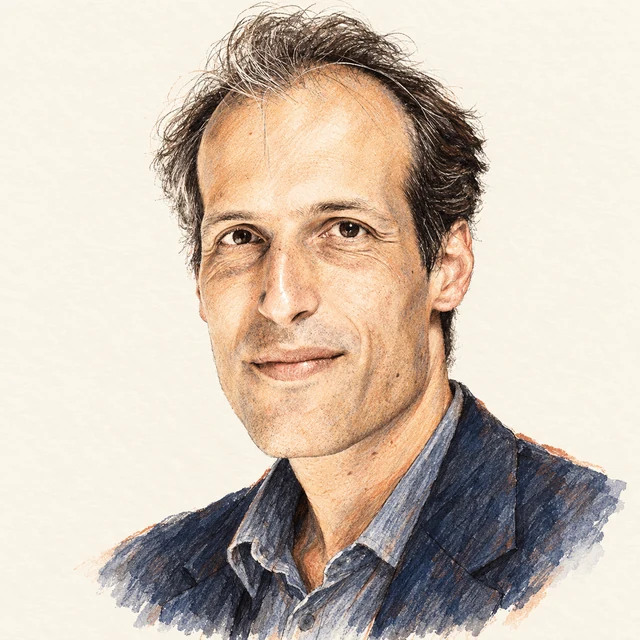
Martin Hairer was born in Geneva and became an analyst studying differential equations influenced by randomness. A professor at Warwick at the time of the 2014 Fields Medal, he developed the theory of regularity structures. This framework gives a rigorous meaning to certain nonlinear stochastic partial differential equations whose terms cannot be multiplied using ordinary calculus. It includes equations modeling randomly growing interfaces, such as the KPZ equation. His work extends local approximation beyond classical Taylor polynomials and controls the removal of small-scale regularization. It opened a systematic route to models that physicists could write down but mathematicians could not previously define consistently.
The contribution, explained
A growing surface may be modeled by an equation combining smoothing, nonlinear growth and random forcing. If the noise is sufficiently rough, the surface has no ordinary derivative, so squaring its slope is not automatically meaningful. Hairer’s regularity structures replace the usual local polynomial expansion with an algebra of symbols adapted to the equation and its noise. One first smooths the noise, identifies divergent terms and subtracts suitable counterterms. The theory then controls a limit as the smoothing is removed. This makes important singular stochastic equations, including the one-dimensional KPZ equation, into well-defined mathematical objects with stable solution theories.
Why it matters
The framework opened a systematic study of singular stochastic partial differential equations and clarified the mathematical role of renormalization. It allows researchers to connect microscopic random models with meaningful continuum equations in carefully defined settings.