c.curionodeThe Fields Archive

2014 · Analysis & PDEs

Giving meaning to equations driven by rough noise

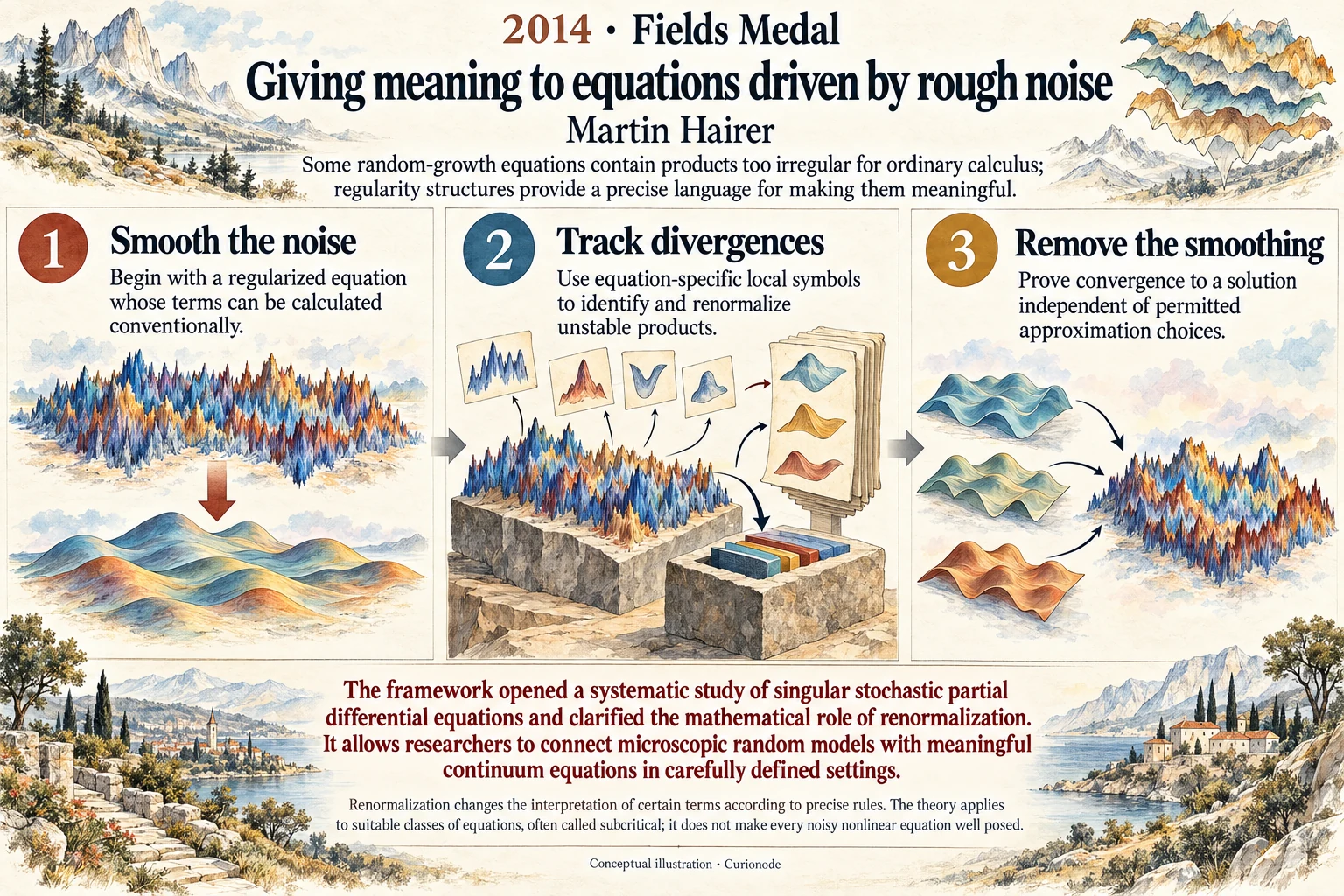
Some random-growth equations contain products too irregular for ordinary calculus; regularity structures provide a precise language for making them meaningful.

2014Fields Medal
Giving meaning to equations driven by rough noise: Some random-growth equations contain products too irregular for ordinary calculus; regularity structures provide a precise language for making them meaningful.
Original AI-generated infographic by Curionode. Read the text version below for the full explanation.
Read the poster text
  1. Smooth the noise

    Begin with a regularized equation whose terms can be calculated conventionally.

  2. Track divergences

    Use equation-specific local symbols to identify and renormalize unstable products.

  3. Remove the smoothing

    Prove convergence to a solution independent of permitted approximation choices.

The framework opened a systematic study of singular stochastic partial differential equations and clarified the mathematical role of renormalization. It allows researchers to connect microscopic random models with meaningful continuum equations in carefully defined settings.

Renormalization changes the interpretation of certain terms according to precise rules. The theory applies to suitable classes of equations, often called subcritical; it does not make every noisy nonlinear equation well posed.

01 · The idea

In everyday language

A growing surface may be modeled by an equation combining smoothing, nonlinear growth and random forcing. If the noise is sufficiently rough, the surface has no ordinary derivative, so squaring its slope is not automatically meaningful. Hairer’s regularity structures replace the usual local polynomial expansion with an algebra of symbols adapted to the equation and its noise. One first smooths the noise, identifies divergent terms and subtracts suitable counterterms. The theory then controls a limit as the smoothing is removed. This makes important singular stochastic equations, including the one-dimensional KPZ equation, into well-defined mathematical objects with stable solution theories.

Why it matters

The framework opened a systematic study of singular stochastic partial differential equations and clarified the mathematical role of renormalization. It allows researchers to connect microscopic random models with meaningful continuum equations in carefully defined settings.

02 · The people

Who brought the idea to life?

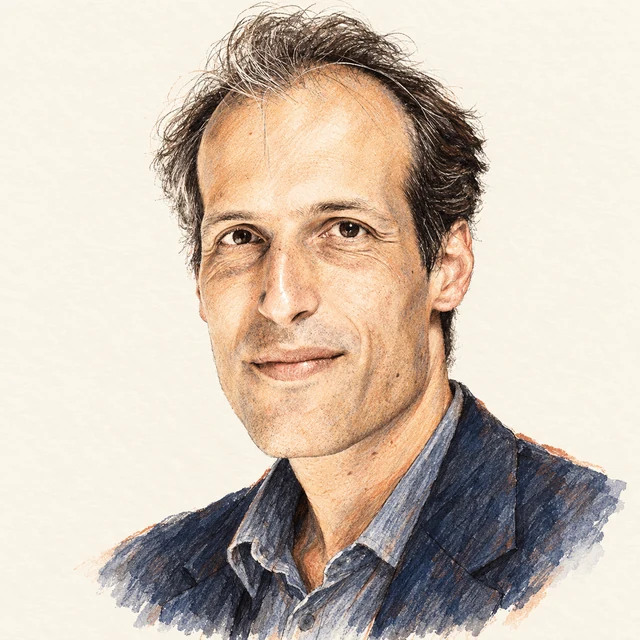
Illustrated portrait of Martin Hairer

Martin Hairer

Martin Hairer was born in Geneva and became an analyst studying differential equations influenced by randomness. A professor at Warwick at the time of the 2014 Fields Medal, he developed the theory of regularity structures. This framework gives a rigorous meaning to certain nonlinear stochastic partial differential equations whose terms cannot be multiplied using ordinary calculus. It includes equations modeling randomly growing interfaces, such as the KPZ equation. His work extends local approximation beyond classical Taylor polynomials and controls the removal of small-scale regularization. It opened a systematic route to models that physicists could write down but mathematicians could not previously define consistently.

Read the biography ↗

03 · Read further

From the original sources

Original explanations based on the official award record. The subject label is an editorial navigation aid.

  1. Official IMU citation: Martin Hairer ↗www.mathunion.org
  2. Heidelberg Laureate Forum: Martin Hairer ↗www.heidelberg-laureate-forum.org
  3. Warwick: Martin Hairer awarded Fields Medal, 13 August 2014 ↗warwick.ac.uk
  4. IMU: Hairer work and biography ↗www.mathunion.org