01 · A life in mathematics
The person behind the work
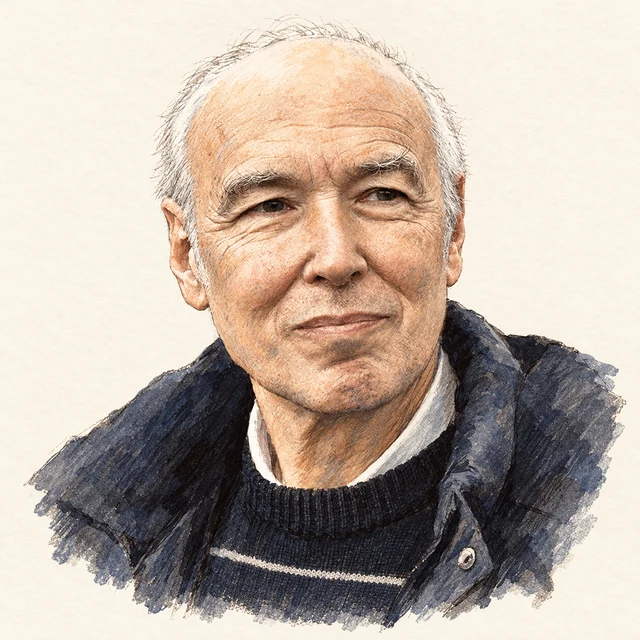
Pierre Deligne was born in Brussels in 1944. He became a permanent professor at the IHES in 1970 and received the 1978 Fields Medal for work linking algebraic geometry and number theory, notably his proof of the remaining Weil conjecture. Building on a large programme developed by Weil, Grothendieck and others, he established the finite-field analogue of the Riemann hypothesis for smooth projective varieties. His research showed how geometric cohomology can govern arithmetic counting. The result completed a central part of the programme without settling the classical Riemann hypothesis over the integers.
The contribution, explained
Over a finite field, polynomial equations have finitely many solutions. Count them not only in the original field but also in its finite extensions, and package the counts into a zeta function. The Weil conjectures predict a remarkably structured form for this function. Deligne proved the crucial bounds on Frobenius eigenvalues, completing the remaining conjecture for smooth projective varieties. Cohomology supplies the spaces on which Frobenius acts, while the eigenvalue bounds control fluctuations in point counts. Arithmetic counting therefore becomes a window into an underlying geometric structure, rather than a series of unrelated enumerations.
Why it matters
The proof completed the Weil-conjecture programme and provided fundamental estimates and structural tools throughout arithmetic geometry, with consequences for many counting and number-theoretic problems.