c.curionodeThe Fields Archive

1978 · Algebraic geometry

Geometry behind counting finite-field solutions

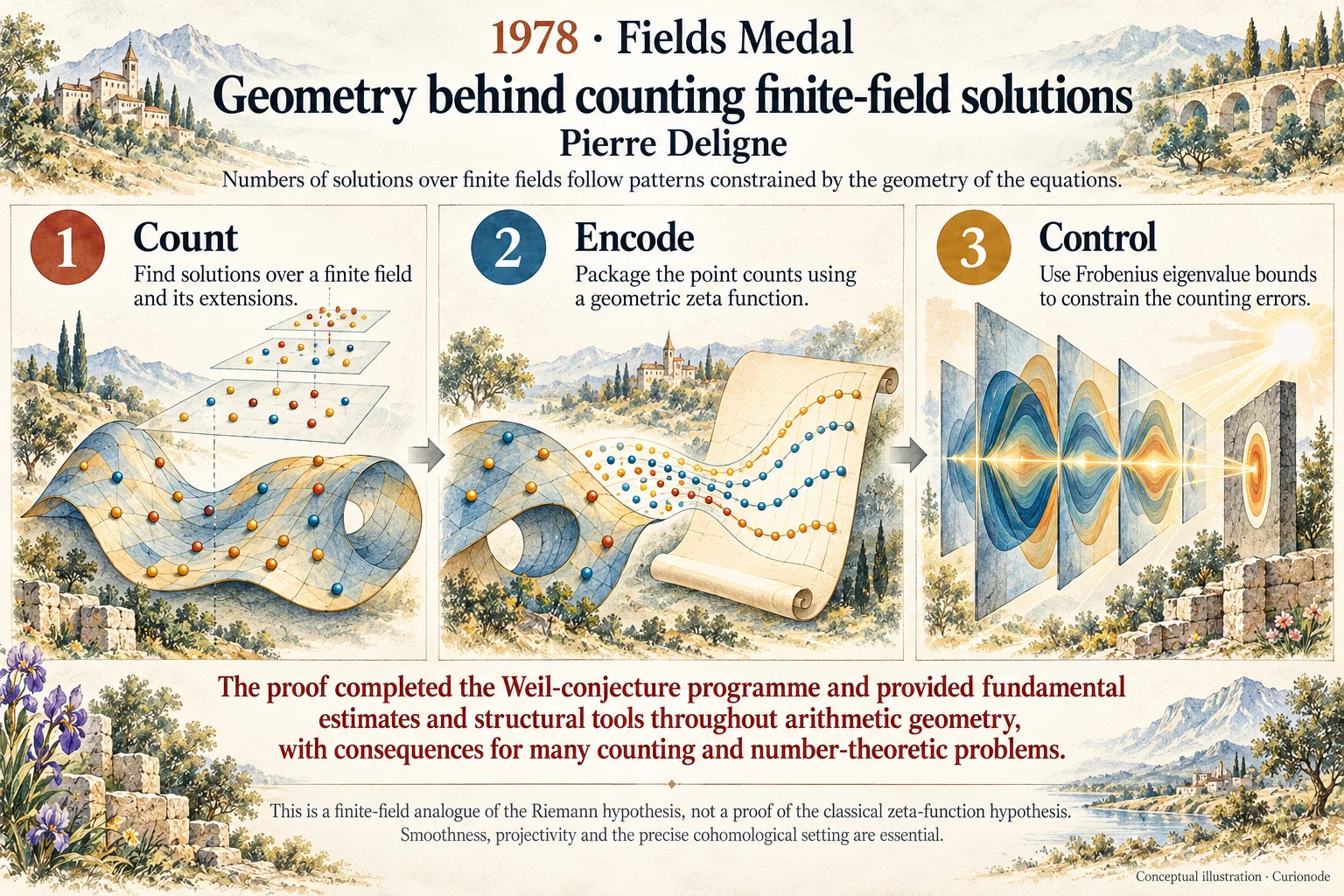
Numbers of solutions over finite fields follow patterns constrained by the geometry of the equations.

1978Fields Medal
Geometry behind counting finite-field solutions: Numbers of solutions over finite fields follow patterns constrained by the geometry of the equations.
Original AI-generated infographic by Curionode. Read the text version below for the full explanation.
Read the poster text
  1. Count

    Find solutions over a finite field and its extensions.

  2. Encode

    Package the point counts using a geometric zeta function.

  3. Control

    Use Frobenius eigenvalue bounds to constrain the counting errors.

The proof completed the Weil-conjecture programme and provided fundamental estimates and structural tools throughout arithmetic geometry, with consequences for many counting and number-theoretic problems.

This is a finite-field analogue of the Riemann hypothesis, not a proof of the classical zeta-function hypothesis. Smoothness, projectivity and the precise cohomological setting are essential.

01 · The idea

In everyday language

Over a finite field, polynomial equations have finitely many solutions. Count them not only in the original field but also in its finite extensions, and package the counts into a zeta function. The Weil conjectures predict a remarkably structured form for this function. Deligne proved the crucial bounds on Frobenius eigenvalues, completing the remaining conjecture for smooth projective varieties. Cohomology supplies the spaces on which Frobenius acts, while the eigenvalue bounds control fluctuations in point counts. Arithmetic counting therefore becomes a window into an underlying geometric structure, rather than a series of unrelated enumerations.

Why it matters

The proof completed the Weil-conjecture programme and provided fundamental estimates and structural tools throughout arithmetic geometry, with consequences for many counting and number-theoretic problems.

02 · The people

Who brought the idea to life?

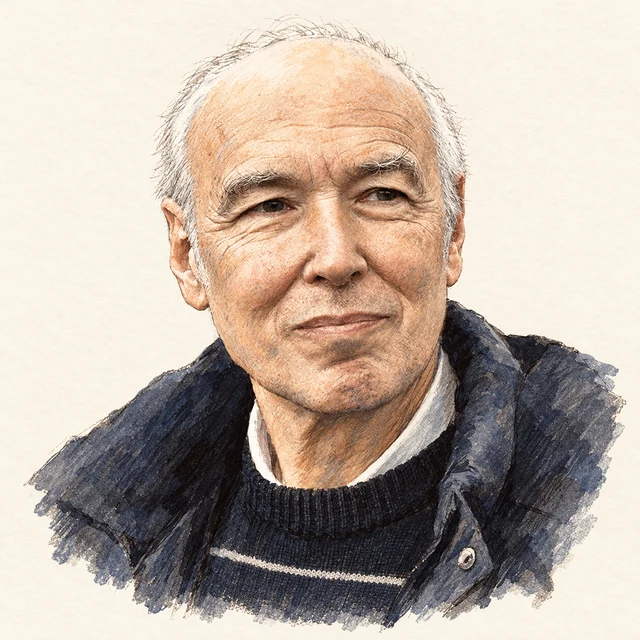
Illustrated portrait of Pierre Deligne

Pierre Deligne

Pierre Deligne was born in Brussels in 1944. He became a permanent professor at the IHES in 1970 and received the 1978 Fields Medal for work linking algebraic geometry and number theory, notably his proof of the remaining Weil conjecture. Building on a large programme developed by Weil, Grothendieck and others, he established the finite-field analogue of the Riemann hypothesis for smooth projective varieties. His research showed how geometric cohomology can govern arithmetic counting. The result completed a central part of the programme without settling the classical Riemann hypothesis over the integers.

Read the biography ↗

03 · Read further

From the original sources

Original explanations based on the official award record. The subject label is an editorial navigation aid.

  1. Official IMU citation: Pierre Deligne ↗www.mathunion.org
  2. Heidelberg Laureate Forum: Pierre Deligne ↗www.heidelberg-laureate-forum.org
  3. IHES: institutional history and Deligne, 1970–1984 ↗www.ihes.fr