01 · A life in mathematics
The person behind the work
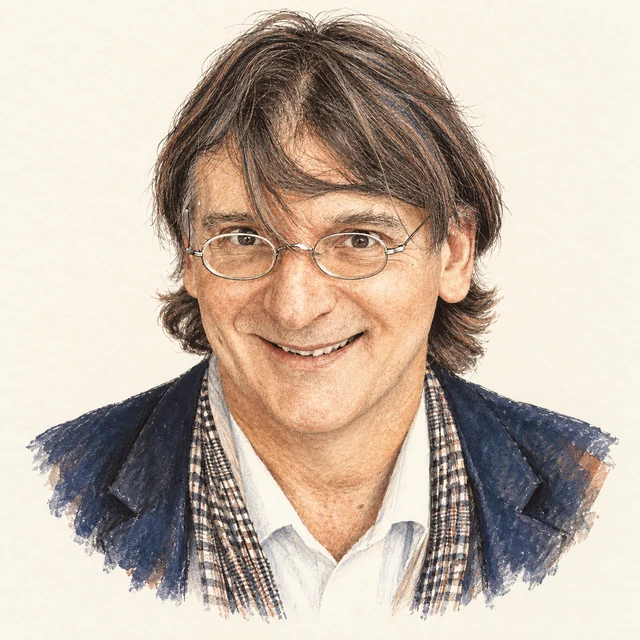
Pierre-Louis Lions was born in Grasse, France. At the time of his 1994 Fields Medal he was a professor at Paris-Dauphine and also taught at École Polytechnique. His work created methods for broad classes of nonlinear partial differential equations, including equations of optimisation, transport and kinetic theory. With Michael Crandall, he developed the theory of viscosity solutions, allowing meaningful solutions even where classical differentiability fails. His concentration-compactness principle addressed another fundamental difficulty: approximate solutions can move away or concentrate rather than converge. These methods changed how analysts formulate questions of existence, uniqueness and stability, linking rigorous theory with models motivated by applications.
The contribution, explained
A value function from an optimisation problem can have corners, so the derivatives demanded by a classical Hamilton–Jacobi equation may not exist. Crandall and Lions’ viscosity framework compares the unknown function with smooth test functions touching it from above or below. Inequalities for those test functions express what it means to satisfy the equation at a nonsmooth point. Under suitable assumptions, a comparison principle orders subsolutions and supersolutions, often yielding uniqueness and stability. The word viscosity comes from a regularisation viewpoint, but the definition is mathematical and need not describe a physically viscous fluid.
Why it matters
Viscosity solutions made many nonlinear equations from control and optimisation mathematically well posed, connecting nonsmooth value functions with reliable principles for uniqueness, approximation and stability.