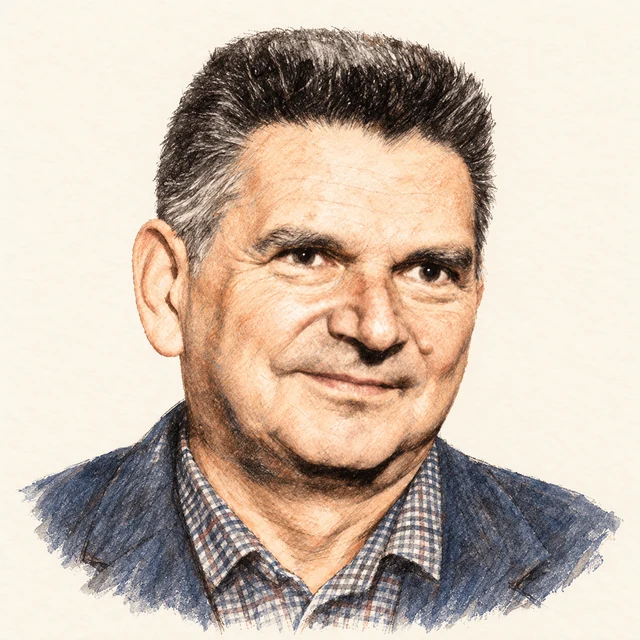
01 · A life in mathematics
The person behind the work
René Thom was born in Montbéliard, France, in 1923. He received the 1958 Fields Medal while at the University of Strasbourg for work in topology, particularly cobordism. This theory asks when manifolds can be related as the boundary of a higher-dimensional manifold, connecting geometric classification with algebraic invariants. Thom later joined the IHES in 1963. Although he became widely known for catastrophe theory, his medal-period work centred on the structure of manifolds and the topological methods that classify them, leaving a foundational legacy in differential and algebraic topology.
The contribution, explained
A circle bounds a disk, while a cylinder has two circular boundary components. Cobordism turns such pictures into a systematic relation between manifolds: two closed manifolds are cobordant when their disjoint union, with the appropriate orientation convention, is the boundary of a higher-dimensional manifold. Thom connected this geometric relation to homotopy theory and computable characteristic numbers. Rather than classify every possible shape individually, one studies algebraic classes that capture what can be changed through a cobordism. This created a powerful bridge between geometric constructions and algebraic topology.
Why it matters
Cobordism became a central organising tool for manifolds and a model for generalised cohomology theories, influencing subsequent work throughout topology and geometry.