c.curionodeThe Fields Archive

1958 · Geometry & topology

Classifying shapes by their boundaries

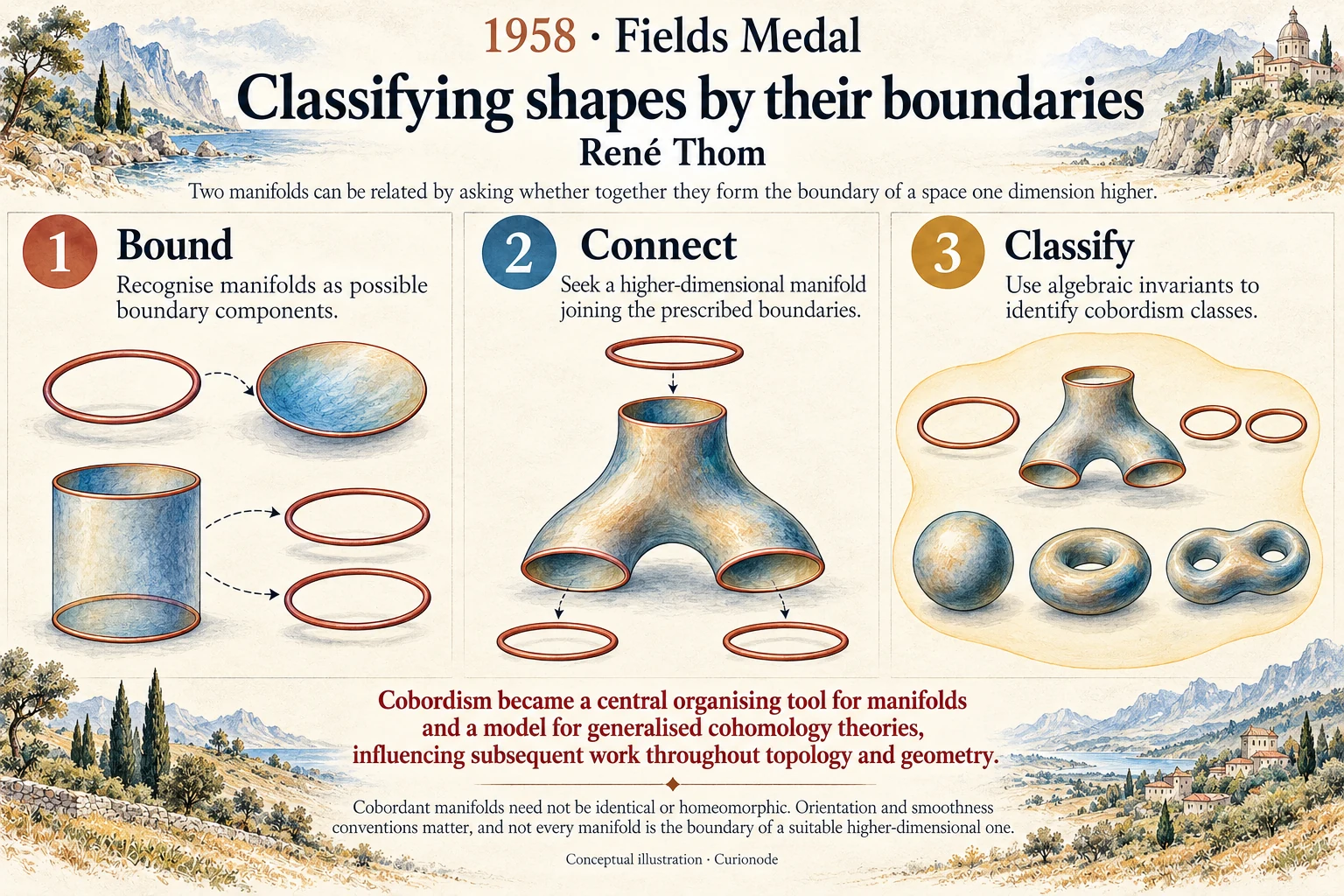
Two manifolds can be related by asking whether together they form the boundary of a space one dimension higher.

1958Fields Medal
Classifying shapes by their boundaries: Two manifolds can be related by asking whether together they form the boundary of a space one dimension higher.
Original AI-generated infographic by Curionode. Read the text version below for the full explanation.
Read the poster text
  1. Bound

    Recognise manifolds as possible boundary components.

  2. Connect

    Seek a higher-dimensional manifold joining the prescribed boundaries.

  3. Classify

    Use algebraic invariants to identify cobordism classes.

Cobordism became a central organising tool for manifolds and a model for generalised cohomology theories, influencing subsequent work throughout topology and geometry.

Cobordant manifolds need not be identical or homeomorphic. Orientation and smoothness conventions matter, and not every manifold is the boundary of a suitable higher-dimensional one.

01 · The idea

In everyday language

A circle bounds a disk, while a cylinder has two circular boundary components. Cobordism turns such pictures into a systematic relation between manifolds: two closed manifolds are cobordant when their disjoint union, with the appropriate orientation convention, is the boundary of a higher-dimensional manifold. Thom connected this geometric relation to homotopy theory and computable characteristic numbers. Rather than classify every possible shape individually, one studies algebraic classes that capture what can be changed through a cobordism. This created a powerful bridge between geometric constructions and algebraic topology.

Why it matters

Cobordism became a central organising tool for manifolds and a model for generalised cohomology theories, influencing subsequent work throughout topology and geometry.

02 · The people

Who brought the idea to life?

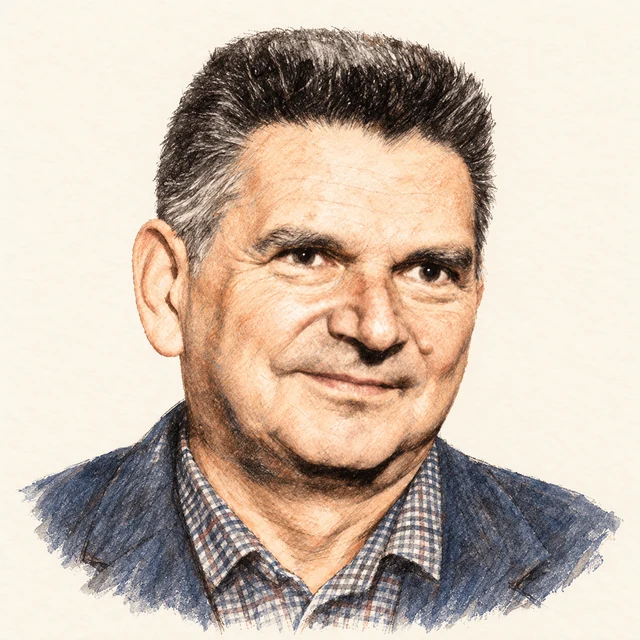
Illustrated portrait of René Thom

René Thom

René Thom was born in Montbéliard, France, in 1923. He received the 1958 Fields Medal while at the University of Strasbourg for work in topology, particularly cobordism. This theory asks when manifolds can be related as the boundary of a higher-dimensional manifold, connecting geometric classification with algebraic invariants. Thom later joined the IHES in 1963. Although he became widely known for catastrophe theory, his medal-period work centred on the structure of manifolds and the topological methods that classify them, leaving a foundational legacy in differential and algebraic topology.

Read the biography ↗

03 · Read further

From the original sources

Original explanations based on the official award record. The subject label is an editorial navigation aid.

  1. Official IMU citation: René Thom ↗www.mathunion.org
  2. Heidelberg Laureate Forum: René Thom ↗www.heidelberg-laureate-forum.org
  3. IHES: René Thom ↗www.ihes.fr