c.curionodeThe Fields Archive

1950 · Number theory

Counting primes without a complex detour

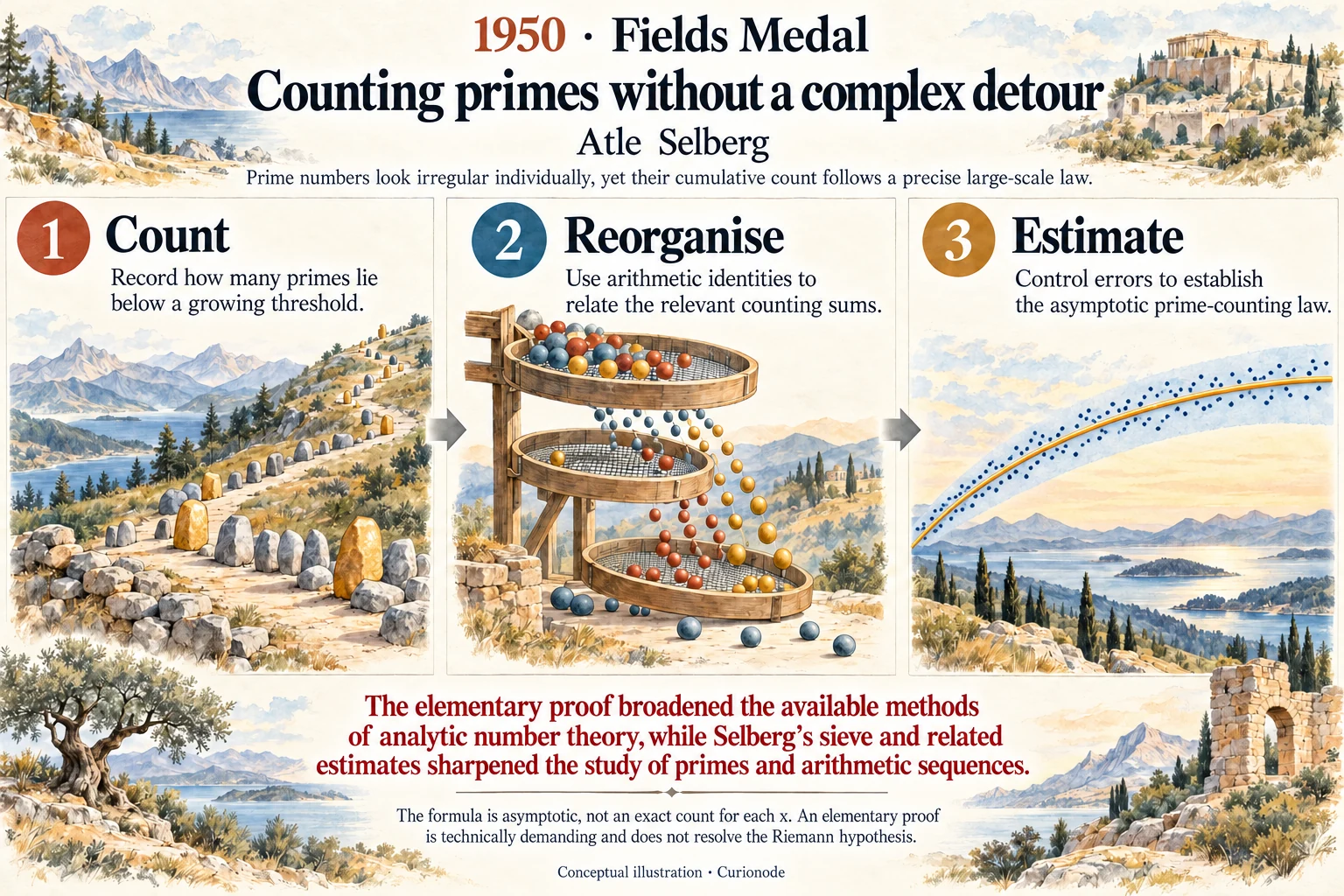
Prime numbers look irregular individually, yet their cumulative count follows a precise large-scale law.

1950Fields Medal
Counting primes without a complex detour: Prime numbers look irregular individually, yet their cumulative count follows a precise large-scale law.
Original AI-generated infographic by Curionode. Read the text version below for the full explanation.
Read the poster text
  1. Count

    Record how many primes lie below a growing threshold.

  2. Reorganise

    Use arithmetic identities to relate the relevant counting sums.

  3. Estimate

    Control errors to establish the asymptotic prime-counting law.

The elementary proof broadened the available methods of analytic number theory, while Selberg’s sieve and related estimates sharpened the study of primes and arithmetic sequences.

The formula is asymptotic, not an exact count for each x. An elementary proof is technically demanding and does not resolve the Riemann hypothesis.

01 · The idea

In everyday language

Let π(x) count the primes not exceeding x. The prime number theorem says that π(x) is asymptotic to x/log x: the ratio approaches one as x grows. Earlier proofs used complex analysis of the zeta function. Selberg’s work, together with Erdős’s contributions, provided an elementary route using arithmetic identities and estimates instead. Elementary here describes the permitted methods, not the difficulty. The achievement showed that a global statistical law about primes could be reached by reorganising sums and controlling their errors within a different mathematical toolkit.

Why it matters

The elementary proof broadened the available methods of analytic number theory, while Selberg’s sieve and related estimates sharpened the study of primes and arithmetic sequences.

02 · The people

Who brought the idea to life?

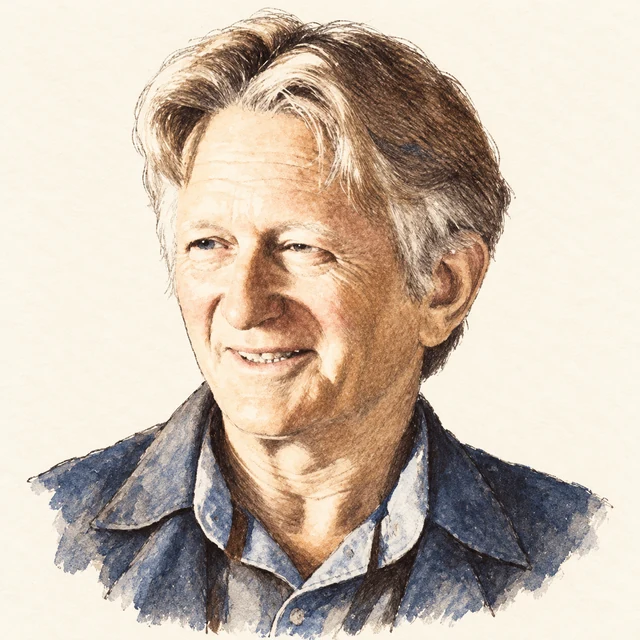
Illustrated portrait of Atle Selberg

Atle Selberg

Atle Selberg was born in Langesund, Norway, in 1917. He investigated prime numbers through analytic estimates, sieve methods and the zeros of the zeta function. His 1950 Fields Medal recognised achievements including the elementary approach to the prime number theorem associated with his and Paul Erdős’s work. He was at the Institute for Advanced Study in Princeton during the award period and became a professor there in 1951. His later trace formula linked spectral information with geometry, extending a career notable for finding powerful structures behind arithmetic counting problems.

Read the biography ↗

03 · Read further

From the original sources

Original explanations based on the official award record. The subject label is an editorial navigation aid.

  1. Official IMU citation: Atle Selberg ↗www.mathunion.org
  2. Heidelberg Laureate Forum: Atle Selberg ↗www.heidelberg-laureate-forum.org
  3. Institute for Advanced Study: Atle Selberg ↗www.ias.edu