c.curionodeThe Fields Archive

2026 · Number theory

Tame geometry reveals hidden arithmetic structure

An idea from mathematical logic helps distinguish exceptional arithmetic patterns from the ordinary points of complicated geometric parameter spaces.

2026Fields Medal
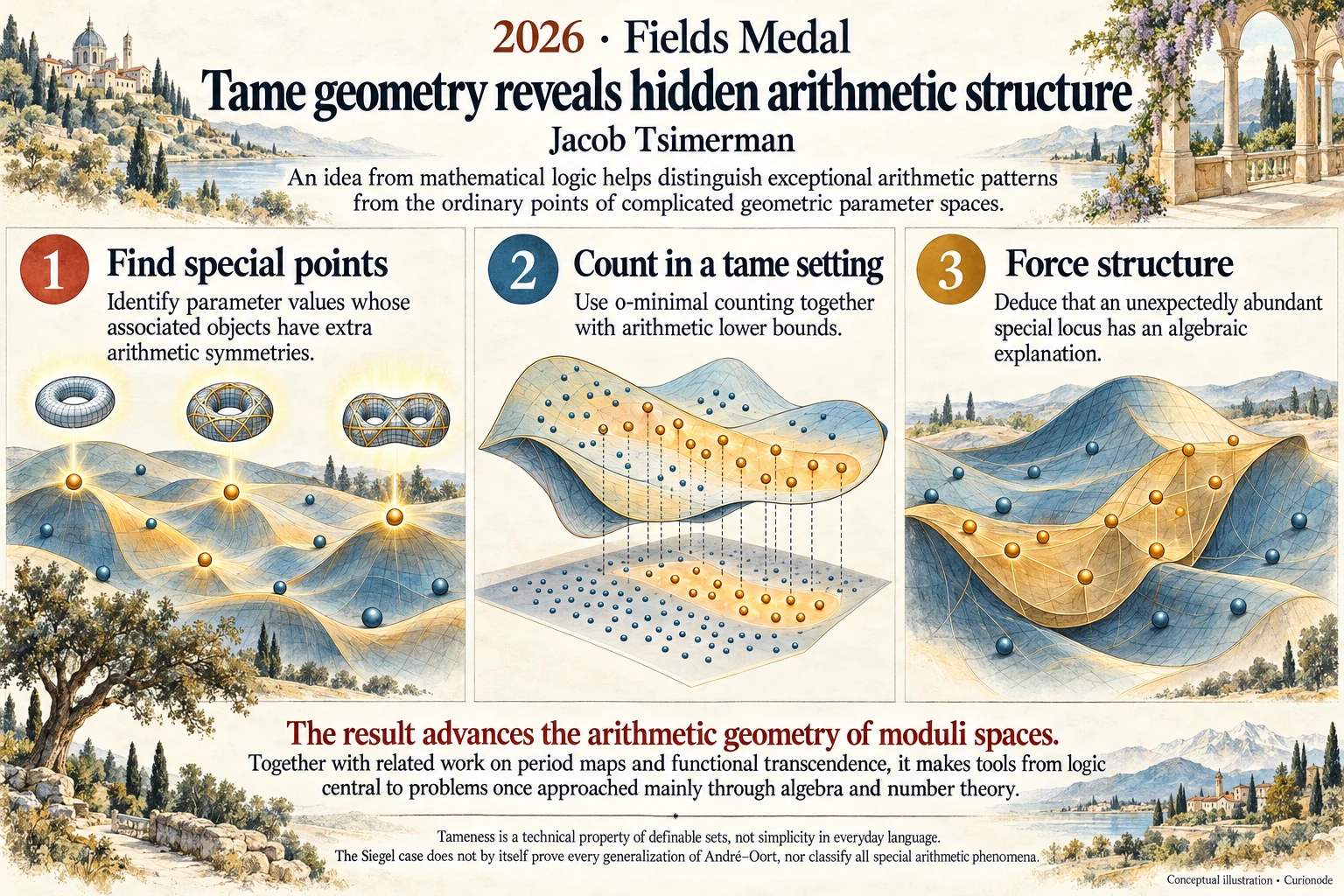
Tame geometry reveals hidden arithmetic structure: An idea from mathematical logic helps distinguish exceptional arithmetic patterns from the ordinary points of complicated geometric parameter spaces.
Original AI-generated infographic by Curionode. Read the text version below for the full explanation.
Read the poster text
  1. Find special points

    Identify parameter values whose associated objects have extra arithmetic symmetries.

  2. Count in a tame setting

    Use o-minimal counting together with arithmetic lower bounds.

  3. Force structure

    Deduce that an unexpectedly abundant special locus has an algebraic explanation.

The result advances the arithmetic geometry of moduli spaces. Together with related work on period maps and functional transcendence, it makes tools from logic central to problems once approached mainly through algebra and number theory.

Tameness is a technical property of definable sets, not simplicity in everyday language. The Siegel case does not by itself prove every generalization of André–Oort, nor classify all special arithmetic phenomena.

01 · The idea

In everyday language

Some geometric spaces parametrize other geometric objects, such as complex tori with extra structure. Within these spaces, certain points are arithmetically special because their objects possess additional symmetries. The André–Oort conjecture predicts that a subvariety containing a sufficiently rich collection of special points must itself have a special description. Tsimerman proved this for Siegel modular varieties. The strategy combines arithmetic bounds with o-minimality, a logical framework that prevents definable sets from oscillating uncontrollably. Comparing the scarcity of ordinary rational points with the abundance forced by arithmetic produces a bridge from analytic descriptions to rigid algebraic structure.

Why it matters

The result advances the arithmetic geometry of moduli spaces. Together with related work on period maps and functional transcendence, it makes tools from logic central to problems once approached mainly through algebra and number theory.

02 · The people

Who brought the idea to life?

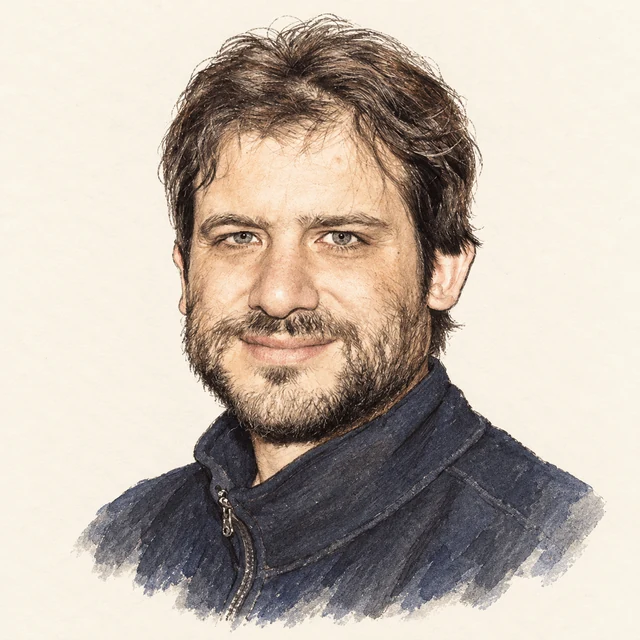
Illustrated portrait of Jacob Tsimerman

Jacob Tsimerman

Jacob Tsimerman was born in Kazan and works at the meeting point of number theory, algebraic geometry and logic. He was a professor at the University of Toronto when awarded the 2026 Fields Medal. His research helped turn o-minimality, a theory of geometrically tame definable sets, into a powerful tool for arithmetic problems. He proved the André–Oort conjecture for Siegel modular varieties and, with collaborators, established major results about period maps and functional transcendence. His work reveals how restrictions on complicated analytic descriptions can force hidden algebraic structure, providing new routes through longstanding classification problems.

Read the biography ↗

03 · Read further

From the original sources

Original explanations based on the official award record. The subject label is an editorial navigation aid.

  1. Official IMU citation: Jacob Tsimerman ↗www.mathunion.org
  2. Heidelberg Laureate Forum: Jacob Tsimerman ↗www.heidelberg-laureate-forum.org
  3. University of Toronto: Jacob Tsimerman awarded 2026 Fields Medal ↗www.utoronto.ca
  4. IMU: Jacob Tsimerman detailed citation ↗www.mathunion.org