c.curionodeThe Fields Archive

2022 · Number theory

Finding clusters in the sparse prime numbers

Primes become rarer as numbers grow, yet carefully designed sieve weights reveal infinitely many intervals containing several of them together.

2022Fields Medal
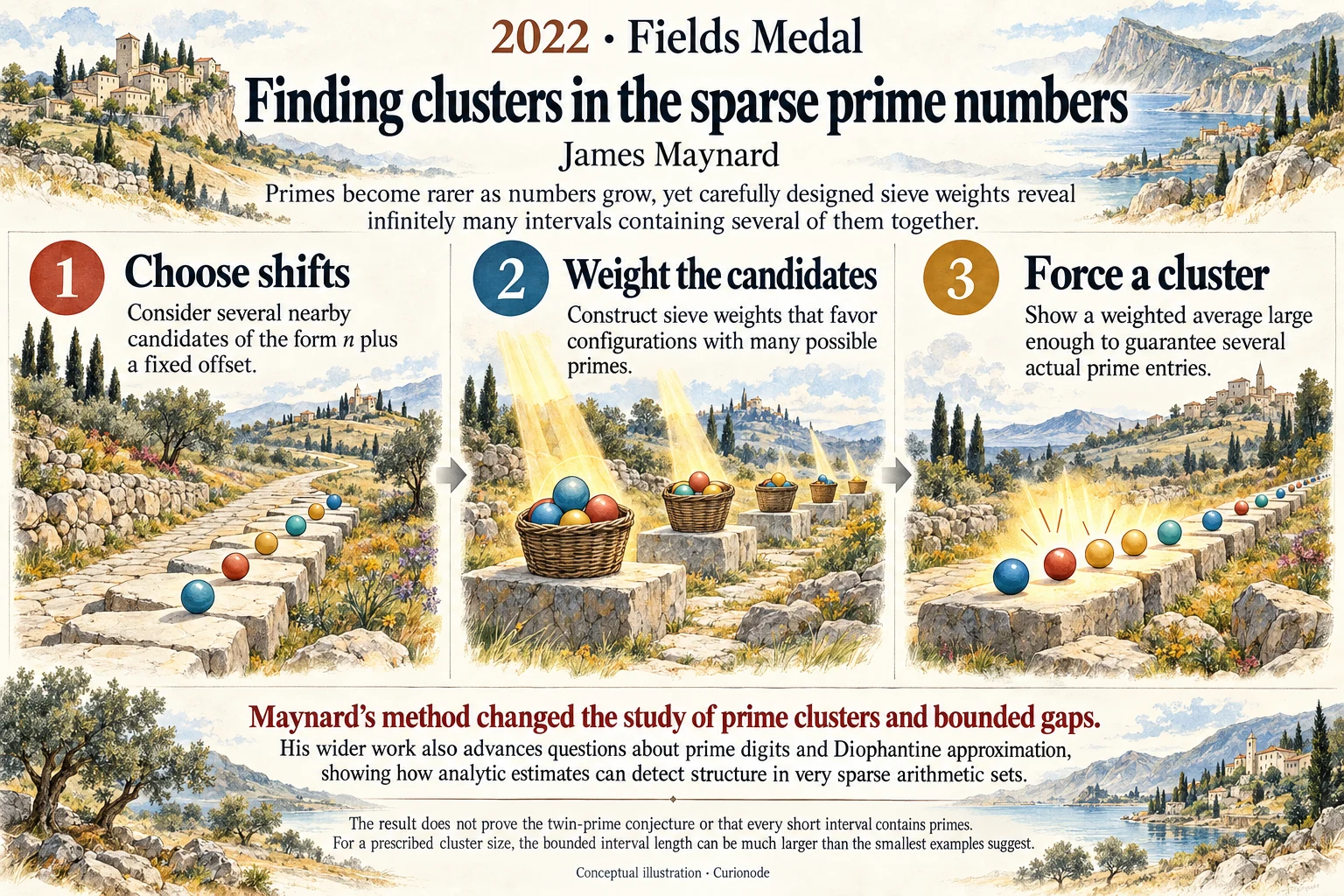
Finding clusters in the sparse prime numbers: Primes become rarer as numbers grow, yet carefully designed sieve weights reveal infinitely many intervals containing several of them together.
Original AI-generated infographic by Curionode. Read the text version below for the full explanation.
Read the poster text
  1. Choose shifts

    Consider several nearby candidates of the form n plus a fixed offset.

  2. Weight the candidates

    Construct sieve weights that favor configurations with many possible primes.

  3. Force a cluster

    Show a weighted average large enough to guarantee several actual prime entries.

Maynard’s method changed the study of prime clusters and bounded gaps. His wider work also advances questions about prime digits and Diophantine approximation, showing how analytic estimates can detect structure in very sparse arithmetic sets.


The result does not prove the twin-prime conjecture or that every short interval contains primes. For a prescribed cluster size, the bounded interval length can be much larger than the smallest examples suggest.

01 · The idea

In everyday language

The prime number theorem describes the average frequency of primes, but it does not ensure that several primes occur close together infinitely often. Maynard devised sieve weights that detect multiple primes among a collection of shifted integers. Instead of proving that every chosen entry is prime, he arranged the calculation so that the average weighted number of prime entries must be large. This proves that, for any fixed number of primes, some interval length contains that many primes infinitely often. The interval bound may be enormous, but it is finite and independent of how far along the number line one searches.

Why it matters

Maynard’s method changed the study of prime clusters and bounded gaps. His wider work also advances questions about prime digits and Diophantine approximation, showing how analytic estimates can detect structure in very sparse arithmetic sets.

02 · The people

Who brought the idea to life?

Illustrated portrait of James Maynard

James Maynard

James Maynard, born in Chelmsford, is an analytic number theorist who studies the distribution of primes and rational approximations. He was a professor at Oxford when he received the 2022 Fields Medal. His new sieve methods proved that bounded intervals can contain arbitrarily prescribed finite numbers of primes infinitely often, with the bound depending on that number. His research also found primes avoiding a chosen decimal digit and advanced metric Diophantine approximation with collaborators. Rather than predicting each prime individually, his methods exploit aggregate information and carefully chosen weights to reveal patterns in sequences that become increasingly sparse.

Read the biography ↗

03 · Read further

From the original sources

Original explanations based on the official award record. The subject label is an editorial navigation aid.

  1. Official IMU citation: James Maynard ↗www.mathunion.org
  2. Heidelberg Laureate Forum: James Maynard ↗www.heidelberg-laureate-forum.org
  3. Oxford: James Maynard awarded Fields Medal 2022 ↗www.ox.ac.uk
  4. IMU: Maynard detailed citation ↗www.mathunion.org