01 · The idea
In everyday language
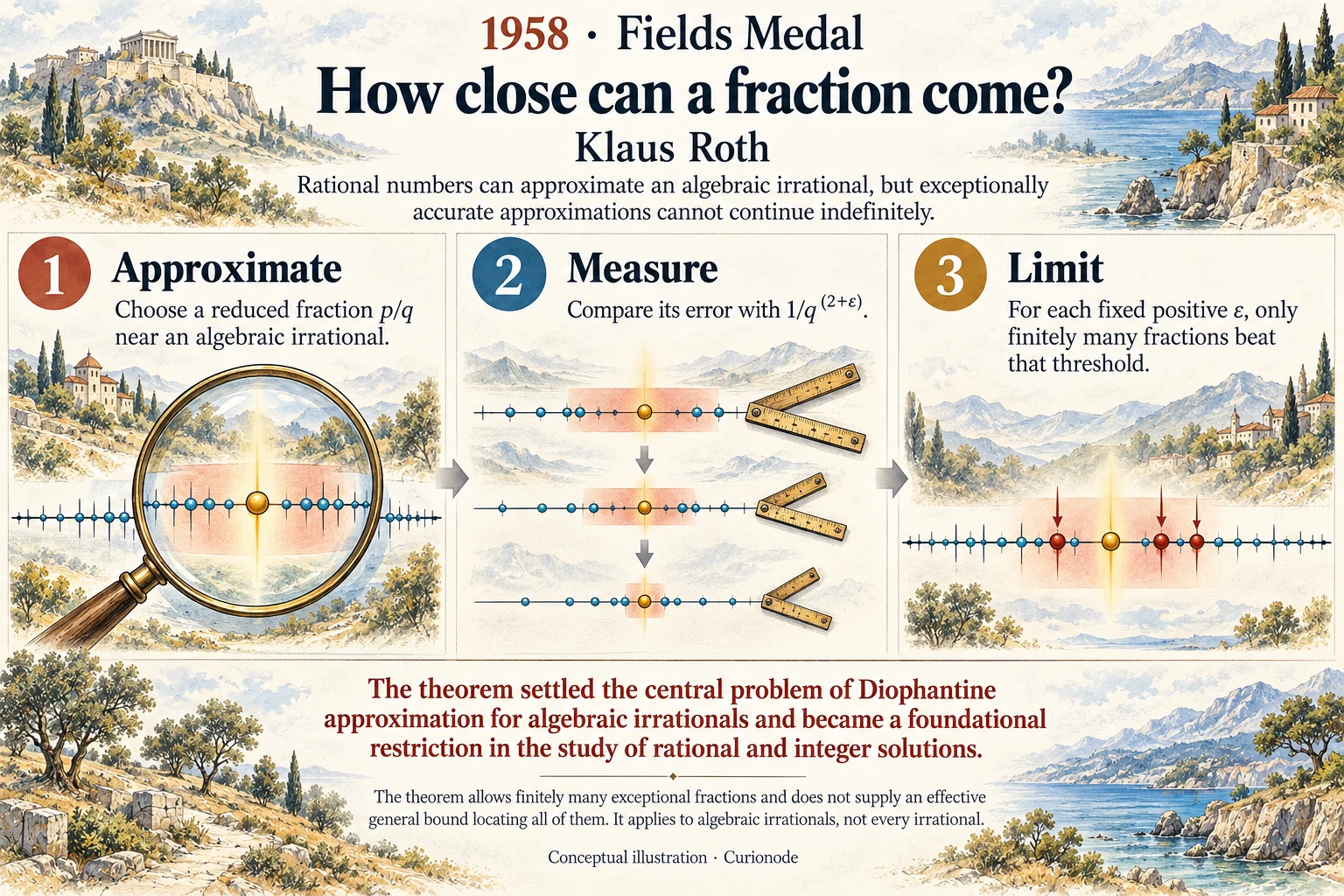
Fractions provide increasingly good approximations to irrational numbers. Roth’s theorem identifies a sharp limit for algebraic irrationals: for every positive ε, only finitely many reduced fractions p/q satisfy |α−p/q|<1/q^(2+ε). The exponent two is the crucial threshold; approximations of order 1/q² occur naturally for every irrational number. Roth showed that an algebraic number cannot repeatedly beat this threshold by any fixed positive amount. The result completed a long sequence of improvements and revealed a fundamental arithmetic difference between algebraic numbers and some extraordinarily well-approximable transcendental numbers.
Why it matters
The theorem settled the central problem of Diophantine approximation for algebraic irrationals and became a foundational restriction in the study of rational and integer solutions.