c.curionodeThe Fields Archive

1966 · Algebraic geometry

A common language for geometry and arithmetic

Schemes extend the idea of a space defined by equations, allowing geometric methods to reach arithmetic settings.

1966Fields Medal
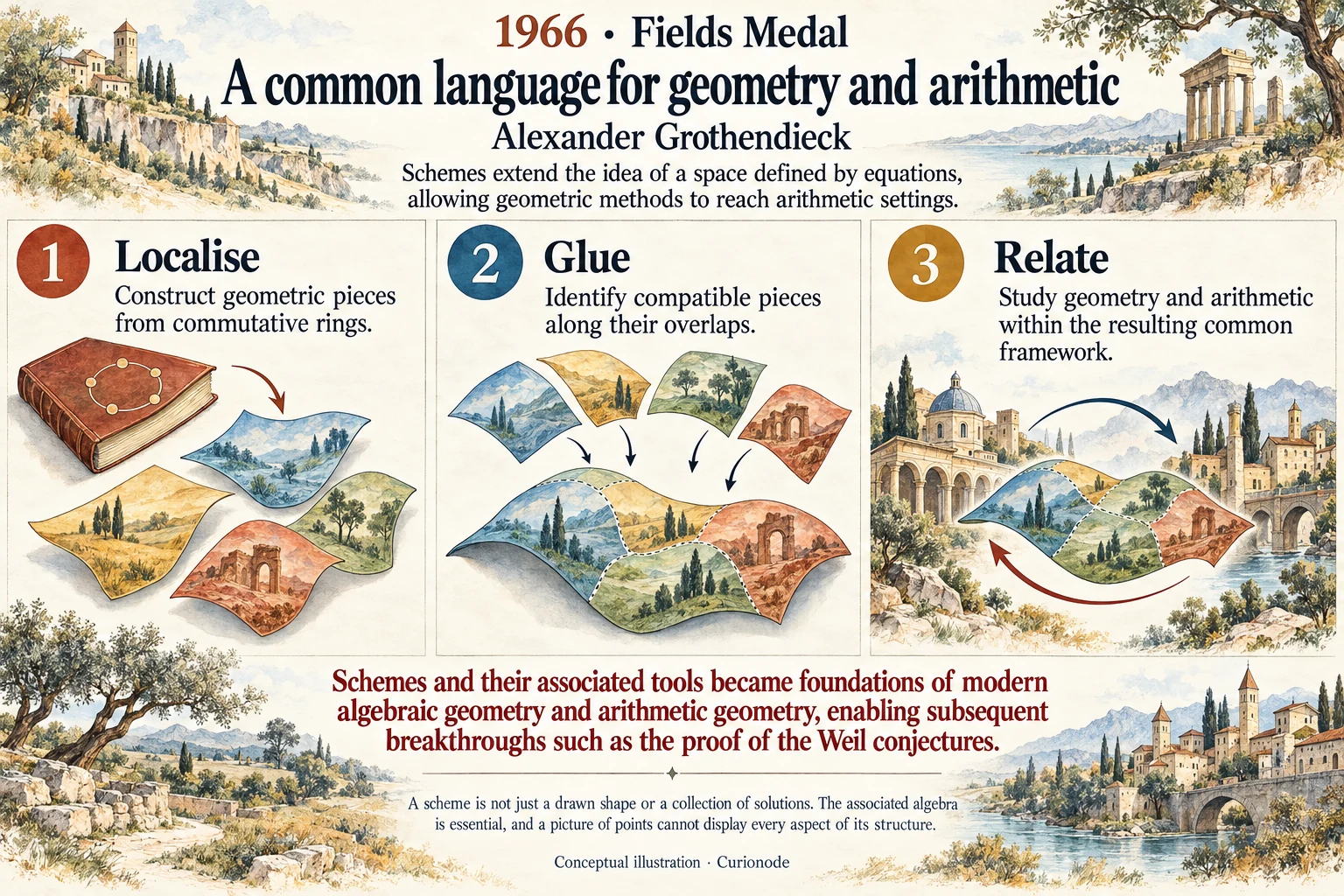
A common language for geometry and arithmetic: Schemes extend the idea of a space defined by equations, allowing geometric methods to reach arithmetic settings.
Original AI-generated infographic by Curionode. Read the text version below for the full explanation.
Read the poster text
  1. Localise

    Construct geometric pieces from commutative rings.

  2. Glue

    Identify compatible pieces along their overlaps.

  3. Relate

    Study geometry and arithmetic within the resulting common framework.

Schemes and their associated tools became foundations of modern algebraic geometry and arithmetic geometry, enabling subsequent breakthroughs such as the proof of the Weil conjectures.

A scheme is not just a drawn shape or a collection of solutions. The associated algebra is essential, and a picture of points cannot display every aspect of its structure.

01 · The idea

In everyday language

Classical algebraic geometry studies shapes cut out by polynomial equations, often over an algebraically closed field. Grothendieck’s schemes extend the underlying language. One builds local geometric pieces from commutative rings and glues them using compatible overlaps. This lets arithmetic rings and families varying over a base be treated geometrically, while retaining algebraic information that a set of visible points can miss. The framework works together with sheaves and cohomology to compare local and global structure. Its power comes from making many previously separate situations instances of one carefully defined language.

Why it matters

Schemes and their associated tools became foundations of modern algebraic geometry and arithmetic geometry, enabling subsequent breakthroughs such as the proof of the Weil conjectures.

02 · The people

Who brought the idea to life?

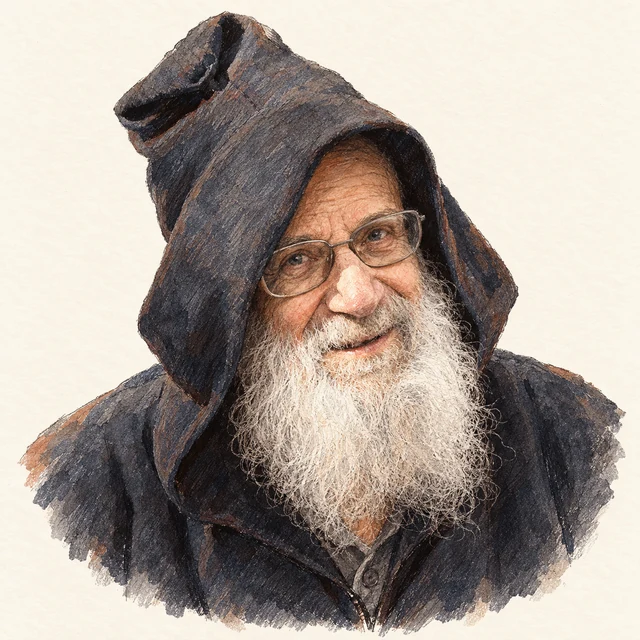
Illustrated portrait of Alexander Grothendieck

Alexander Grothendieck

Alexander Grothendieck was born in Berlin in 1928 and reshaped algebraic geometry through a new conceptual framework. At the IHES, where he was a permanent professor from 1958 to 1970, he developed schemes, new cohomological methods and far-reaching relationships between geometry and arithmetic. He received the 1966 Fields Medal. Although the IMU’s retrospective list labels his institution as the University of Paris, the IHES documents his appointment during that period. His collaborative seminars and extensive foundational writing changed the questions mathematicians could formulate about spaces defined by equations.

Read the biography ↗

03 · Read further

From the original sources

Original explanations based on the official award record. The subject label is an editorial navigation aid.

  1. Official IMU citation: Alexander Grothendieck ↗www.mathunion.org
  2. Heidelberg Laureate Forum: Alexander Grothendieck ↗www.heidelberg-laureate-forum.org
  3. IHES: Grothendieck permanent professorship, 1958–1970 ↗www.ihes.fr