01 · The idea
In everyday language
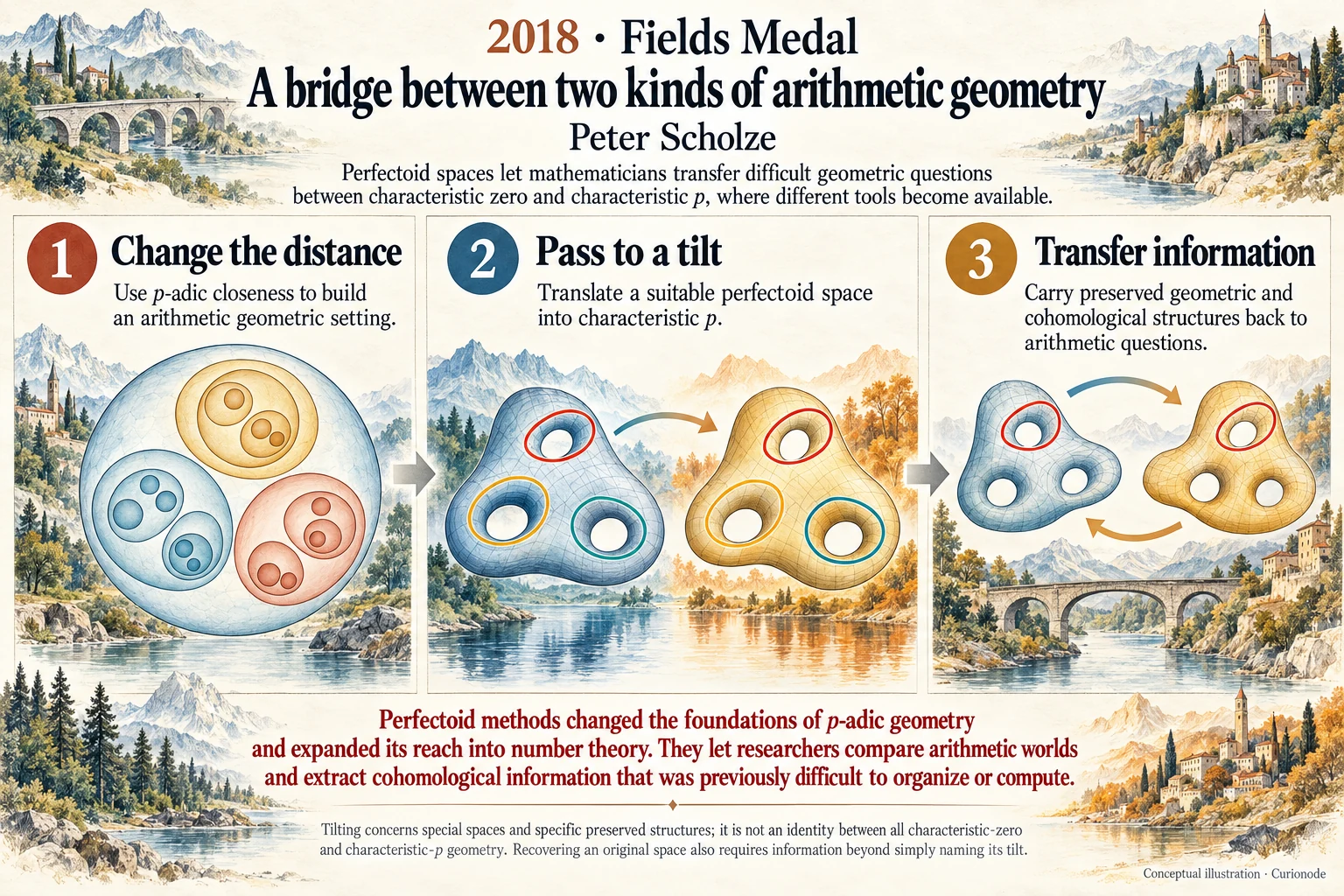
Ordinary geometry often measures closeness with real numbers. Arithmetic geometry also uses p-adic numbers, where numbers are close when their difference is divisible by a high power of a chosen prime. Scholze introduced perfectoid spaces, a class of p-adic geometric objects with a remarkable transformation called tilting. Under precise hypotheses, tilting relates their geometry in characteristic zero to geometry in characteristic p. Structures that look very different can then share important information. This bridge makes difficult constructions more accessible and feeds new cohomology theories and results about Galois representations, helping describe how arithmetic symmetries act on solutions of equations.
Why it matters
Perfectoid methods changed the foundations of p-adic geometry and expanded its reach into number theory. They let researchers compare arithmetic worlds and extract cohomological information that was previously difficult to organize or compute.