c.curionodeThe Fields Archive

1970 · Number theory

Turning an equation into a finite search

Lower bounds for nonzero combinations of logarithms can place explicit limits on certain integer solutions.

1970Fields Medal
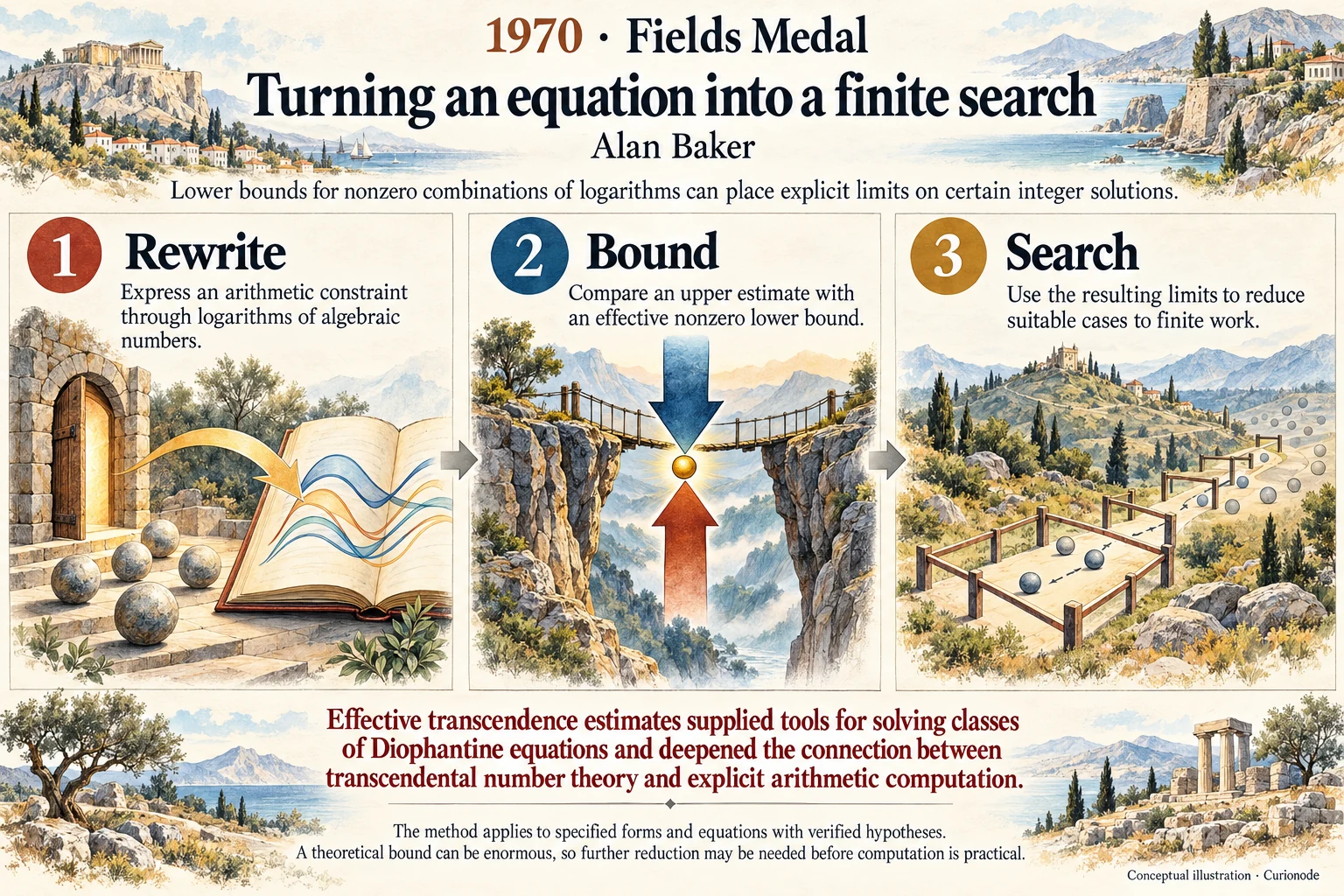
Turning an equation into a finite search: Lower bounds for nonzero combinations of logarithms can place explicit limits on certain integer solutions.
Original AI-generated infographic by Curionode. Read the text version below for the full explanation.
Read the poster text
  1. Rewrite

    Express an arithmetic constraint through logarithms of algebraic numbers.

  2. Bound

    Compare an upper estimate with an effective nonzero lower bound.

  3. Search

    Use the resulting limits to reduce suitable cases to finite work.

Effective transcendence estimates supplied tools for solving classes of Diophantine equations and deepened the connection between transcendental number theory and explicit arithmetic computation.


The method applies to specified forms and equations with verified hypotheses. A theoretical bound can be enormous, so further reduction may be needed before computation is practical.

01 · The idea

In everyday language

An exponential-looking Diophantine equation can sometimes be rewritten as a linear combination of logarithms of algebraic numbers. A proposed large solution may force this combination to be extremely close to zero. Baker’s theory gives effective lower bounds for suitable nonzero linear forms, creating a contradiction if the supposed solution is too large. The comparison converts a number-theoretic question into an explicit bound and, in favourable cases, a finite calculation. The key is to rule out impossibly small nonzero quantities, not merely to approximate logarithms on a calculator.

Why it matters

Effective transcendence estimates supplied tools for solving classes of Diophantine equations and deepened the connection between transcendental number theory and explicit arithmetic computation.

02 · The people

Who brought the idea to life?

Illustrated portrait of Alan Baker

Alan Baker

Alan Baker was born in London in 1939 and became a leading number theorist at Cambridge. His 1970 Fields Medal recognised a profound extension of transcendence methods through linear forms in logarithms of algebraic numbers. These results did more than distinguish algebraic from transcendental numbers: effective estimates made it possible to bound solutions of certain Diophantine equations. Baker’s work changed the relationship between abstract existence results and explicit computation, allowing finite searches in situations where earlier methods could establish finiteness without locating the solutions.

Read the biography ↗

03 · Read further

From the original sources

Original explanations based on the official award record. The subject label is an editorial navigation aid.

  1. Official IMU citation: Alan Baker ↗www.mathunion.org
  2. Heidelberg Laureate Forum: Alan Baker ↗www.heidelberg-laureate-forum.org
  3. Trinity College Cambridge: tribute to Alan Baker ↗www.trin.cam.ac.uk