c.curionodeThe Fields Archive

1970 · Algebra & representation

A powerful restriction on finite symmetry

The odd-order theorem rules out nonabelian simple groups with an odd number of elements.

1970Fields Medal
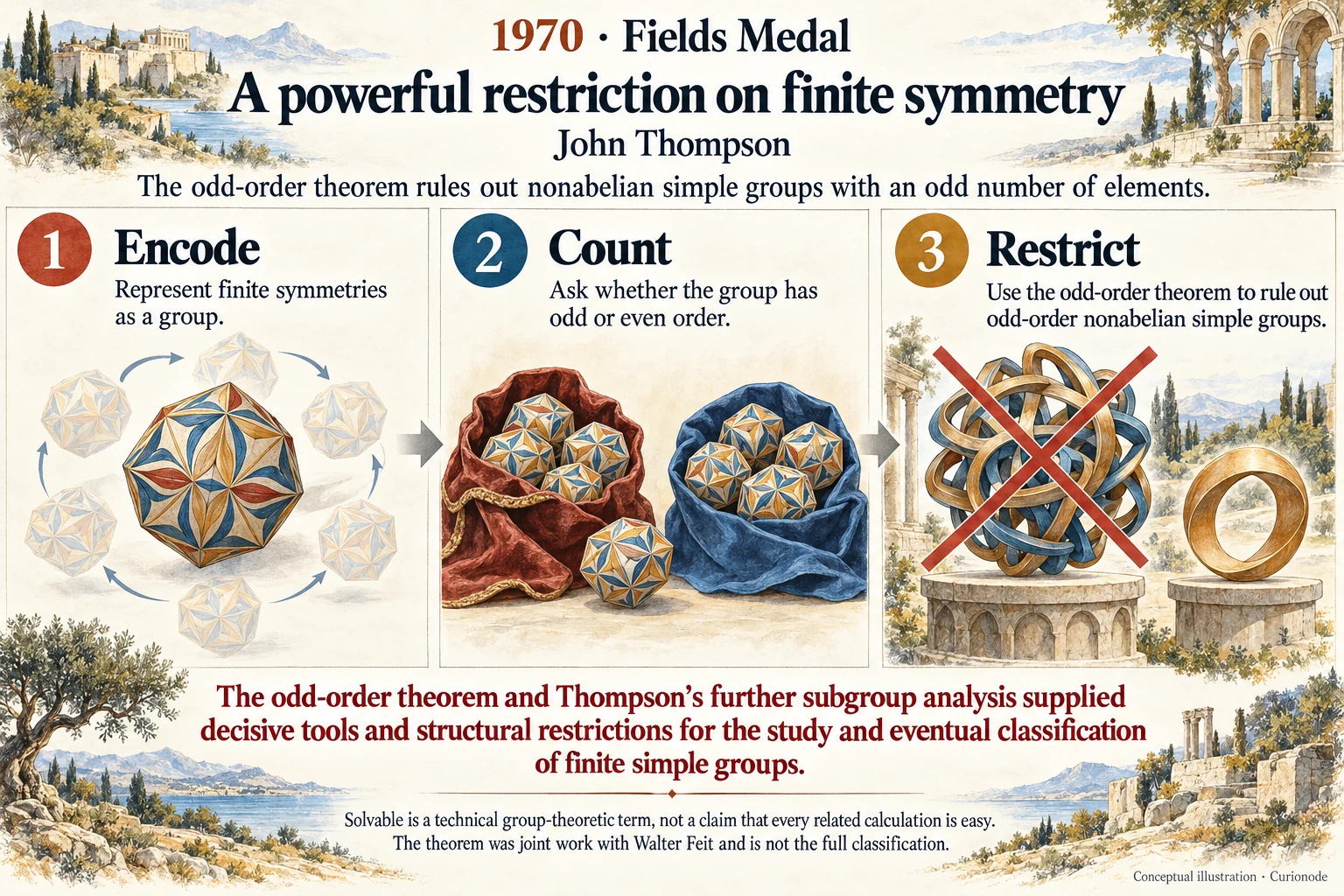
A powerful restriction on finite symmetry: The odd-order theorem rules out nonabelian simple groups with an odd number of elements.
Original AI-generated infographic by Curionode. Read the text version below for the full explanation.
Read the poster text
  1. Encode

    Represent finite symmetries as a group.

  2. Count

    Ask whether the group has odd or even order.

  3. Restrict

    Use the odd-order theorem to rule out odd-order nonabelian simple groups.

The odd-order theorem and Thompson’s further subgroup analysis supplied decisive tools and structural restrictions for the study and eventual classification of finite simple groups.


Solvable is a technical group-theoretic term, not a claim that every related calculation is easy. The theorem was joint work with Walter Feit and is not the full classification.

01 · The idea

In everyday language

A finite group records a collection of reversible symmetries and how they combine. Simple groups have no nontrivial proper normal subgroup, making them fundamental building blocks. Feit and Thompson proved that every finite group of odd order is solvable. Consequently a nonabelian finite simple group must have even order; the odd-order simple groups are cyclic groups of prime order. The result imposes an unexpectedly strong restriction using only the number of elements. Its lengthy proof combined local subgroup analysis with character theory and became a landmark in the classification programme.

Why it matters

The odd-order theorem and Thompson’s further subgroup analysis supplied decisive tools and structural restrictions for the study and eventual classification of finite simple groups.

02 · The people

Who brought the idea to life?

Illustrated portrait of John Thompson

John Thompson

John Thompson was born in Ottawa, Kansas, in 1932 and became a central architect of finite group theory. His 1970 Fields Medal recognised results on finite simple groups, including the odd-order theorem proved with Walter Feit and his classification of minimal simple groups. Cambridge records list him as a visiting professor from 1968 to 1970, before his later Rouse Ball chair; this is more precise for the award period than the IMU’s Chicago label. His work helped organise the algebraic building blocks that underlie finite symmetry.

Read the biography ↗

03 · Read further

From the original sources

Original explanations based on the official award record. The subject label is an editorial navigation aid.

  1. Official IMU citation: John Thompson ↗www.mathunion.org
  2. Heidelberg Laureate Forum: John Thompson ↗www.heidelberg-laureate-forum.org
  3. Cambridge University Archives: Thompson appointments ↗venn.lib.cam.ac.uk