c.curionodeThe Fields Archive

2006 · Algebra & representation

Exact geometry emerging from random surfaces

Counting discrete configurations can uncover smooth limit shapes and shared probability laws, linking random growth with representation theory and algebraic geometry.

2006Fields Medal
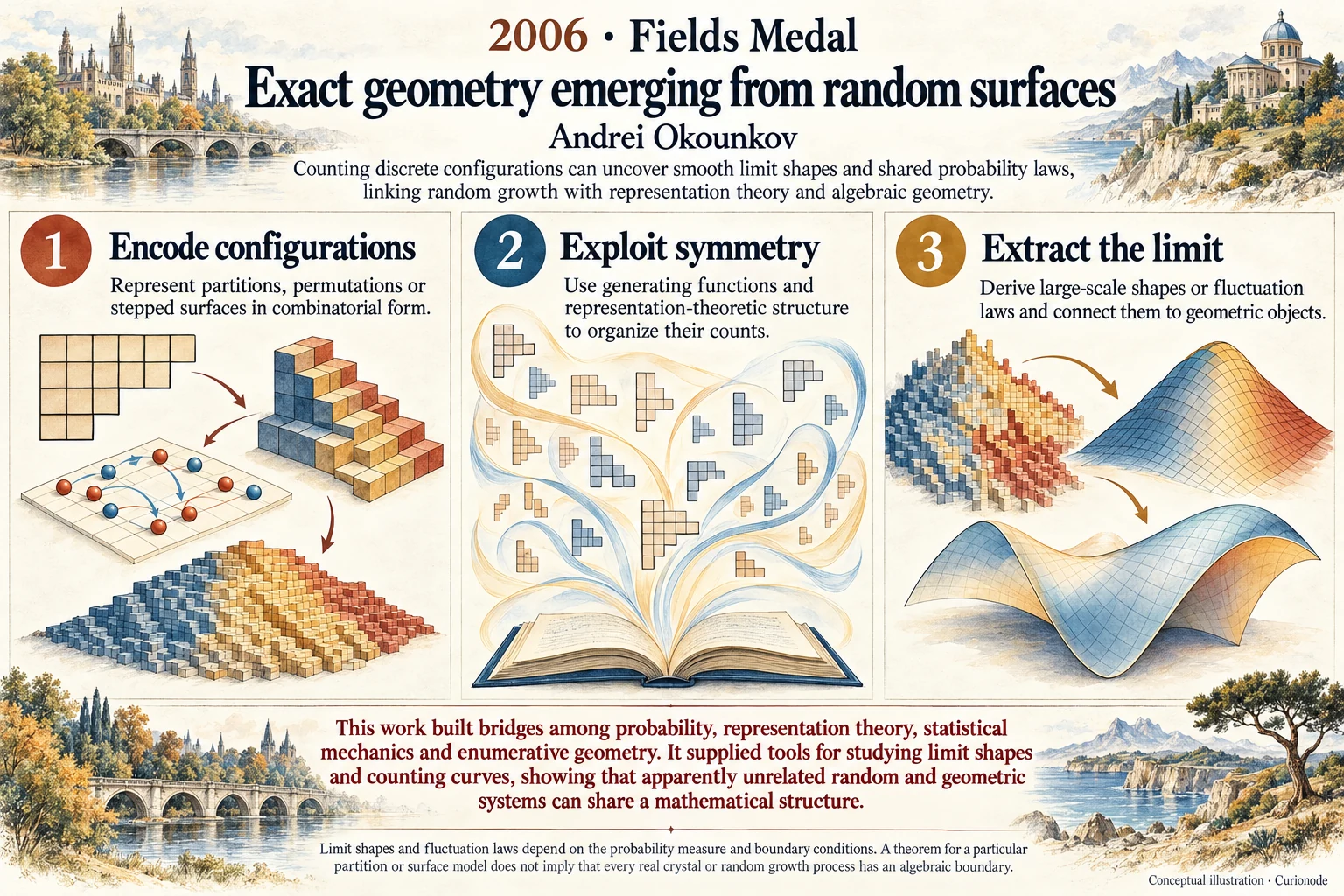
Exact geometry emerging from random surfaces: Counting discrete configurations can uncover smooth limit shapes and shared probability laws, linking random growth with representation theory and algebraic geometry.
Original AI-generated infographic by Curionode. Read the text version below for the full explanation.
Read the poster text
  1. Encode configurations

    Represent partitions, permutations or stepped surfaces in combinatorial form.

  2. Exploit symmetry

    Use generating functions and representation-theoretic structure to organize their counts.

  3. Extract the limit

    Derive large-scale shapes or fluctuation laws and connect them to geometric objects.

This work built bridges among probability, representation theory, statistical mechanics and enumerative geometry. It supplied tools for studying limit shapes and counting curves, showing that apparently unrelated random and geometric systems can share a mathematical structure.

Limit shapes and fluctuation laws depend on the probability measure and boundary conditions. A theorem for a particular partition or surface model does not imply that every real crystal or random growth process has an algebraic boundary.

01 · The idea

In everyday language

An integer partition can be drawn as rows of boxes, turning an arithmetic object into a small discrete shape. Random partitions and related stepped surfaces occur in models of crystals, permutations and representation theory. Okounkov discovered powerful connections among these settings. His methods related fluctuations of long increasing subsequences in random permutations to random matrix phenomena, and with collaborators he studied large random surfaces whose macroscopic boundaries have unexpected algebraic structure. The recurring strategy is to encode many discrete possibilities in generating functions and exploit their symmetries. Exact counting then reveals geometric patterns and probability laws that are invisible in a single configuration.

Why it matters

This work built bridges among probability, representation theory, statistical mechanics and enumerative geometry. It supplied tools for studying limit shapes and counting curves, showing that apparently unrelated random and geometric systems can share a mathematical structure.

02 · The people

Who brought the idea to life?

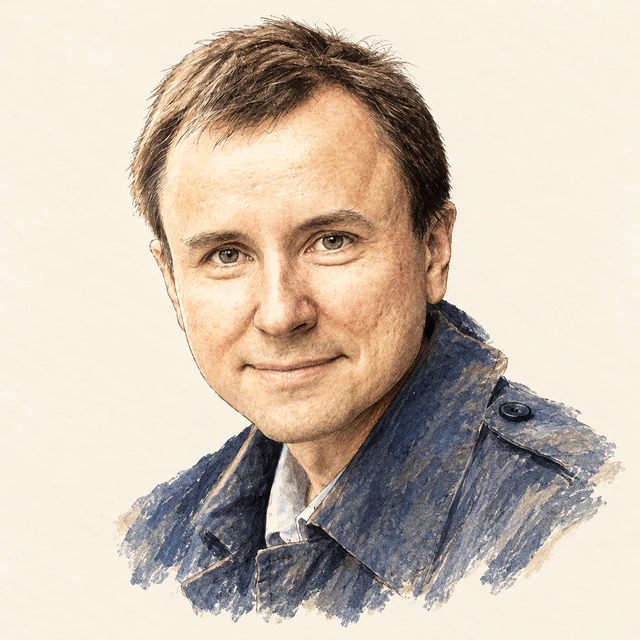
Illustrated portrait of Andrei Okounkov

Andrei Okounkov

Andrei Okounkov was born in Moscow and received his doctorate from Moscow State University in 1995. After research positions in Russia and the United States, he became a professor at Princeton, his affiliation at the 2006 Fields Medal. His work connects representation theory, probability and algebraic geometry through the counting of partitions, surfaces and curves. He uncovered links between random permutations and random matrices and, with collaborators, studied limit shapes of random surfaces and enumerative invariants. His achievement is the ability to carry structures across mathematical boundaries, revealing common mechanisms beneath problems originally formulated in strikingly different languages.

Read the biography ↗

03 · Read further

From the original sources

Original explanations based on the official award record. The subject label is an editorial navigation aid.

  1. Official IMU citation: Andrei Okounkov ↗www.mathunion.org
  2. Heidelberg Laureate Forum: Andrei Okounkov ↗www.heidelberg-laureate-forum.org
  3. IMU: Okounkov work and 2006 Princeton affiliation ↗www.mathunion.org
  4. Princeton: 2006 medal and appointment since 2002 ↗www.princeton.edu