c.curionodeThe Fields Archive

2010 · Algebra & representation

A geometric proof of an arithmetic identity

The fundamental lemma compares quantities from different groups; a new geometric viewpoint made an elusive bridge in the Langlands program provable.

2010Fields Medal
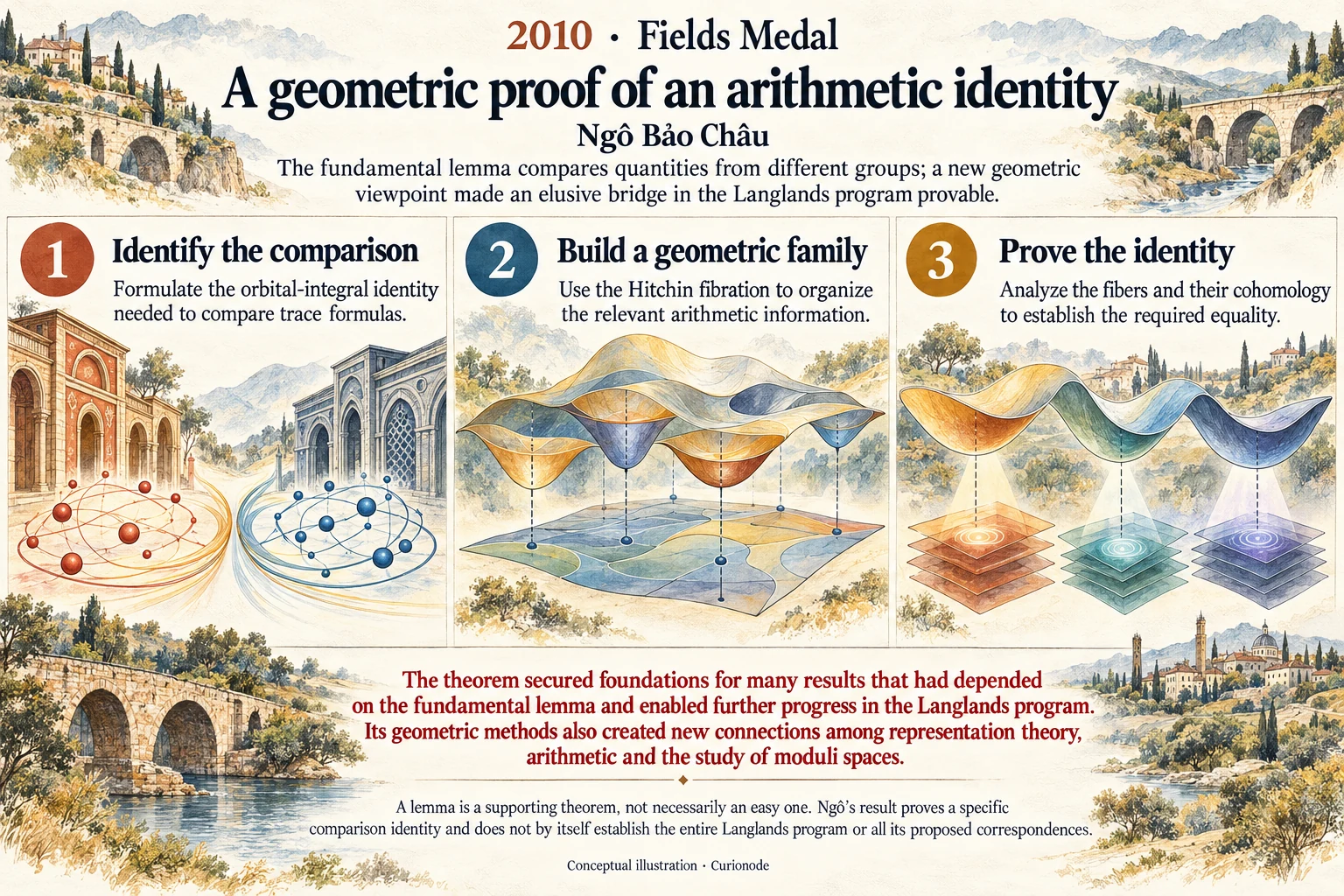
A geometric proof of an arithmetic identity: The fundamental lemma compares quantities from different groups; a new geometric viewpoint made an elusive bridge in the Langlands program provable.
Original AI-generated infographic by Curionode. Read the text version below for the full explanation.
Read the poster text
  1. Identify the comparison

    Formulate the orbital-integral identity needed to compare trace formulas.

  2. Build a geometric family

    Use the Hitchin fibration to organize the relevant arithmetic information.

  3. Prove the identity

    Analyze the fibers and their cohomology to establish the required equality.

The theorem secured foundations for many results that had depended on the fundamental lemma and enabled further progress in the Langlands program. Its geometric methods also created new connections among representation theory, arithmetic and the study of moduli spaces.


A lemma is a supporting theorem, not necessarily an easy one. Ngô’s result proves a specific comparison identity and does not by itself establish the entire Langlands program or all its proposed correspondences.

01 · The idea

In everyday language

The Langlands program seeks deep correspondences among number theory, group representations and automorphic forms. Comparing trace formulas is a powerful way to build such correspondences, but it requires exact local identities between orbital integrals. Despite its modest name, the fundamental lemma resisted proof for decades. Ngô transformed the comparison into algebraic geometry using the Hitchin fibration, a family whose fibers encode relevant information. Studying the geometry and cohomology across the family made a previously opaque numerical equality accessible. The proof established the needed identity under its precise formulation and removed a major obstruction to the machinery of endoscopy and trace-formula comparison.

Why it matters

The theorem secured foundations for many results that had depended on the fundamental lemma and enabled further progress in the Langlands program. Its geometric methods also created new connections among representation theory, arithmetic and the study of moduli spaces.

02 · The people

Who brought the idea to life?

Illustrated portrait of Ngô Bảo Châu

Ngô Bảo Châu

Ngô Bảo Châu was born in Hanoi and trained as a mathematician in France. At the 2010 medal he was affiliated with Université Paris-Sud and was a long-term member at the Institute for Advanced Study; his Chicago professorship began the following month. He proved the fundamental lemma in the Langlands program, a difficult identity comparing orbital integrals. His proof transformed the problem through algebraic geometry, particularly the Hitchin fibration and the geometry of its fibers. The result removed a central obstacle to comparing trace formulas, giving firm foundations to many previously conditional links between automorphic forms and arithmetic.

Read the biography ↗

03 · Read further

From the original sources

Original explanations based on the official award record. The subject label is an editorial navigation aid.

  1. Official IMU citation: Ngô Bảo Châu ↗www.mathunion.org
  2. Heidelberg Laureate Forum: Ngô Bảo Châu ↗www.heidelberg-laureate-forum.org
  3. ICM 2010: Ngô Bảo Châu citation and biography ↗www.mathunion.org
  4. University of Chicago: medal announcement and 1 September appointment ↗news.uchicago.edu