c.curionodeThe Fields Archive

1974 · Algebraic geometry

A space whose points are shapes

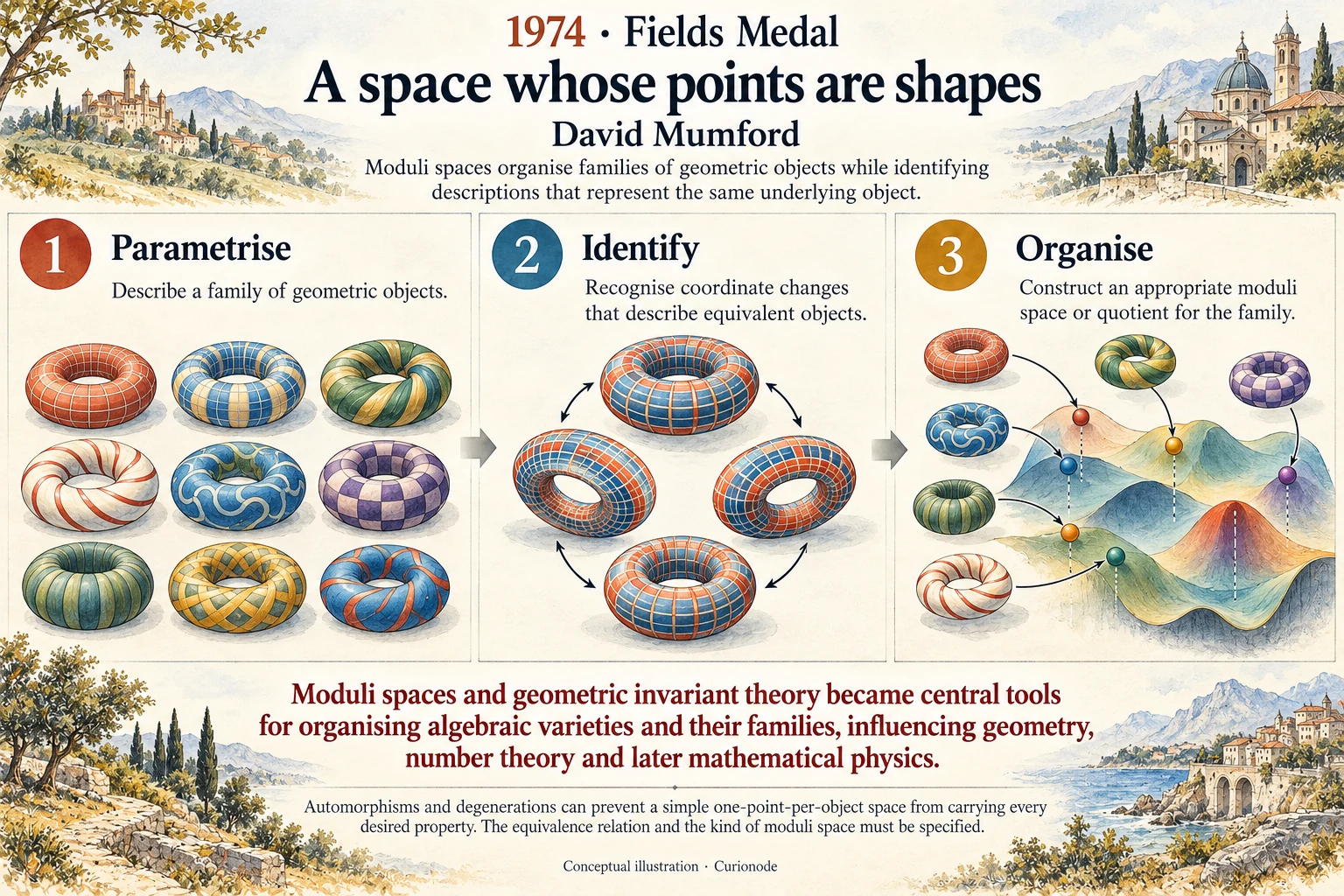
Moduli spaces organise families of geometric objects while identifying descriptions that represent the same underlying object.

1974Fields Medal
A space whose points are shapes: Moduli spaces organise families of geometric objects while identifying descriptions that represent the same underlying object.
Original AI-generated infographic by Curionode. Read the text version below for the full explanation.
Read the poster text
  1. Parametrise

    Describe a family of geometric objects.

  2. Identify

    Recognise coordinate changes that describe equivalent objects.

  3. Organise

    Construct an appropriate moduli space or quotient for the family.

Moduli spaces and geometric invariant theory became central tools for organising algebraic varieties and their families, influencing geometry, number theory and later mathematical physics.


Automorphisms and degenerations can prevent a simple one-point-per-object space from carrying every desired property. The equivalence relation and the kind of moduli space must be specified.

01 · The idea

In everyday language

A curve can be written by different equations after a change of coordinates. A meaningful classification should not count those descriptions as entirely different curves. A moduli problem seeks a parameter space whose points represent objects up to the chosen equivalence, together with control over how families vary. Mumford developed geometric invariant theory to construct useful quotients and distinguish stable behaviour from degenerations. The resulting spaces make classification itself geometric: moving through the parameter space means varying the object. This requires attention to symmetries and singular limits, not just attaching a list of numerical labels.

Why it matters

Moduli spaces and geometric invariant theory became central tools for organising algebraic varieties and their families, influencing geometry, number theory and later mathematical physics.

02 · The people

Who brought the idea to life?

Illustrated portrait of David Mumford

David Mumford

David Mumford was born in Worth, Sussex, in 1937. At Harvard he developed foundational methods for algebraic geometry, particularly moduli spaces and geometric invariant theory. His 1974 Fields Medal recognised work on the existence and structure of spaces whose points classify geometric objects, together with contributions to algebraic surfaces. The challenge was not simply to collect equations, but to identify when different descriptions represent the same object. Mumford later worked on vision and applied mathematics, but the medal-period achievement concerned the rigorous organisation of families of algebraic shapes.

Read the biography ↗

03 · Read further

From the original sources

Original explanations based on the official award record. The subject label is an editorial navigation aid.

  1. Official IMU citation: David Mumford ↗www.mathunion.org
  2. Heidelberg Laureate Forum: David Mumford ↗www.heidelberg-laureate-forum.org
  3. Brown University: David Mumford biography and research ↗news.brown.edu